Top Soil Testing Tools for Commercial Farms
A fertilizer program can look efficient on paper and still waste money across the field. One block may be short on potassium, another may have a pH problem limiting nutrient uptake, and a compacted headland may be restricting roots before nutrients become the issue. The right top soil testing tools turn those unknowns into decisions that growers, agronomists, and input suppliers can act on.
For commercial farms, the best setup is rarely one device. It is usually a practical system: representative sampling, a reliable laboratory result, and field tools that help teams monitor conditions between formal tests. The goal is not to collect more numbers. It is to collect dependable information that improves input timing, protects yields, and supports stronger purchasing decisions.
Why soil testing belongs in every input plan
Soil testing helps businesses match fertilizer, lime, irrigation, and cultivation practices to actual field conditions. This matters when margins are tight and the cost of a poorly targeted application is spread across hundreds or thousands of acres.
A complete test can identify soil pH, organic matter, macronutrients such as phosphorus and potassium, secondary nutrients, micronutrients, salinity, and cation exchange capacity. Depending on the crop and region, it may also assess nitrate nitrogen, texture, biological activity, or contamination risks.
The commercial value is clear: a soil test can support variable-rate applications, reduce unnecessary nutrient purchases, document agronomic decisions, and create a stronger baseline for evaluating season-to-season changes. Results are only as useful as the sample, however. A high-end meter cannot correct a poor sampling pattern.
Top soil testing tools by job
The best tool depends on whether the user needs a full nutrient prescription, a quick field check, continuous monitoring, or a diagnosis of a specific physical constraint. The table below compares the main options used on commercial farms.
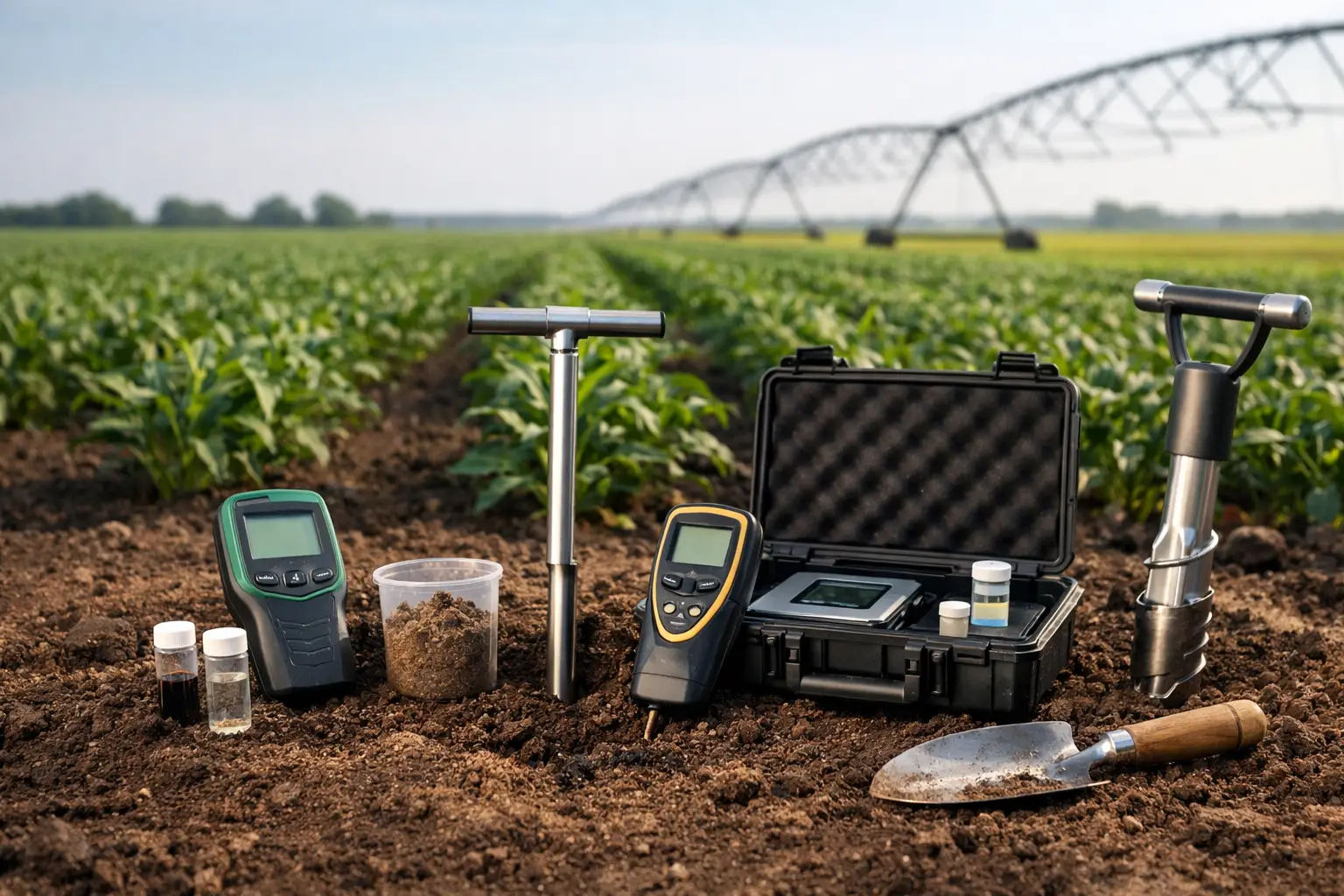
| Tool | Best use | Key measurements | Main advantage | Main limitation | |—|—|—|—|—| | Soil sampling kit | Collecting representative samples | Sample depth and location | Low cost and essential for all testing programs | Does not provide results on its own | | Accredited soil laboratory test | Fertility planning and nutrient recommendations | pH, organic matter, nutrients, CEC, salinity | Broad, calibrated analysis with actionable reports | Requires shipping and turnaround time | | Portable pH and EC meter | In-field checks and irrigation diagnosis | pH, electrical conductivity | Fast readings for spot decisions | Needs calibration and does not replace a lab test | | Soil moisture sensor | Irrigation scheduling | Volumetric water content or soil tension | Supports water-use efficiency throughout the season | Requires correct installation and interpretation | | Soil penetrometer | Finding compaction layers | Soil resistance | Simple way to locate root-restricting zones | Results change with soil moisture | | Rapid nitrate test kit | Nitrogen management | Nitrate nitrogen | Useful for timely nitrogen checks in certain crops | Less comprehensive and more variable than lab analysis |
1. Soil sampling kits: the foundation tool
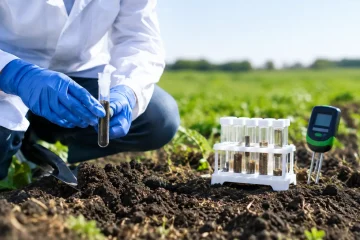
A commercial soil sampling kit is simple but critical. It typically includes a probe or auger, clean sample bags, labels, and a record sheet or digital mapping process. For larger operations, GPS-enabled sampling workflows make it easier to return to the same management zones and compare trends over time.
Use stainless steel or clean plastic equipment when samples will be analyzed for micronutrients or contaminants. Avoid galvanized containers, fertilizer buckets, and any tool that could introduce residue. Samples should also be taken at a consistent depth. For many field crops, 0 to 6 inches is standard for routine fertility analysis, but nitrogen testing and perennial crops often require deeper samples.
A good sampling strategy separates fields by soil type, crop history, yield zone, drainage pattern, or management history. Combining soil from an irrigated area with soil from a dryland section may produce a neat average and a poor recommendation.
2. Laboratory soil tests: the strongest tool for fertilizer decisions
Laboratory testing remains the most reliable option for building an annual or seasonal fertility plan. A reputable lab uses standardized extraction methods and provides results in units that agronomists can interpret against local crop recommendations.
For broad-acre production, request a routine fertility panel that includes pH, buffer pH where liming is relevant, phosphorus, potassium, calcium, magnesium, sulfur, organic matter, and cation exchange capacity. Add micronutrients when crop demand, soil type, or past deficiencies justify the expense. In high-value horticulture, greenhouse, and intensive vegetable systems, soluble salts and sodium measurements are often essential.
The trade-off is speed. Samples must be collected, shipped, processed, and reviewed. Yet this is the tool most likely to prevent a major purchasing mistake, such as applying phosphorus where levels are already excessive or overlooking a low pH condition that makes fertilizer less effective.
3. Portable pH and EC meters: fast field verification
Handheld pH and electrical conductivity meters are useful for checking conditions in soil slurries, drainage water, fertigation solutions, and greenhouse media. They are especially valuable when a grower sees uneven crop growth and needs an initial indication of acidity or salt buildup before sending samples to a lab.
EC is commonly used as a measure of dissolved salts. High readings may indicate salinity risk, fertilizer accumulation, poor drainage, or irrigation-water issues. But EC does not identify which salts are present, so a lab analysis is needed before making major corrective decisions.
Buy meters with replaceable probes, automatic temperature compensation, and clear calibration instructions. Teams should calibrate them with fresh standard solutions before use. A cheap, uncalibrated meter can create false confidence and costly field decisions.
4. Soil moisture sensors: convert irrigation data into action
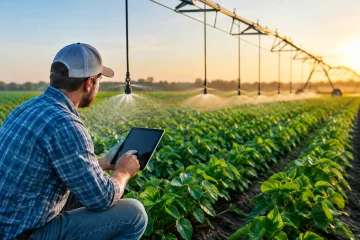
Moisture sensors are not nutrient tests, but they are among the most commercially valuable soil-monitoring tools. They show whether water is reaching the active root zone, whether irrigation is too frequent, and whether deep percolation may be carrying nutrients below the roots.
Capacitance probes, time-domain sensors, tensiometers, and granular matrix sensors each serve different conditions. Tensiometers are particularly useful in wet soil ranges and high-value crops, while capacitance probes can provide readings at multiple depths for ongoing irrigation management.
Installation is the deciding factor. Place sensors in representative areas, at crop-appropriate depths, and in firm contact with the soil. A sensor in an atypical wet spot or beside a damaged drip line will not represent the field. For irrigated farms, pairing sensor data with weather, crop stage, and irrigation records produces better decisions than relying on a single reading.
5. Penetrometers: find compaction before it limits yields
Compaction is often mistaken for a fertility problem. A penetrometer measures resistance as a probe is pushed through soil, helping identify compacted layers that restrict root growth, water infiltration, and nutrient access.
This tool is most useful for comparing traffic lanes, headlands, and low-performing zones with healthy areas. Readings should be taken when soil moisture is reasonably consistent because dry soil naturally produces higher resistance. Use the results alongside a shovel inspection of root depth and soil structure before deciding on deep tillage or controlled-traffic changes.
How to build a practical testing program
Commercial farms do not need every tool at once. Start with the tools that answer the most expensive questions in the operation.
For most row-crop and mixed farms, a soil probe, labeled sampling supplies, GPS or field records, and laboratory analysis provide the strongest return. Add portable pH and EC meters when irrigation water, fertigation, greenhouse production, or salinity concerns make fast checks useful. Invest in moisture sensors when irrigation costs, water availability, or nitrogen leaching risk are significant. Penetrometers fit well where compaction and uneven rooting are recurring problems.
A sensible annual workflow includes four steps:
- Map fields or management zones before sampling, using past yield data, soil maps, and known drainage differences.
- Collect samples at the same depth and season each year or rotation cycle so results are comparable.
- Review laboratory results with crop targets, expected yield, manure history, and planned fertilizer sources.
- Record applications and revisit questionable areas with field meters, moisture sensors, or physical soil inspections.
What buyers should compare before sourcing equipment
When comparing top soil testing tools from suppliers, focus on fit rather than headline specifications. A sensor with advanced connectivity may not add value where cellular coverage is unreliable. A laboratory package may look inexpensive until shipping, turnaround time, and missing analyses are considered.
Ask suppliers about calibration requirements, replacement probes, operating temperature, warranty coverage, data export options, and local technical support. For digital tools, confirm whether software subscriptions are required and whether the platform can export data in a format your agronomist, irrigation manager, or farm management system can use.
Distributors and ag retailers can create stronger customer value by offering testing tools alongside sampling guidance, agronomy support, and replacement consumables. The product sale starts the relationship; accurate interpretation keeps it productive.
Turn soil data into better farm decisions
The most effective soil testing program is repeatable, not complicated. Use laboratory analysis to set the fertility direction, field tools to monitor changing conditions, and disciplined records to connect results with crop performance. For growers and agricultural businesses sourcing equipment across markets, Agricial can help make supplier discovery and product comparison more efficient. Better soil information does not guarantee a better crop, but it gives every input dollar a clearer job to do.