Liquid Fertilizer Versus Granular Fertilizer
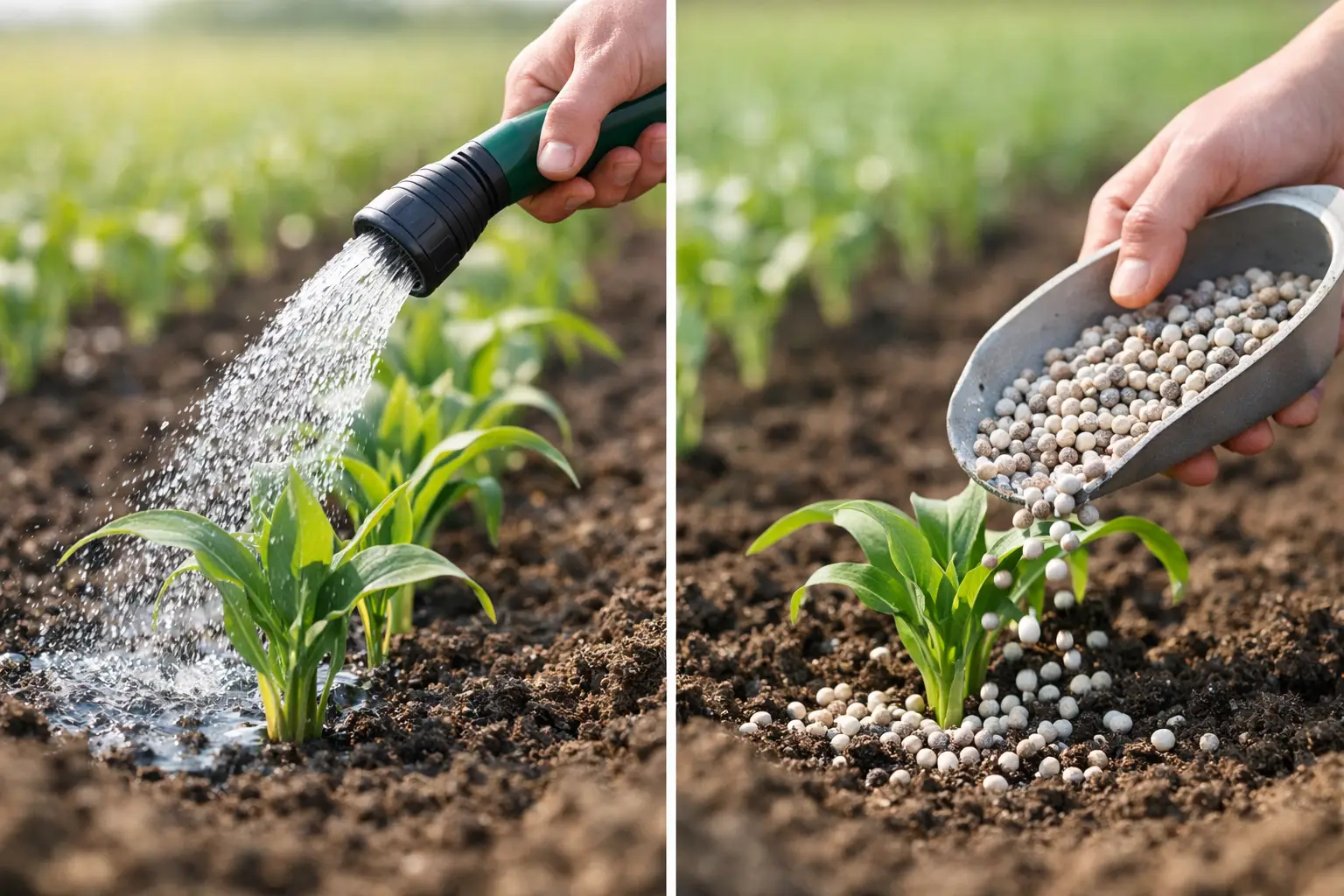
A fertilizer purchase can look simple on a product sheet, then become expensive in the field. The decision between liquid fertilizer versus granular fertilizer affects application timing, labor, equipment, nutrient placement, storage, freight planning, and ultimately crop response. Neither form is automatically better. The right choice depends on the crop, soil test, acreage, weather risk, available machinery, and the supplier’s ability to deliver consistent analysis and documentation.
For commercial growers and agricultural buyers, the practical question is not which product is best in general. It is which fertilizer form delivers the required nutrients at the right time, at a competitive applied cost, with manageable operational risk.
Liquid Fertilizer Versus Granular Fertilizer: At a Glance
| Factor | Liquid Fertilizer | Granular Fertilizer | |—|—|—| | Physical form | Nutrients dissolved or suspended in water | Dry particles, prills, granules, or blends | | Best-known advantage | Precise placement and flexible in-season application | Efficient bulk handling and economical nutrient delivery | | Common application methods | Starter application, fertigation, foliar feeding, sidedress, spraying | Broadcast spreading, banding, row placement, topdressing | | Nutrient concentration | Often lower per unit of product because of water content | Usually higher nutrient concentration per ton | | Equipment needs | Tanks, pumps, hoses, compatible sprayers or injection systems | Spreaders, dry boxes, conveyors, or air carts | | Storage considerations | Requires protected tanks and attention to corrosion, settling, and freezing | Requires dry, covered storage and moisture control | | Typical fit | High-value crops, precision systems, irrigation-equipped farms | Broad-acre crops, preplant programs, and large-volume nutrient needs |
What Is Liquid Fertilizer?
Liquid fertilizers contain nutrients in solution or suspension. Common products include nitrogen solutions, liquid phosphorus starters, potassium solutions, micronutrient blends, and specialty formulations designed for foliar or irrigation application.
Their main operational advantage is placement. A grower can apply nutrients in a narrow band near the seed, inject them into irrigation water, or make a targeted in-season pass when crop demand increases. This flexibility is particularly valuable where nutrient timing matters as much as total nutrient rate.
Liquid products can also simplify blending for farms that need small amounts of boron, zinc, sulfur, or other secondary and micronutrients. Instead of handling multiple dry products, a supplier may prepare a compatible liquid mix for a specific crop plan. Compatibility still needs careful review, especially when pesticides, biological products, or hard water are involved.
Where Liquid Fertilizer Performs Well
Liquid fertilizer is often a strong option for starter programs in corn, vegetables, and other row crops. Nutrients placed close to the developing root zone can support early growth, especially in cool soils where phosphorus movement is limited.
It also fits fertigation programs. Farms using drip, pivot, or other controlled irrigation systems can split nitrogen and potassium applications across the season rather than applying the full amount before planting. This can improve nutrient-use efficiency when scheduling matches crop uptake and irrigation is managed carefully.
Foliar feeding is another useful tool, but it should not be treated as a replacement for a complete soil fertility program. Foliar applications can correct certain deficiencies quickly or support crops during key growth stages, yet leaves can only safely absorb limited nutrient amounts per application.
Limits of Liquid Products
The water that makes liquid fertilizers easy to pump also adds freight weight. When a buyer is sourcing large nutrient volumes over long distances, transportation can significantly affect the delivered cost per pound of nitrogen, phosphorus, or potassium.
Liquid systems also require infrastructure. Tanks must be compatible with the product, pumps need regular maintenance, and operators must manage spills and corrosion risks. Some suspended products may settle if not agitated correctly. In cold regions, freezing temperatures can complicate storage and handling.
What Is Granular Fertilizer?
Granular fertilizer includes dry materials such as urea, monoammonium phosphate, diammonium phosphate, muriate of potash, sulfate of potash, and custom N-P-K blends. These products are commonly sold in bulk, bags, or larger commercial packaging.
For many field-crop operations, granular fertilizer remains the backbone of the nutrient program because it moves efficiently in large volumes. A dry spreader can cover substantial acreage quickly, while a planter, air seeder, or strip-till unit can place granular nutrients close to the seed row or below the soil surface.
Granular products are also familiar across global supply chains. Buyers can compare analysis, particle size, origin, moisture specifications, packaging, and loading terms when evaluating suppliers. That makes dry fertilizer especially practical for distributors, importers, and larger farms planning seasonal demand well ahead of application.
Where Granular Fertilizer Performs Well
Granular fertilizer is typically well suited to preplant application, fall application where agronomically appropriate, and large-acre broadcast programs. It can provide high nutrient density without moving extra water, which often makes it cost-effective for base fertility needs.
It is also effective for banding and deep placement. Placing phosphorus and potassium in the root zone can improve access for young plants, while subsurface placement can help reduce nitrogen losses compared with leaving some nitrogen sources on the soil surface.
Controlled-release granular products may be valuable in nurseries, turf, container production, and certain high-value horticultural crops. Their higher price can be justified when fewer applications, reduced labor, or more consistent nutrient release creates a measurable benefit.
Limits of Granular Products
Granular fertilizer needs moisture to dissolve and move into the soil solution where roots can absorb it. A dry application followed by extended drought may delay crop response. Uneven spread patterns can also create uneven growth, so spreader calibration and product particle uniformity matter.
Some dry materials carry specific loss or crop-safety risks. Surface-applied urea can lose nitrogen through ammonia volatilization, particularly on warm, moist, high-pH soils or where residue is present. Fertilizer placed too close to seed can cause salt injury or ammonia toxicity. Product selection and placement must follow crop-specific recommendations.
Comparing Cost Beyond the Price per Ton
A lower product price does not always mean a lower farm cost. Compare fertilizer options by the delivered and applied cost per pound of actual nutrient, then add the operating factors that affect the final result.
For a meaningful liquid fertilizer versus granular fertilizer comparison, buyers should evaluate product analysis, freight, storage, application labor, equipment depreciation, field passes, and expected nutrient losses. A liquid product may cost more per nutrient unit but reduce passes through fertigation. A dry product may offer a lower nutrient cost but require separate spreading and incorporation.
For importers and distributors, commercial comparison should also include packaging, port handling, bulk density, shelf stability, seasonal availability, hazardous-material requirements, and local demand. A formulation that works well agronomically may still be a poor inventory choice if it requires specialized storage that local buyers do not have.
How to Choose the Right Fertilizer Form
Start with a current soil test and realistic yield target. Then build a nutrient budget around crop removal, existing soil fertility, irrigation water quality, manure or compost contributions, and local regulations. Fertilizer form comes after the nutrient requirement is clear.
Choose liquid fertilizer when timing, precision placement, fertigation, or micronutrient delivery creates a clear operational advantage. It is often the better fit for irrigated farms, specialty crops, transplant production, and operations already equipped with liquid handling systems.
Choose granular fertilizer when the program requires large nutrient volumes, broad-acre coverage, high nutrient density, or economical bulk storage. It is frequently the practical choice for preplant phosphorus and potassium, dryland production, and farms with efficient spreading or planting equipment.
Many successful operations use both. A granular base application can build or maintain soil fertility, while liquid starter, sidedress, fertigation, or foliar products address crop-stage needs. This combined approach should be based on agronomy and applied economics, not on the assumption that one form is universally superior.
Questions to Ask Before Buying
When comparing offers from fertilizer suppliers, request more than an N-P-K number. Confirm whether the product is a true solution or suspension, its nutrient sources, density or bulk density, particle size where relevant, moisture content, storage requirements, compatibility limits, recommended application methods, and quality documentation.
Ask suppliers how the material performs in your crop and climate, but verify recommendations against local soil conditions and agronomic advice. For bulk purchases, clarify delivery windows, minimum order volumes, packaging, loading capacity, payment terms, and procedures for handling damaged or off-spec product.
A reliable supplier relationship matters because fertilizer decisions are time-sensitive. Agricial helps agricultural businesses compare fertilizer product offerings and connect with suppliers that match their sourcing, distribution, and crop-input requirements.
The best fertilizer program is the one that puts the right nutrient in the right place, at the right rate and time, while keeping cost and operational risk under control. Treat the product form as a business and agronomy decision, and each application becomes easier to justify in the field and on the balance sheet.