
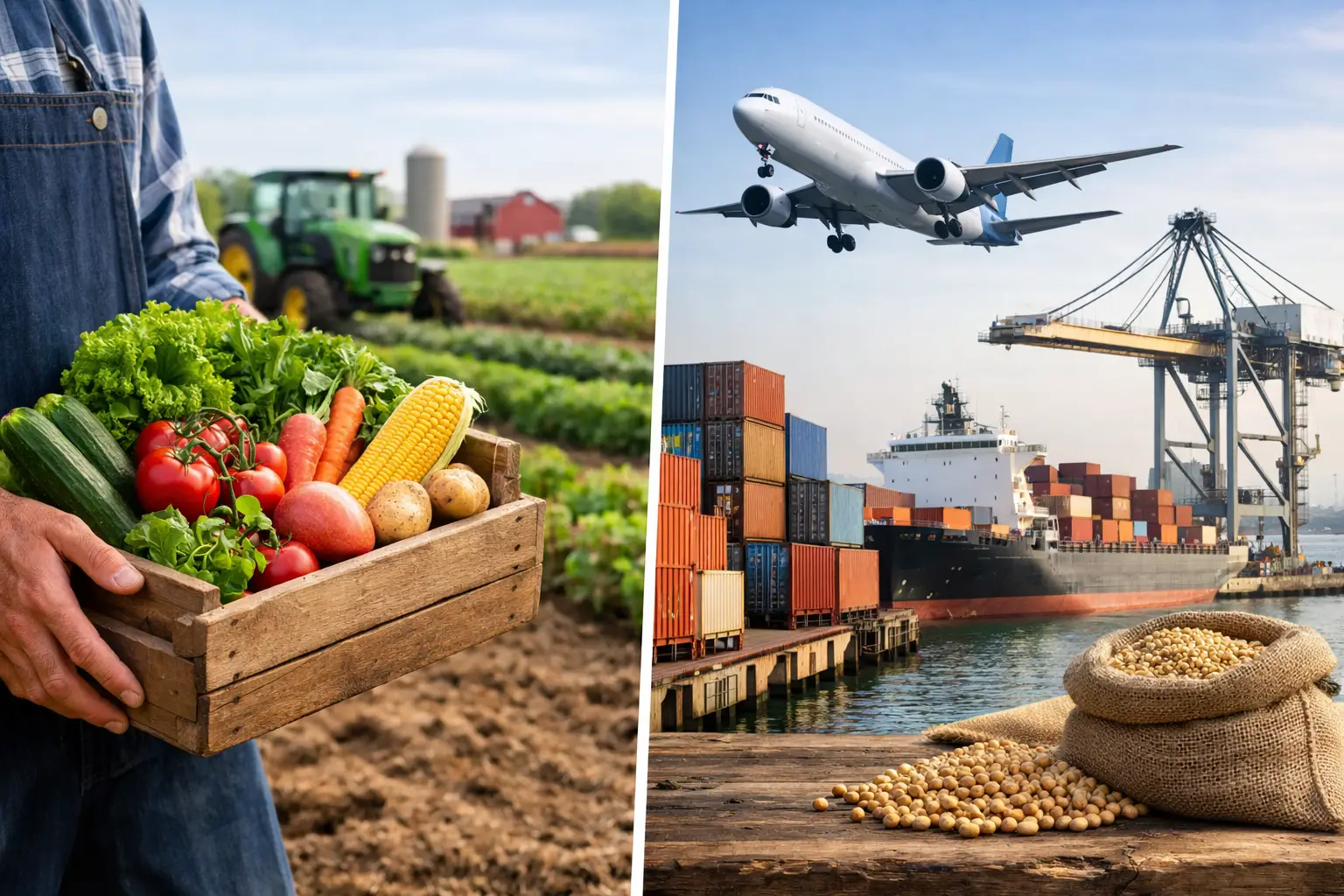
Local Sourcing vs Global Sourcing in Agriculture
A fertilizer order delayed at planting, a replacement irrigation part stuck in transit, a seed supplier nearby with limited variety but same-week delivery – agricultural purchasing decisions rarely stay theoretical for long. Local sourcing vs global sourcing becomes a real business question the moment timing, margin, and supply risk start affecting the season.
For farmers, distributors, input suppliers, and agri-business buyers, the right sourcing model is not about picking one side forever. It is about matching supply strategy to crop cycles, production targets, compliance needs, and customer demand. In agriculture, where weather, freight, and market swings can change conditions quickly, sourcing decisions need to be commercial, practical, and flexible.
What local sourcing vs global sourcing means
Local sourcing means buying products, inputs, equipment, or services from suppliers within your country or region. In some cases, it may even mean purchasing within the same state or farming area. Buyers usually choose local sources for faster delivery, easier communication, lower freight complexity, and stronger after-sales support.
Global sourcing means procuring from suppliers in other countries or international markets. This approach is often used to access better pricing, wider product availability, specialized machinery, new technologies, or bulk supply that may not be available domestically.
Neither model is automatically better. The decision depends on what you are sourcing, how urgently you need it, the level of technical support required, and how much supply-chain risk your business can absorb.
Local sourcing vs global sourcing: side-by-side comparison
| Factor | Local sourcing | Global sourcing |
|---|---|---|
| Lead times | Usually shorter | Often longer and less predictable |
| Freight complexity | Lower | Higher |
| Product range | More limited in some categories | Typically broader |
| Pricing | Can be higher on some items | Can be lower at scale |
| Minimum order quantities | Often more flexible | May require larger volumes |
| Regulatory handling | Easier to manage | More documentation and compliance |
| Technical support | Usually faster and closer | Can vary by supplier and region |
| Supply risk | Less exposure to international disruption | More exposure to freight, customs, and geopolitical issues |
| Relationship building | Easier in-person coordination | Broader access to new markets and suppliers |
When local sourcing makes better business sense
Local sourcing often wins when speed matters more than unit price. If a grower needs drip irrigation fittings during installation week or a livestock operation needs feed additives without delay, local supply can prevent downtime that costs more than any price difference on paper.
It also works well when products require close support. Machinery parts, greenhouse systems, veterinary supplies, irrigation service, and agronomic consulting often benefit from nearby suppliers who can answer questions quickly, visit the site, or arrange returns without cross-border delays.
For many agricultural businesses, local sourcing also reduces operational friction. There are fewer customs concerns, fewer currency issues, and usually a clearer understanding of domestic standards, labeling, and product registration requirements.
Advantages of local sourcing
- Faster delivery and shorter replenishment cycles
- Easier communication in the same market and time zone
- Lower shipping complexity and fewer border-related delays
- Better access to service, installation, and warranty support
- Greater flexibility for smaller or urgent orders
Limits of local sourcing
- Higher prices in some input and equipment categories
- Fewer supplier options in specialized agricultural segments
- Lower availability during regional shortages
- Less access to emerging technologies or international product lines
When global sourcing creates stronger value
Global sourcing becomes attractive when businesses need scale, variety, or price competitiveness. Importers, distributors, processors, and larger farms often look abroad for bulk fertilizers, crop protection products, seed genetics, packaging materials, replacement parts, or specialized equipment that domestic suppliers cannot provide at the same volume or cost.
This model can also support growth. A distributor expanding into new categories may use international sourcing to find differentiated products and strengthen margins. An exporter may need globally recognized packaging or traceability solutions to meet buyer requirements in destination markets. In those cases, global sourcing is not simply a purchasing tactic. It is part of market positioning.
Still, lower quoted pricing does not always mean lower total cost. Duties, documentation, inland transport, port fees, storage, inspection requirements, and payment terms can change the economics quickly.
Advantages of global sourcing
- Access to a wider supplier base and broader product range
- Better pricing opportunities, especially for volume orders
- Availability of specialized technologies and agricultural equipment
- More options for private label, contract manufacturing, or product differentiation
- Capacity to diversify supply beyond one domestic market
Limits of global sourcing
- Longer lead times and more variable transit schedules
- Higher exposure to shipping disruptions and policy changes
- More complex compliance, documentation, and customs procedures
- Greater need for supplier verification and quality control
- Higher working capital requirements in some cases
The cost question: price is only one part of the decision
A common sourcing mistake is comparing only supplier quotes. In agriculture, buyers need to compare landed cost, not just purchase price. A lower-cost imported product may still be the better decision, but only after factoring in freight, duties, warehousing, insurance, inspection, finance costs, and the cost of delay.
The reverse is also true. A local supplier may appear more expensive until you measure the savings from shorter lead times, reduced stockouts, easier claims handling, and less cash tied up in inventory.
Cost factors to compare
| Cost element | Local sourcing impact | Global sourcing impact |
|---|---|---|
| Unit price | May be higher | Often lower at scale |
| Freight | Usually lower | Often significantly higher |
| Inventory carrying cost | Lower if lead times are short | Higher when ordering early or in bulk |
| Customs and duties | Minimal or none | Can materially affect margin |
| Delay cost | Usually lower | Can be high during season-sensitive periods |
| Quality issue resolution | Faster and less expensive | Slower and potentially costly |
For seasonal businesses, timing can outweigh almost every other variable. Saving 8 percent on imported input costs means little if product arrives after the application window.
Quality, consistency, and supplier trust
Agricultural buyers cannot afford sourcing decisions based on assumptions. Whether buying locally or internationally, supplier validation matters. Product claims, certifications, batch consistency, and service responsiveness directly affect field performance and commercial outcomes.
Local suppliers may offer stronger accountability because they are easier to visit, call, and evaluate in person. Global suppliers may offer excellent manufacturing standards and stronger production capacity, but they usually require more due diligence up front.
Buyers should review product specifications carefully, request samples when practical, confirm certifications, and clarify warranty or dispute procedures before committing to volume. In a marketplace environment, visibility into supplier profiles and category-specific offerings helps reduce search time and improve comparison quality.
A smart sourcing model for agriculture: hybrid, not rigid
For many agricultural businesses, the strongest answer to local sourcing vs global sourcing is a blended strategy. Critical, time-sensitive, service-heavy items are often best sourced locally. High-volume, standardized, or specialty products may be better sourced globally.
A greenhouse operator, for example, may buy emergency repair parts and local technical service domestically, while importing climate-control components or substrate materials in planned purchasing cycles. A fertilizer distributor may maintain local backup supply while using international contracts for core seasonal volume.
This hybrid model creates balance. It protects continuity while still giving buyers access to pricing leverage, broader product selection, and new commercial opportunities.
How to decide which sourcing strategy fits
The best sourcing decision usually comes from asking a few direct business questions:
- Is this item urgent, seasonal, or operationally critical?
- Does it require local installation, servicing, or fast replacement?
- Are domestic suppliers competitively priced for the volume needed?
- What is the full landed cost of importing?
- How reliable is the supplier’s documentation, quality control, and communication?
- What happens if the shipment is delayed by two weeks?
If the answers point toward speed, service, and flexibility, local sourcing may be the stronger move. If they point toward scale, specialization, and margin improvement, global sourcing may offer more value.
For businesses managing multiple categories, the real advantage comes from building a sourcing system rather than making isolated purchases. That means comparing suppliers consistently, tracking delivery performance, and keeping backup options visible across regions. Platforms built around agricultural trade, such as Agricial, can help buyers and suppliers reduce search friction and make those comparisons faster.
The strongest agricultural businesses do not treat sourcing as a one-time transaction. They treat it as a growth lever. When you choose between local access and global reach with clear eyes on cost, timing, and risk, you put your operation in a better position to buy smarter, respond faster, and keep business moving when the market changes.