Tractor Brands: How to Compare for Your Operation
A tractor purchase can shape field capacity, labor costs, and downtime for years. That is why comparing tractor brands is not simply a question of engine horsepower or purchase price. For a working farm, contractor, dealer, or importer, the right choice depends on local parts availability, implement compatibility, operator needs, financing, resale demand, and the quality of support after delivery.
The best-known name is not automatically the best commercial fit. A compact tractor for a diversified vegetable farm has very different requirements than a high-horsepower row-crop unit, an orchard model, or a utility tractor serving a livestock operation. A structured comparison helps buyers source equipment with fewer surprises and stronger long-term value.
What Separates Leading Tractor Brands
Most established manufacturers compete across several tractor categories, but their strengths can vary by region and product line. Some have broad dealer networks and deep parts inventories. Others are especially competitive on compact equipment, value pricing, simple mechanical designs, or advanced precision-agriculture capability.
Buyers should begin with the work, not the badge on the hood. List the implements to be used, the acreage or annual operating hours, terrain, crop system, transport requirements, and available service resources. This creates a practical specification before brand comparisons begin.
Major factors to compare
A useful tractor evaluation looks beyond headline specifications. Focus on the factors that affect productivity over the full ownership period:
- Power and torque: Match engine output to the toughest regular task, such as deep tillage, baling, loader work, or pulling a large planter.
- Hydraulic capacity: Loader, front linkage, sprayer, and hydraulic motor performance depend on flow rate, pressure, and available remotes.
- Transmission: Gear, shuttle, hydrostatic, powershift, and continuously variable options suit different jobs and operator preferences.
- PTO and hitch configuration: Check PTO horsepower, speed options, lift capacity, and Category 1, 2, or 3 hitch compatibility.
- Dealer and parts coverage: A lower purchase price can lose its advantage quickly if a critical component takes weeks to arrive.
- Technology support: Guidance, telematics, variable-rate tools, and diagnostic systems may improve fleet management but can add training and subscription costs.
Tractor Brands by Operating Need
The table below offers a practical market-level view. Individual model quality, dealer performance, and regional availability still matter more than broad reputation alone.
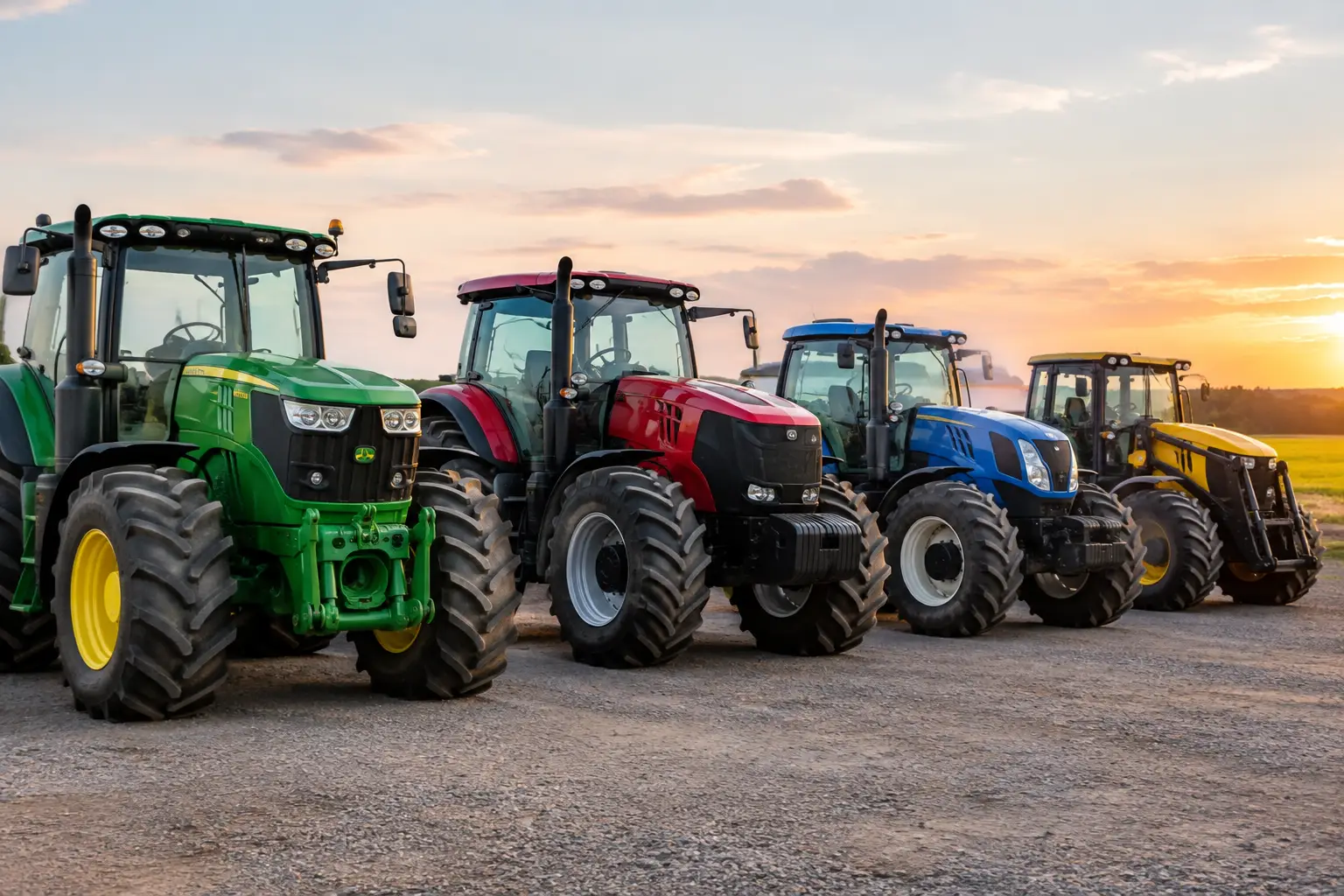
| Brand group | Typical strengths | Best-fit applications | Points to assess before buying | |—|—|—|—| | John Deere | Broad product range, strong technology ecosystem, established resale demand | Row crops, hay, livestock, municipal and large mixed farms | Dealer responsiveness, technology packages, acquisition cost | | Case IH and New Holland | Wide range of utility and high-horsepower equipment, precision options | Cash crops, hay, specialty operations, mixed fleets | Local dealer capability and model-specific parts stock | | Kubota | Strong compact and utility tractor presence, loader-focused options | Acreage, horticulture, livestock, landscaping, light municipal work | PTO capacity and weight for heavier draft work | | Massey Ferguson | Diverse global lineup, practical utility and mid-range choices | Mixed farms, livestock, field work, export markets | Configuration consistency and local service availability | | AGCO brands, including Fendt and Valtra | Advanced technology, operator comfort, specialized configurations | High-output field operations and professional fleets | Purchase cost, technician access, software support | | Mahindra, TYM, Kioti and similar value-focused brands | Competitive compact and utility pricing, straightforward applications | Small farms, property maintenance, loader and mowing work | Parts lead times, dealer stability, resale demand |
This comparison is a starting point, not a substitute for reviewing exact models. A well-supported utility tractor from a smaller brand can be a better business decision than a premium machine with limited local service. Conversely, a large farm running narrow planting and harvest windows may justify a higher-priced brand because rapid field service and fleet telematics protect seasonal capacity.
Match Horsepower to the Job, Not the Marketing
Horsepower remains a useful filter, but it can mislead buyers when used alone. Engine horsepower does not equal PTO horsepower, drawbar pull, hydraulic performance, or stability with a loaded front-end loader. Tractor weight, tire selection, ballast, axle capacity, and transmission design all influence real working performance.
Compact and utility tractors
Compact tractors commonly serve acreage management, livestock chores, mowing, loader work, light tillage, and horticultural operations. Hydrostatic transmissions can make repeated loader work easier, while gear or shuttle configurations may suit operators who spend more time pulling implements.
For these machines, buyers should pay close attention to loader lift height, lift capacity at full height, third-function hydraulics, and the availability of compatible attachments. A tractor that handles a pallet fork safely may not have enough capacity for dense fertilizer bags or large round bales.
Mid-range and row-crop tractors
Mid-range tractors often support planting, spraying, hay production, cultivation, and heavier loader work. Here, hydraulic flow and remote valve capacity become more important, particularly when operating planters, balers, or implements with multiple hydraulic functions.
Row-crop tractors require careful attention to wheel spacing, clearance, turning radius, guidance compatibility, and cab visibility. A machine that fits one planting system may be inefficient in another. Test the turning radius with the intended implement, not only in the dealer yard.
High-horsepower tractors
High-horsepower units are designed for broad-acre tillage, air seeding, large planters, and heavy transport. Buyers often prioritize fuel efficiency under load, transmission behavior, cooling performance, tire or track choices, and remote diagnostic support.
These tractors can produce major gains in field capacity, but only when implements, labor, and logistics can keep pace. Oversizing can increase capital costs, soil compaction risk, and fuel consumption without improving the operation’s actual bottleneck.
Total Cost Matters More Than the Purchase Quote
The lowest bid is rarely the lowest ownership cost. Compare quotes on an equivalent configuration, including loader, tires, ballast, rear remotes, guidance hardware, warranty coverage, delivery, setup, and any required attachments.
A commercial buyer should estimate total cost of ownership across the expected replacement cycle. Include finance charges, insurance, fuel use, scheduled maintenance, wear items, operator training, expected repairs, downtime exposure, and projected resale value. For importers and distributors, add freight, customs requirements, spare-parts stocking, technical documentation, and local warranty obligations.
| Cost area | Questions to ask suppliers | |—|—| | Initial configuration | What equipment is standard, optional, or excluded from the quote? | | Service | Is mobile service available during planting and harvest periods? | | Parts | Which fast-moving filters, belts, sensors, and wear parts are stocked locally? | | Warranty | What is covered, for how long, and who authorizes repairs? | | Resale | Is there an active used-equipment market for this model in the region? |
How to Source Tractor Brands With More Confidence
Start by sending the same operational brief to multiple suppliers. Include target horsepower, annual hours, crop or livestock application, implement list, preferred transmission, hydraulic requirements, delivery location, and budget range. Comparable information produces comparable quotations.
Ask for a demonstration using the actual implement whenever possible. During the test, assess visibility, controls, cab access, hydraulic response, turning behavior, noise, and ease of daily checks. Operators often identify practical issues that specification sheets do not reveal.
For cross-border procurement, verify the engine emissions standard, electrical configuration, safety certification, language of manuals, availability of diagnostic tools, and warranty validity in the destination market. These details can affect registration, commissioning, and long-term support.
Agricial helps agricultural businesses compare machinery suppliers, discover tractor-related products, and connect directly with potential commercial partners across markets. The goal is not to chase the longest supplier list, but to find a partner that can support the machine after the sale.
The Best Brand Is the One Your Business Can Support
A tractor earns its value when it starts reliably, pulls the required implement efficiently, and can be repaired without disrupting the season. Brand reputation matters, but local dealer quality, parts access, operator fit, and configuration discipline usually matter more.
Choose a tractor that fits the work already on your farm and the realistic growth plan ahead. The right supplier relationship can turn a major equipment purchase into dependable capacity when the next critical field window arrives.