Organic Fertilizer vs NPK for Commercial Farms
A fertilizer decision can affect far more than this season’s yield. It can change labor needs, freight costs, soil performance, storage requirements, and the consistency of a crop program. In the organic fertilizer vs NPK discussion, the best choice is rarely a simple either-or answer. Commercial growers need to match nutrient source, timing, soil conditions, crop value, and purchasing strategy.
For buyers, distributors, and farm managers, the practical question is this: which input delivers the required nutrients at the right time and at an acceptable total cost? That includes the price per ton, but also application, transport, nutrient losses, and the long-term condition of the soil.
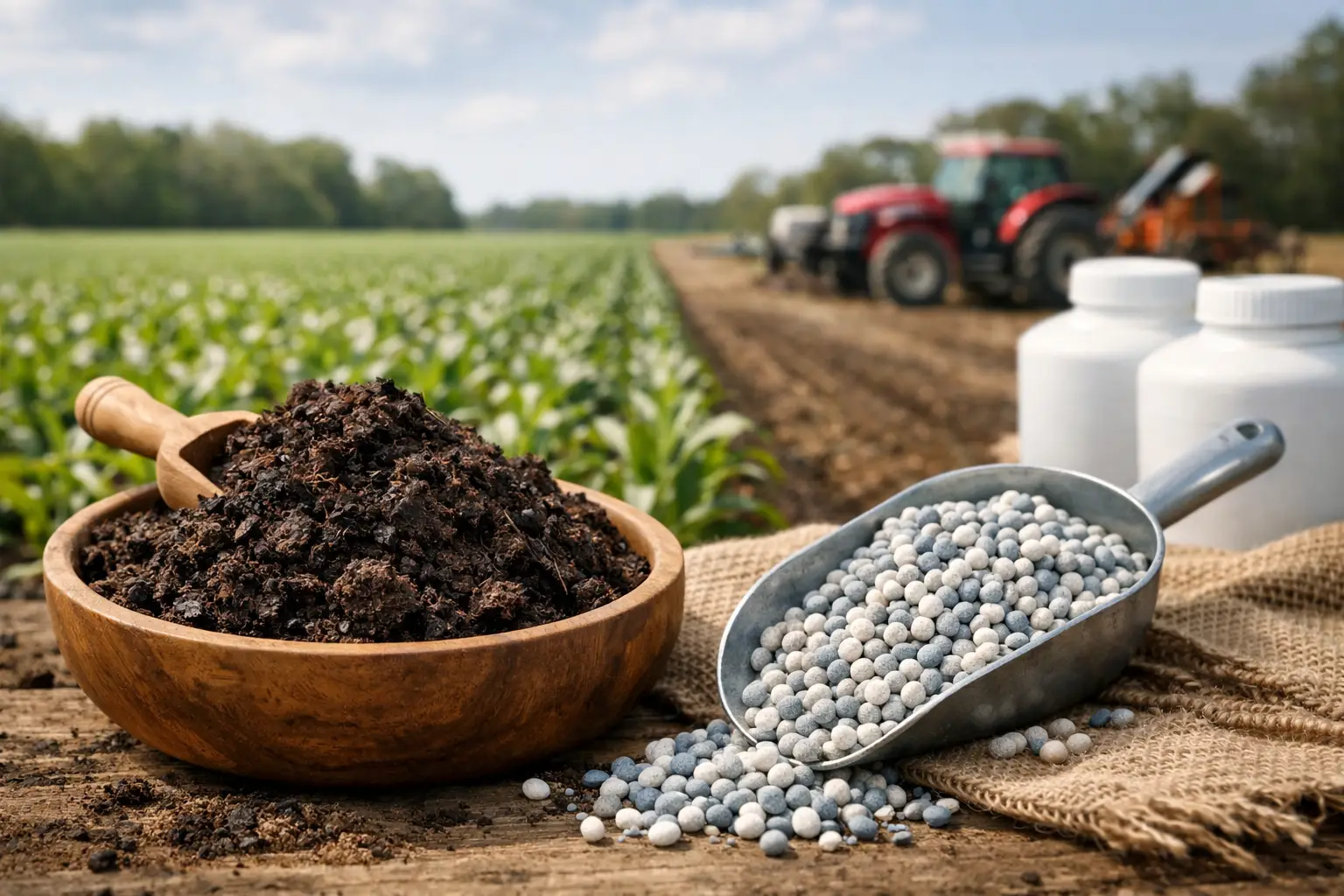
Organic Fertilizer vs NPK: The Core Difference
Organic fertilizers are derived from plant, animal, or naturally occurring mineral sources. Common products include compost, manure, poultry litter, bone meal, fish emulsion, seaweed products, and certain processed organic blends. Their nutrients are generally released as soil organisms break down organic matter, although some products can supply nutrients more quickly than others.
NPK fertilizers are formulated mineral fertilizers supplying nitrogen (N), phosphorus (P), and potassium (K). They may be sold as straight fertilizers, such as urea or muriate of potash, or as compound and blended grades such as 10-10-10, 15-15-15, or crop-specific formulas. Their nutrient analysis is standardized, enabling precise nutrient calculations and targeted applications.
| Factor | Organic Fertilizer | NPK Fertilizer | |—|—|—| | Nutrient concentration | Usually lower and more variable | Usually high and clearly labeled | | Nutrient release | Gradual, dependent on biology and weather | Often rapid and predictable | | Soil organic matter | Can contribute to soil carbon and structure | Does not add meaningful organic matter | | Application volume | Often high bulk rates | Lower rates per acre for the same nutrient supply | | Nutrient precision | Requires testing and careful calculation | Easier to match a nutrient prescription | | Storage and freight | Can be bulky, moist, and expensive to transport | Usually easier to store, ship, and handle |
The distinction matters because nutrient percentage is not the same as nutrient availability. A compost may contain nitrogen, phosphorus, and potassium, but not all of those nutrients will become plant-available in the first growing season. A granular NPK product states its analysis clearly, and a large share may be available soon after application, depending on the nutrient form and field conditions.
When Organic Fertilizer Creates More Value
Organic inputs are most compelling when a farm needs to improve soil function alongside nutrient supply. Repeated use of well-managed compost, manure, or other organic materials can support soil aggregation, water infiltration, microbial activity, and moisture-holding capacity. These benefits can be especially valuable in low-organic-matter soils, sandy ground with weak water retention, or compacted fields that need a broader soil-management response.
Organic fertilizer also fits operations with accessible local feedstocks. A livestock farm with tested manure, a food processor with a reliable compost stream, or a grower near a quality composting facility may secure a favorable nutrient cost. In these cases, the material can be economically competitive even when its nutrient concentration is low.
The Limits of Organic Inputs
Organic does not automatically mean balanced, safe, or cost-effective. Nutrient content can vary between loads, especially with manure-based materials. Moisture raises freight costs, while spreading large volumes requires equipment, time, and suitable field access. Poorly managed manure may also create odor concerns, weed seed risks, food-safety restrictions, or nutrient runoff problems.
Phosphorus deserves particular attention. Applying manure or compost solely to meet nitrogen demand can overapply phosphorus over time, especially where soil test phosphorus is already high. A regular nutrient analysis, soil testing, and field-by-field application plan are essential for protecting margins and meeting local nutrient-management requirements.
When NPK Fertilizer Is the Better Commercial Tool
NPK fertilizer is often the most efficient option when a crop needs a known nutrient quantity at a specific growth stage. Corn, wheat, vegetables, orchards, turf, and greenhouse crops may all require precise nutrient timing. Mineral products make it easier to build a program around soil tests, yield targets, tissue tests, fertigation plans, or variable-rate prescriptions.
High-analysis products also simplify logistics. A truckload of concentrated fertilizer can carry far more plant nutrients than a truckload of compost or manure. That difference affects transportation, on-farm storage, loading, application passes, and labor. For farms sourcing across long distances or managing many acres in a narrow planting window, this efficiency can be decisive.
The Limits of NPK Programs
NPK is not a substitute for healthy soil management. It can correct a nutrient shortage quickly, but it does not build soil organic matter or improve soil structure on its own. Overapplication can reduce profitability and increase the risk of nutrient losses to groundwater or surface water.
Nitrogen management is particularly sensitive. Heavy rain, saturated soils, high temperatures, and the fertilizer source itself can all affect nitrogen loss. Split applications, stabilizers, placement near the root zone, and fertigation may improve efficiency, but each approach adds planning and operational cost.
Compare Total Cost, Not Price Per Ton
A low per-ton price can be misleading. Organic materials often appear inexpensive until spreading, hauling, moisture content, storage, and nutrient availability are included. NPK products may carry a higher purchase price, yet deliver lower application volume and more predictable nutrients.
Use a common unit for comparison: cost per pound of plant-available nutrient delivered to the field. Then add handling and application costs. For example, a compost product with 1% total nitrogen may require many tons per acre to contribute meaningful nitrogen, while a concentrated NPK blend may meet the same short-term requirement with a small fraction of the material volume.
A sound buying comparison should account for:
- Guaranteed or tested nutrient analysis, including available nutrient forms
- Expected first-year nutrient availability under local weather and soil conditions
- Freight distance, moisture content, packaging, and storage requirements
- Application method, equipment capacity, labor, and field access
- Residual value from organic matter and nutrients available in later seasons
- Quality assurance, contaminant screening, and regulatory documentation
For importers and distributors, consistency is equally important. NPK grades are usually easier to specify in contracts because the analysis, particle size, packaging, and delivery terms can be standardized. Organic products require stronger supplier verification, batch testing, and clear documentation on feedstocks and contaminants.
A Blended Strategy Often Produces the Best Result
The most profitable nutrient program may combine both sources. Organic inputs can support long-term soil improvement and provide a portion of nutrient demand. NPK can then fill the remaining gap with accurate, timely nutrition. This approach is useful where soil organic matter is low but the crop also has a narrow window for nitrogen, phosphorus, or potassium uptake.
A vegetable grower, for example, may apply compost before planting to improve bed condition and contribute baseline nutrients. A soluble or granular NPK program can then supply precise nutrition during rapid crop growth. A broadacre operation may use manure on nearby fields where hauling is practical, while relying on mineral fertilizer for distant acreage or crops with higher nutrient-demand precision.
The correct balance depends on crop economics. High-value crops can often justify more intensive soil testing, tissue testing, and split applications. Lower-margin commodity crops may prioritize efficient nutrient delivery, local availability, and fewer field passes.
How to Source Fertilizer With Less Risk
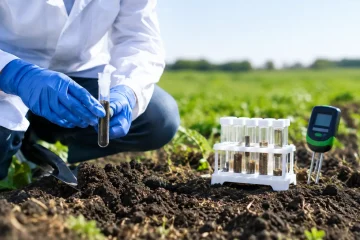
Whether purchasing organic fertilizer or NPK, start with a written nutrient requirement based on soil tests, realistic yield goals, previous crop removal, and local regulations. Do not buy a product solely because it is available, familiar, or priced attractively.
Ask suppliers for a current analysis, product specifications, application guidance, minimum order quantities, packaging details, lead times, and quality-control documents. For organic materials, request information on feedstock origin, maturity, pathogen controls, heavy metals, salts, and weed seed management. For NPK products, confirm nutrient grade, physical condition, compatibility with blending or spreading equipment, and whether the product is coated, stabilized, or water-soluble.
Comparing multiple qualified suppliers improves negotiating power and reduces supply risk. A focused agricultural marketplace such as Agricial can help businesses identify relevant fertilizer suppliers and compare commercial options by category, region, and product offering before requesting quotes.
Make the Decision Field by Field
Organic fertilizer is strongest when soil-building value, local supply, and long-term nutrient planning outweigh the cost of moving bulk material. NPK is strongest when precision, speed, consistency, and nutrient density are the priority. Neither product category is inherently better across every farm or crop.
The practical advantage comes from treating fertilizer as a managed investment. Test the soil, calculate plant-available nutrients, verify the supplier, and choose the source that supports both the crop in front of you and the business you are building.