Best Precision Spraying Equipment for Commercial Farms
A nozzle that applies too much product wastes money. A nozzle that misses the target can cost yield, quality, and market access. The best precision spraying equipment gives commercial growers tighter control over every pass, helping match spray volume, droplet size, and application zones to real field conditions.
For farms, orchards, vineyards, and agricultural service providers, the right purchase is rarely the machine with the longest feature list. It is the system that fits the crop, terrain, acreage, labor capacity, chemical program, and available technical support. A large row-crop operator may prioritize section control and variable-rate application, while a vineyard may see the fastest return from canopy sensing and targeted airblast spraying.
What Precision Spraying Equipment Actually Does
Precision spraying combines application hardware with data and controls that reduce unnecessary chemical use. At its simplest, that may mean GPS guidance and automatic boom-section shutoff. At a more advanced level, it can include cameras, LiDAR, ultrasonic sensors, pulse-width modulation, prescription maps, and individual nozzle control.
The commercial objective is straightforward: put the correct amount of product on the intended target while limiting overlap, drift, runoff, and untreated areas. Better records are another valuable outcome. Operators can document where, when, and at what rate products were applied, supporting traceability and more informed decisions next season.
Core technologies to compare
The most useful features depend on the production system, but buyers should understand four core technology groups:
- GPS guidance and section control prevent skips and overlaps, especially on large, irregular fields.
- Variable-rate control changes output by zone using prescription maps, live sensors, or crop data.
- Individual nozzle control and pulse-width modulation maintain target rates across changing travel speeds and can improve turn compensation.
- Canopy sensors and vision systems identify vegetation in orchards, vineyards, and specialty crops, allowing spray to be directed where foliage is present.
These technologies can work together, but they do not need to be purchased all at once. Starting with accurate rate control and automatic section shutoff often delivers meaningful savings before a business invests in cameras or individual-nozzle systems.
Best Precision Spraying Equipment by Application
There is no single best precision spraying equipment for every agricultural operation. The table below compares the main equipment categories buyers encounter when sourcing new machines, retrofit kits, or contract spraying capability.
| Equipment type | Best fit | Main advantages | Trade-offs | |—|—|—|—| | GPS-guided boom sprayer with section control | Broadacre grains, oilseeds, and row crops | Cuts overlap, improves field efficiency, accessible entry point | Does not respond to within-field crop variation without added controls | | Variable-rate sprayer | Farms using soil maps, yield data, or agronomist prescriptions | Applies inputs by management zone and supports better input planning | Requires reliable data, setup time, and operator discipline | | PWM or individual-nozzle control sprayer | High-value row crops and operations with variable speeds | Precise rate control, turn compensation, wider droplet-management options | Higher purchase price and more electronic components to service | | Sensor-guided airblast sprayer | Vineyards, orchards, berries, and nursery crops | Reduces spray into gaps and targets canopy volume | Calibration is crop-specific and sensor performance varies by canopy condition | | Spot sprayer with camera or green-on-brown detection | Fallow ground, weed control, and selective herbicide programs | Can sharply reduce herbicide use on sparse weed populations | Best results depend on weed visibility, lighting, and detection software |
Field crops: build from coverage control upward
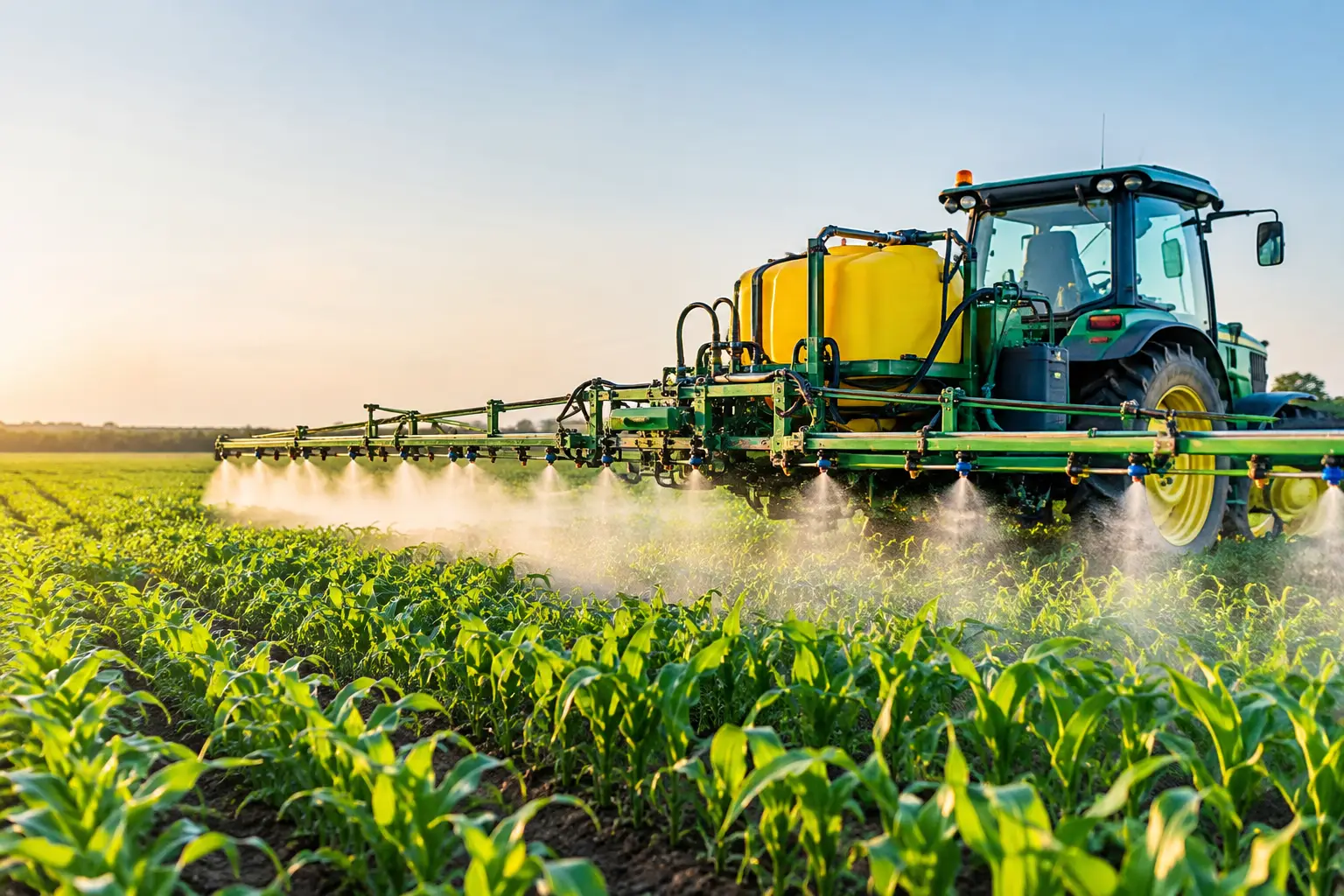
For corn, soybeans, wheat, cotton, and similar crops, a self-propelled or trailed boom sprayer with GPS guidance, automated section control, and rate control is often the commercial baseline. Wide booms cover acres quickly, but they also create substantial overlap risk on headlands, point rows, and irregular boundaries. Section control directly addresses that problem.
Variable-rate capability becomes more valuable when the farm has dependable zone data and a clear agronomic reason to vary applications. Applying a different rate simply because the machine can do it is not precision. The rate plan should be validated by an agronomist, product label requirements, weed pressure, soil conditions, and expected crop response.
For operations traveling at changing speeds or managing sensitive herbicide and fungicide applications, PWM can be worth the additional investment. It helps maintain flow while allowing more consistent pressure, which supports stable droplet size. That matters when drift risk, coverage quality, and label compliance are central concerns.
Orchards and vineyards: measure the canopy
Airblast spraying remains common in permanent crops because air carries droplets into dense canopies. Its weakness is obvious when rows have gaps, young trees, missing vines, or uneven foliage: the sprayer can send product where no canopy exists.
Sensor-guided airblast systems address this by measuring canopy presence or density and adjusting individual outlets, flow, or both. The strongest business case is often found in high-value crops with variable plant structure and repeated seasonal applications. Savings can be significant, but only if the machine is calibrated for the orchard or vineyard block and operators regularly inspect nozzle condition, airflow, and deposition.
How to Choose Equipment That Delivers a Return
Start with the application problem, not the brand name. A supplier should be able to explain how its system performs under your crop canopy, target rate, travel speed, water volume, and terrain. Ask for local references where possible, particularly from farms with similar acreages and production practices.
Evaluate total cost, not just purchase price
A lower-priced sprayer can become expensive if it wastes product, requires frequent downtime, or lacks service support during critical spray windows. Compare the complete operating picture:
| Cost factor | Questions to ask suppliers | |—|—| | Application accuracy | How does the system maintain rate during acceleration, turns, and slope changes? | | Chemical savings | What assumptions support projected savings, and are they realistic for my weed or canopy conditions? | | Service access | Are trained technicians, parts, and remote diagnostics available in my operating region? | | Data compatibility | Can the controller exchange files with my farm-management software or agronomy provider? | | Training needs | How long will operators need to calibrate, run, clean, and troubleshoot the system? |
Also consider whether a retrofit is more commercially sensible than replacing an entire sprayer. Adding section control, a modern rate controller, or nozzle-by-nozzle monitoring can extend the useful life of a mechanically sound machine. Full replacement may make more sense when tank capacity, boom stability, clearance, pump performance, or operator comfort limits productivity.
Put calibration before automation
Advanced electronics cannot compensate for poor calibration. Before every major spray period, verify nozzle output, pressure gauges, flow meters, filters, boom height, agitation, and ground speed. Replace worn nozzles as a set when output variation exceeds acceptable tolerance.
Water-sensitive paper, field checks, and records from previous applications can help confirm whether the selected nozzle and droplet spectrum are reaching the target. This is especially important where disease control depends on canopy penetration or where off-target movement can threaten neighboring crops.
Sourcing Precision Spraying Systems Across Markets
International buyers and distributors should look beyond specifications on a product sheet. Confirm electrical standards, controller language options, spare-parts availability, warranty terms, shipping requirements, and the supplier’s ability to provide commissioning support. Imported equipment can offer strong value, but a delayed replacement sensor or proprietary controller can quickly interrupt a spray program.
For manufacturers and suppliers, clear technical listings make buyers more confident. Include tank capacity, pump type, boom width, nozzle spacing, controller compatibility, sensor technology, recommended crop uses, service coverage, and available certifications. On a specialized agriculture marketplace such as Agricial, detailed listings and responsive quote communication help buyers compare suitable equipment faster and help suppliers reach qualified commercial inquiries.
Questions to Ask Before Requesting Quotes
Before contacting suppliers, prepare a short operating profile: crop types, treated acreage, row spacing or canopy dimensions, annual spray passes, typical water volume, terrain, current sprayer limitations, and local service needs. This information turns a general inquiry into a quote that can be compared fairly.
Ask whether the quoted configuration includes the controller, display, GPS receiver, activation licenses, flow sensors, nozzle bodies, installation, operator training, and post-sale support. Precision features are sometimes priced as separate options, so two machines that appear similar may have very different real-world capabilities.
The right precision sprayer should make each pass more deliberate, not more complicated. Choose technology your team can calibrate, operate, and maintain under the pressure of a narrow spray window, then build additional capability as your data, staff, and crop program justify it.