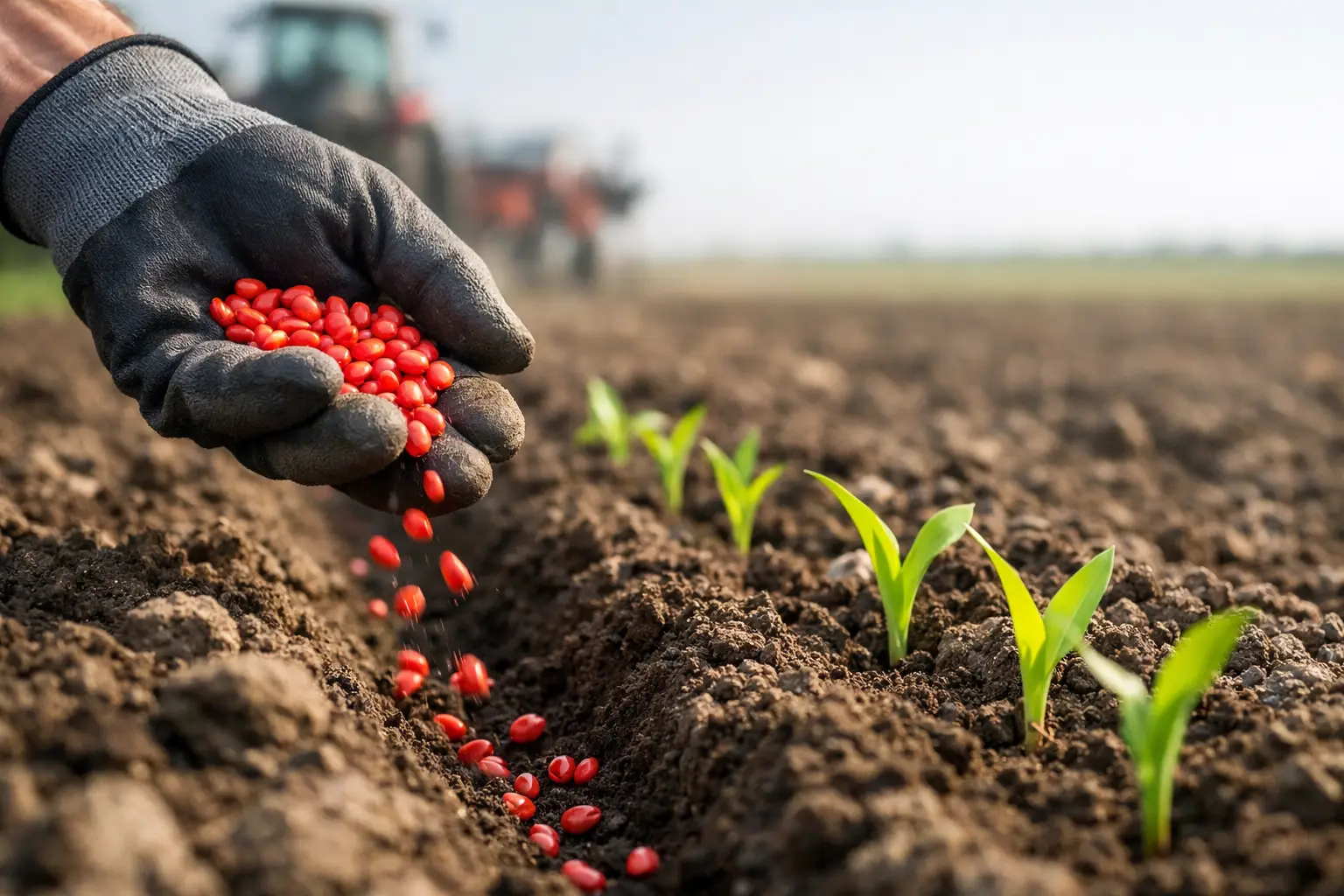
Seed Treatment for Stronger Crop Establishment
A crop’s first few weeks often determine whether the season begins with uniform stands or costly replant decisions. Seed treatment places targeted protection or biological support directly on the seed, helping growers manage risks before seedlings encounter cold soils, pathogens, insects, or uneven emergence conditions. For commercial farms and input buyers, it is also a sourcing decision: the right treatment must fit the crop, local pressure, seed quality, application equipment, and market requirements.
What Is Seed Treatment?
Seed treatment is the application of materials to seed before planting to improve establishment, protect the seed and young seedling, or support early growth. Treatments may be applied by the seed producer, a commercial seed processor, a retailer, or an on-farm treatment operation, depending on the crop and local regulations.
The category includes conventional crop-protection products, biological products, nutrients, polymers, colorants, and inoculants. A treated seed is not automatically better seed. Treatment adds value when it addresses a realistic field risk and when the seed itself has strong germination, physical quality, and genetic fit for the farm.
For buyers comparing suppliers, the most useful question is not simply, “What treatment is included?” It is, “Which risks does this treatment address, under what planting conditions, and what evidence supports its performance?”
Why Seed Treatment Matters in Commercial Production
Early-season losses can be hard to recover. Seed and seedlings are vulnerable to soilborne fungi, seedling diseases, insect feeding, and poor establishment caused by stressful planting conditions. Once a stand is thin or uneven, the cost can show up in lower yield potential, delayed maturity, uneven harvest, and additional labor.
Seed treatment offers a precise delivery method because the active materials are placed where they are needed first. Compared with a broad in-furrow or foliar application, a treatment can use a smaller amount of product per acre while protecting the seed zone. That does not mean it replaces every other crop-protection program. High pest pressure, prolonged wet weather, or severe disease history may still require integrated measures such as rotation, drainage improvements, resistant varieties, planting-date adjustments, and field scouting.
For distributors and exporters, treated seed can also be a differentiated product line. However, treatment registrations, active ingredient restrictions, residue rules, labeling, and import requirements vary by country. Commercial buyers should verify the legal status of both the treatment and the treated seed in the destination market before shipment.
Main Types of Seed Treatment
Fungicide Treatments
Fungicide seed treatments are commonly used to protect against damping-off, seed rot, and early root or shoot diseases. They are especially relevant where soils are cool and wet at planting or where fields have a history of disease caused by organisms such as Pythium, Rhizoctonia, Fusarium, or smut pathogens.
A fungicide package should be matched to the likely pathogen. A product with strong activity against one disease group may offer limited value against another. Ask suppliers for the labeled disease spectrum, crop registration, application rate, and compatibility with other treatment components.
Insecticide Treatments
Insecticide treatments protect germinating seed and emerging plants from certain early-season insects. Their value depends heavily on local pest history, planting window, and the crop’s ability to tolerate early feeding.
They may reduce the need for rescue applications in some situations, but they are not a universal solution for all insects or for season-long control. Pollinator protections, handling requirements, and local restrictions require careful attention, particularly for treated seed that may produce dust during planting.
Biological Treatments and Inoculants
Biological seed treatments use beneficial microorganisms or naturally derived compounds to support root development, nutrient availability, or disease suppression. Legume inoculants, for example, introduce bacteria that support nitrogen fixation when the correct strain reaches viable root nodules.
Biological products can be commercially attractive where buyers seek lower-input or integrated production options. Their performance can be more dependent on storage conditions, seed-treatment compatibility, soil moisture, temperature, and application timing than conventional chemistry. Viability data and shelf-life documentation matter.
Nutrients, Polymers, and Seed Enhancers
Micronutrients, polymers, and other seed-applied enhancers may improve handling, treatment adhesion, and early nutrient access. Polymers can help reduce dust-off and provide more consistent coverage. These products are often used as part of a treatment package rather than as stand-alone protection.
Seed Treatment Options at a Glance
| Treatment type | Primary purpose | Best fit | Key buying consideration | |—|—|—|—| | Fungicide | Reduces seed and seedling disease risk | Cool, wet soils or disease-prone fields | Match active ingredients to local pathogens | | Insecticide | Limits early insect feeding | Fields with documented early pest pressure | Confirm crop label and stewardship requirements | | Biological | Supports roots or disease suppression | Integrated and soil-health-focused programs | Check compatibility, viability, and storage needs | | Inoculant | Promotes nitrogen fixation in legumes | New legume acres or fields without effective rhizobia | Use the correct crop-specific strain | | Nutrient or polymer | Improves early support and application quality | Programs needing better coverage or handling | Confirm rate, compatibility, and economic return |
How to Choose the Right Seed Treatment Program
The strongest programs begin with field information, not product preference. Review crop rotation, planting date, soil temperature, drainage, seedling disease records, insect history, and the seed lot’s germination results. A soybean field planted early into wet residue faces a different risk profile than irrigated corn planted into warm, well-prepared soil.
Use these four commercial checks when comparing treatment packages:
- Crop and field fit: Confirm the treatment is labeled for the crop and addresses an expected local threat.
- Seed quality: Request lot-specific germination, purity, vigor, and treatment coverage information where available.
- Compatibility: Verify that fungicides, insecticides, biologicals, inoculants, polymers, and colorants can be combined without reducing efficacy.
- Total economics: Compare the treatment cost with expected risk reduction, replant exposure, labor savings, and potential yield protection.
Price per unit is only one part of the decision. A lower-cost treatment may be the best choice in a low-risk field. In a field with a consistent history of seedling disease, a more complete package can be less expensive than a partial stand and a second planting pass.
Questions to Ask a Seed Treatment Supplier
Professional buyers should request clear technical and commercial documentation. Ask for the active ingredients or biological strains, application rate, seed coverage standard, storage guidance, batch or lot traceability, safety data, and recommended planting window after treatment.
For international procurement, add country-of-origin documentation, phytosanitary requirements, treatment registration status, packaging specifications, minimum order quantity, and lead time. Treated seed is often subject to stricter transport and labeling rules than untreated seed, so logistics planning should start before the purchase order is issued.
Application Quality Is Part of Product Performance
A well-designed treatment can underperform if it is applied unevenly, stored improperly, or handled roughly. Coverage matters because untreated areas on individual seeds can remain exposed to disease and insect pressure. Excessive application can cause clumping, dust-off, altered flow through planters, or reduced germination in sensitive situations.
Commercial seed treaters should calibrate equipment, monitor liquid flow, inspect coverage, and retain batch records. Seed should be dried and stored according to the product label, protected from excess heat and humidity, and clearly identified as treated. Never use treated seed for food, feed, or oil processing unless a specific label and regulation explicitly allow it.
Planter setup also deserves attention. Match meter settings to seed size and coating characteristics, manage dust during loading and planting, and follow all label-directed disposal procedures for unused treated seed and seed bags.
Benefits and Trade-Offs of Seed Treatment
| Potential benefit | Practical trade-off | |—|—| | Targeted early protection at planting | May add cost without return in low-risk fields | | Reduced replant risk under moderate pressure | Does not solve poor seedbed conditions or severe infestations | | Convenient combination of multiple inputs | Compatibility issues can affect biologicals or seed flow | | Better product differentiation for seed suppliers | Requires stewardship, labeling, and regulatory control | | Lower per-acre product use than some broad applications | Must be applied accurately to deliver consistent coverage |
The right approach is risk-based rather than automatic. Treating every acre with the most extensive package may not be economically justified. At the same time, cutting treatment costs without considering disease history or planting conditions can expose a high-value crop to preventable stand loss.
Sourcing Treated Seed With Confidence
Reliable sourcing depends on transparent supplier information. Buyers should look for seed companies and treatment providers that can explain the product package in practical terms, provide documentation, and communicate realistic delivery schedules. Suppliers should present treatment details clearly rather than relying on broad claims about improved performance.
Marketplace-based sourcing can make it easier to compare seed suppliers, treatment service providers, equipment vendors, and agronomy consultants across regions. Agricial helps agricultural businesses identify relevant partners and start more informed commercial conversations around seed, crop protection, and planting needs.
A seed treatment program earns its place when it protects a real establishment risk at a cost the crop can justify. Start with the field, verify the seed lot and treatment package, and choose suppliers prepared to support both product performance and responsible handling.