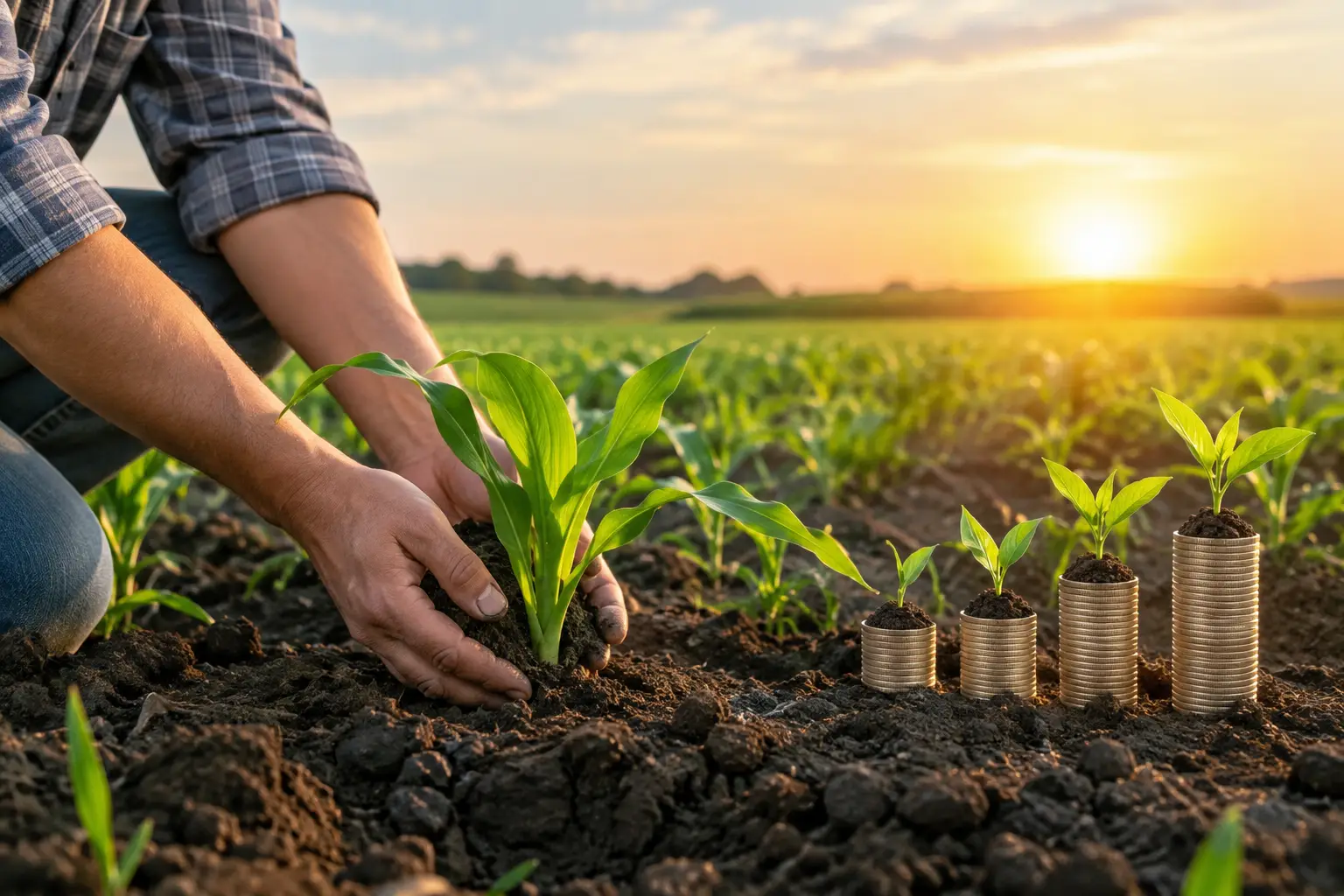
When Regenerative Agriculture Investment Pays
A regenerative agriculture investment is rarely a single purchase with a simple payback period. It is a business decision that changes how land produces, how inputs are bought, and how a farm manages weather and market volatility. For growers, investors, input suppliers, and buyers, the strongest opportunities come from measuring practical outcomes: lower dependency on purchased inputs, more stable yields, improved soil function, and access to premium or preferred markets.
The opportunity is real, but the returns are not automatic. Cover crops, reduced tillage, rotational grazing, compost, precision nutrient management, and agroforestry can improve long-term farm performance. They can also create transition costs, management complexity, and short-term yield risk. A sound investment case starts with the farm system, the local climate, and a clear route to commercial value.
What Regenerative Agriculture Investment Means
Regenerative agriculture investment refers to capital directed toward farming practices, services, infrastructure, or businesses that improve soil health, biodiversity, water efficiency, and farm resilience while maintaining commercial production. Investment can come from farm operators, lenders, food companies, private funds, development institutions, or supply-chain partners.
For a producer, the investment may be a no-till drill, livestock fencing, water lines for managed grazing, soil testing, or a multi-year cover-crop program. For an agribusiness, it may mean financing equipment fleets, distributing biological inputs, building traceability systems, or contracting crops from farms using verified practices.
The key distinction is that regenerative projects should be assessed as operating-system improvements, not only as sustainability claims. A healthy soil profile can improve water infiltration and nutrient cycling, but those benefits must translate into decisions that protect margin, supply reliability, or asset value.
Where Returns Come From
Returns usually arrive through a combination of cost control, risk reduction, productivity, and market access. The mix changes by crop, region, soil type, and farm scale.
Lower Input Exposure
Practices that build organic matter and improve nutrient cycling may reduce fertilizer, fuel, pesticide, and irrigation requirements over time. Savings are often gradual. A farm should not assume that eliminating synthetic inputs in year one will improve profit, particularly where weed pressure or nutrient deficits are significant.
The more immediate value may be better targeting. Soil sampling, variable-rate application, and crop monitoring can help operators apply the right input in the right zone rather than reducing inputs blindly.
Greater Resilience to Weather Risk
Drought, heavy rainfall, and heat are commercial risks, not just agronomic challenges. Soil with better structure can absorb rainfall faster, hold more available water, and reduce erosion. Diversified rotations can also spread revenue risk across crops and seasons.
These gains are difficult to value until a bad year occurs. That does not make them less valuable. Lenders, insurers, and buyers increasingly recognize that resilient production systems can support more reliable repayment, supply continuity, and procurement planning.
New Revenue and Market Access
Some farms earn premiums through verified regenerative, organic, low-carbon, or biodiversity-focused supply programs. Others benefit from livestock integration, specialty crop rotations, or revenue from ecosystem-service programs. Premiums should be treated carefully: they depend on buyer requirements, certification costs, contract terms, and market demand.
A premium without a reliable buyer is not an investment return. Before changing production systems, sellers should confirm volume requirements, quality specifications, traceability rules, payment timing, and the duration of the agreement.
Compare Investment Options Before Committing
Not every regenerative practice fits every operation. The table below shows how common investments differ in capital needs, time horizon, and commercial considerations.
| Investment area | Typical upfront need | Expected return timeline | Primary business value | Main trade-off | |—|—:|—|—|—| | Cover crops | Seed, planting, termination, labor | 2-5 seasons | Erosion control, soil cover, nutrient retention | Added management and possible moisture competition | | Reduced or no-till equipment | Equipment purchase or custom service | 2-5 years | Lower fuel and labor use, less soil disturbance | Residue and weed-management learning curve | | Rotational grazing infrastructure | Fencing, water systems, livestock planning | 1-4 years | Better forage use and livestock performance | Requires frequent monitoring and labor | | Precision nutrient management | Sampling, software, application technology | 1-3 years | Reduced waste and more accurate input use | Data quality and operator capability matter | | Compost or biological inputs | Product, transport, application | 1-3 seasons | Soil biology and nutrient support | Results vary by product and field conditions |
The best option is usually the one that solves an existing operational constraint. A grain operation struggling with erosion may start with cover crops and reduced tillage. A livestock operation with uneven pasture use may see a faster return from fencing and water access. A high-value horticulture business may prioritize irrigation monitoring, compost quality, and nutrient precision.
Build the Investment Case Field by Field
A credible plan begins with baseline data. Investors and farm managers need to know what performance looks like before money is deployed. That means tracking yield, input costs, fuel use, labor hours, soil test results, irrigation volumes, and gross margin by field or enterprise where possible.
Use a phased approach rather than converting the entire farm at once. A trial on representative acres can reveal how the practice performs under local conditions and whether the operation has the labor, equipment, and advisory support to scale it.
Four questions should guide the decision:
- Which cost, production, or risk problem is this investment designed to solve?
- What changes in the first year, and what benefits are expected only after several seasons?
- What evidence will prove whether the practice is working?
- Who carries the transition risk if weather, prices, or yields move against the plan?
This discipline prevents a common mistake: treating soil-health activity as a financial strategy without connecting it to farm economics. A project can be agronomically positive and still be poorly timed for a heavily leveraged operation. Conversely, a modest investment that protects yield stability may be highly valuable even if it does not create an immediate premium.
Financing and Partnership Models That Fit Agriculture
Farm cash flow is seasonal, while regenerative benefits can take years to mature. Financing structure matters as much as the practice itself. Equipment loans may fit machinery purchases, while operating credit may support seed, biologicals, or custom applications. Longer-term land financing can be appropriate for infrastructure that improves the productive value of the property.
Supply-chain partnerships can reduce transition pressure. Food manufacturers, exporters, processors, and retailers may offer multi-year contracts, technical assistance, preferred purchasing, or cost-sharing when they need more resilient and traceable supply. These arrangements deserve careful review. A buyer-funded program can create value, but only if the farmer understands data ownership, verification requirements, pricing formulas, and exit terms.
For suppliers and service providers, the opportunity is to make adoption easier. Growers need dependable cover-crop seed, suitable planters, irrigation systems, soil analytics, grazing infrastructure, agronomy support, and custom operators. Businesses that package products with training, local service, and clear return-on-investment evidence will be better positioned than businesses selling equipment or inputs alone.
Due Diligence for Buyers, Lenders, and Investors
Capital providers should avoid judging regenerative performance through a single score or annual report. Soil change is site-specific and seasonal. Instead, combine field-level indicators with commercial indicators.
Look for management records, multi-year yield history, soil and water measurements, input-use trends, crop rotation plans, and evidence of technical support. Ask whether gains are being measured against an appropriate baseline. Also assess whether the operator has realistic transition plans for labor, machinery, weeds, pests, nutrient availability, and market channels.
For buyers sourcing regenerative products, credibility depends on traceability and consistency. Verify what practices are being used, how claims are documented, and whether supply volumes can meet contract commitments. Marketplace tools can help procurement teams compare specialized suppliers, consultants, equipment providers, and service partners across regions. Agricial supports this kind of category-based discovery when businesses need to find agricultural partners more efficiently.
Avoid the Most Common Mistakes
The first mistake is expecting immediate yield gains from every practice. Some fields may experience a transition dip, especially where soil is degraded or management changes are large. The second is buying technology without changing the management process around it. A precision tool produces value only when data leads to better decisions.
Another mistake is chasing a premium before confirming the buyer relationship. Premium markets can be valuable, but they should complement a stronger cost and risk position rather than carry the entire investment case. Finally, avoid measuring success only through soil metrics. Soil health matters, but cash flow, labor demands, yield quality, and contract performance matter too.
The most durable regenerative agriculture investment is one that improves the farm’s ability to produce profitably under real conditions. Start with a defined business problem, choose partners who understand the production system, and expand only after the numbers and field results support the next step.