Hybrid Seeds Versus Open Pollinated for Farms
A seed purchase can shape a farm’s yield, labor needs, market timing, and input costs long before the crop reaches the field. The decision between hybrid seeds versus open pollinated varieties is not simply a choice between modern and traditional genetics. It is a business decision about uniformity, resilience, seed supply, and how much control a grower wants over next season’s planting material.
For commercial growers, distributors, and seed buyers, the strongest choice depends on the crop, production system, customer requirements, and local growing conditions. Hybrid seed may deliver the consistency needed for a contracted fresh-market program. Open-pollinated seed may provide the adaptability and seed-saving potential needed for a diversified operation. Knowing the difference helps buyers compare suppliers on more than price.
Hybrid Seeds Versus Open Pollinated: The Core Difference
A hybrid seed is produced by crossing two carefully selected parent lines. Most commercial hybrids are labeled F1, meaning first-generation offspring. Breeders select parent plants for traits such as vigor, disease tolerance, maturity timing, fruit size, color, shelf life, or yield. The resulting F1 crop is usually highly uniform.
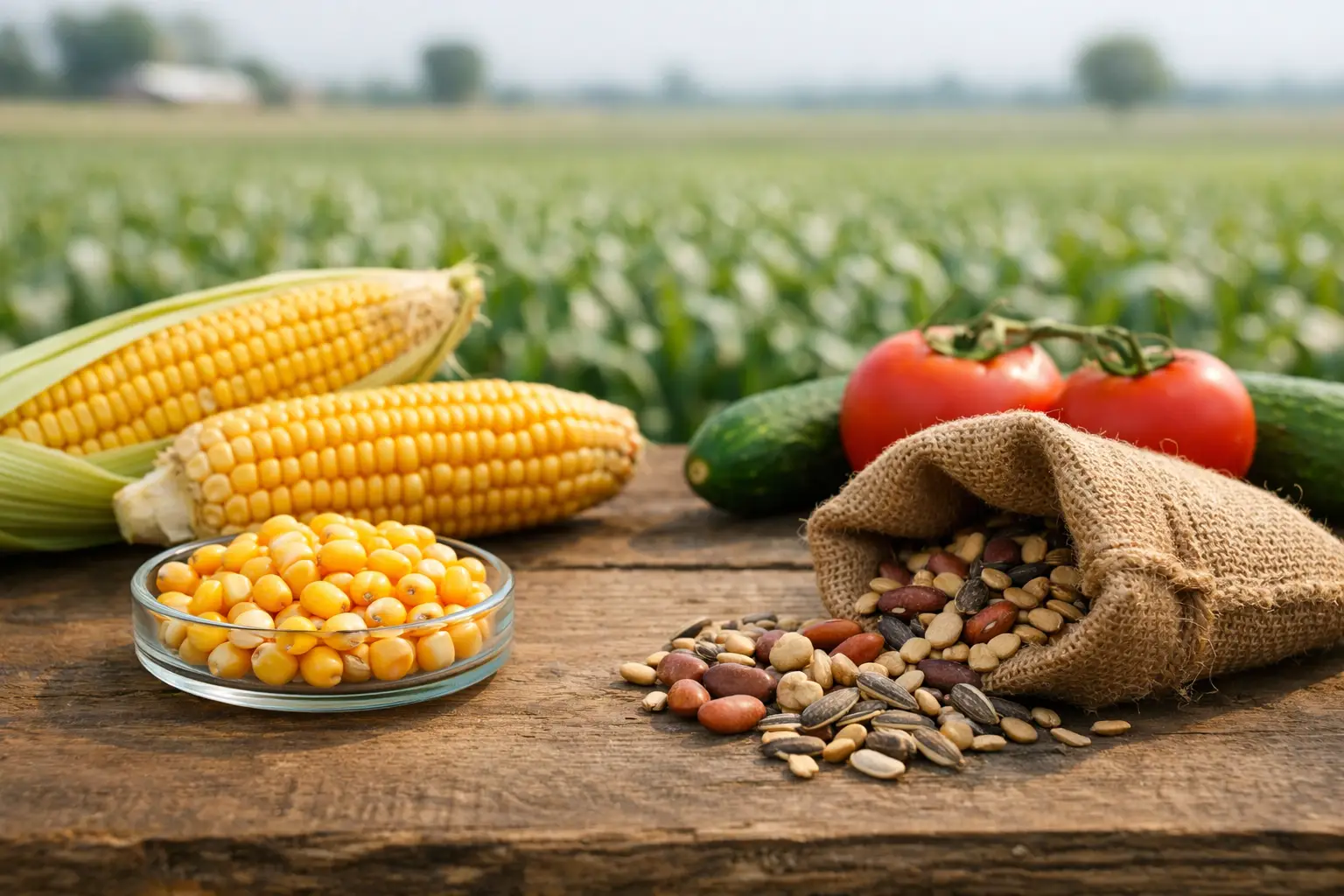
Open-pollinated, often shortened to OP, seed comes from plants pollinated naturally by wind, insects, or other natural processes. When an open-pollinated variety is properly isolated from compatible varieties, seed saved from healthy, true-to-type plants can generally be replanted and will produce plants similar to the parent crop.
This does not mean every open-pollinated variety is a heritage or heirloom variety. Heirlooms are generally older, publicly maintained open-pollinated varieties with cultural or regional value. Many modern open-pollinated varieties have also been bred for improved disease tolerance, yield, or production reliability.
| Factor | Hybrid Seeds | Open-Pollinated Seeds | |—|—|—| | Genetic makeup | Controlled cross between parent lines | Naturally pollinated stable variety | | Crop uniformity | Usually very high | More natural variation within the crop | | Seed saving | Not recommended for consistent commercial results | Possible when isolation and selection are managed well | | First-season performance | Often strong vigor and predictable traits | Depends heavily on variety and local adaptation | | Seed price | Commonly higher | Often lower, though specialty varieties can cost more | | Best fit | Uniform commercial production and specific trait needs | Seed sovereignty, local adaptation, specialty markets |
Why Hybrid Seed Often Leads Commercial Programs
Hybrids are widely used in vegetables, corn, field crops, and many protected-culture systems because consistency has direct commercial value. A buyer supplying supermarkets, processors, or export channels may need crops that mature within a narrow window and meet defined specifications for size, shape, color, and shelf life.
A well-matched hybrid can support that goal. Hybrid vigor, also called heterosis, can produce stronger early growth, more uniform stands, and improved yield potential. Breeders can also combine resistance packages that help growers manage common diseases, although resistance is never a substitute for crop rotation, sanitation, irrigation management, and scouting.
The practical advantages of hybrids
The value of a hybrid is not limited to yield per acre. It can improve operational planning across the farm and supply chain. A uniform crop is easier to schedule for irrigation, harvest, grading, packing, and delivery. For growers selling into formal retail or processing channels, that predictability can reduce rejected product and simplify labor planning.
Hybrid varieties may be a strong choice when a business needs:
- Consistent maturity for mechanized or concentrated harvests
- A specific disease-resistance package for a known production risk
- Uniform produce for packing, retail, or processing specifications
- High output from limited land, greenhouse space, or labor
- Reliable performance from purchased seed each season
The trade-off is cost and dependence on annual seed purchases. Hybrid seed production is technically demanding because parent lines must be maintained and crosses controlled. That work is reflected in the price. Buyers should compare cost per acre, not only cost per packet or pound, because germination rate, seed treatment, plant population, yield potential, and marketable packout all affect the real return.
The Business Case for Open-Pollinated Seed
Open-pollinated varieties offer a different form of value. Their genetic diversity can create more visible variation in plant height, maturity, shape, or yield. That can be a drawback for a standardized wholesale program, but it can be useful where flavor, local adaptation, seed saving, and varietal identity matter more than visual uniformity.
For growers who save seed, open-pollinated varieties can reduce future reliance on purchased seed. However, seed saving is not a zero-cost practice. It requires knowledge, isolation distances, careful selection, harvest timing, drying, storage, labeling, and germination testing. Cross-pollinated crops such as corn, squash, brassicas, and many onions need particular attention to prevent unwanted crossing.
Where open-pollinated varieties can perform well
Open-pollinated seed may be commercially attractive for diversified vegetable farms, regional brands, seed producers, restoration projects, and growers serving farmers markets or specialty food buyers. Some varieties have been selected over generations in a particular climate or production region, making them valuable candidates for farms facing local heat, drought, soil, or pest pressures.
The key is to avoid assuming that open-pollinated always means lower yielding or less reliable. Performance varies by crop and variety. A proven OP variety grown in conditions where it is well adapted may outperform an expensive hybrid that was selected for a different climate, disease complex, or market system.
Compare More Than the Seed Price
A seed catalog description is useful, but it is not a production plan. Before making a large purchase, compare varieties using local trial data when available and test promising options on a smaller acreage. This is especially important when sourcing seed across regions, because performance claims may be based on different day length, temperature, disease pressure, irrigation quality, or soil type.
| Purchasing Question | Why It Matters | |—|—| | What market will receive the crop? | Fresh retail, processing, export, and direct sales value different traits. | | Is seed saving part of the operation? | This immediately favors stable OP varieties over F1 hybrids. | | Which diseases are common locally? | Match resistance claims to verified field risks, not general marketing language. | | What level of uniformity is required? | Grading, packaging, contract terms, and mechanization can make uniformity essential. | | Is the supplier dependable? | Lot traceability, germination standards, delivery timing, and technical support affect crop risk. | | Are treated seeds acceptable? | Seed treatment rules and buyer preferences vary by crop, market, and production system. |
For importers and distributors, supplier evaluation should include more than variety names. Ask for the seed lot number, test date, germination percentage, purity information, treatment status, country of origin where relevant, and available phytosanitary or regulatory documentation. Commercial buyers should also confirm packaging sizes, storage requirements, minimum order quantities, lead times, and replacement procedures for quality claims.
Hybrid Does Not Mean GMO
Hybrid seed and genetically modified seed are different categories. A hybrid is made through controlled breeding between compatible parent plants. Genetic modification involves biotechnology methods that alter or introduce genetic material in ways not achieved through conventional crossing alone.
Some buyers incorrectly use “hybrid” and “GMO” interchangeably, which can create confusion in procurement and customer communication. A hybrid can be non-GMO, and many widely used vegetable hybrids are produced through conventional breeding. If a market has non-GMO, organic, export, or labeling requirements, buyers should request clear documentation from suppliers rather than relying on assumptions.
Organic production also requires careful seed sourcing. Hybrid varieties can be used in organic systems when they meet applicable certification requirements. Open-pollinated does not automatically mean organic, and hybrid does not automatically disqualify a seed from organic production. The production and certification status of the seed must be verified separately.
A Smarter Seed Sourcing Strategy
The most resilient farms do not treat the choice as all-or-nothing. A vegetable operation might use hybrids for its core revenue crops, where uniformity and disease resistance protect contracted sales, while reserving open-pollinated varieties for specialty lines, local adaptation trials, or seed-saving programs.
Start with the commercial outcome you need: reliable processing volume, premium fresh-market quality, lower annual seed dependence, climate adaptation, or differentiated produce. Then build a variety trial around that outcome. Record emergence, vigor, disease incidence, harvest dates, labor hours, marketable yield, customer feedback, and actual revenue. A variety that looks good in the field but creates sorting losses or misses a delivery window may not be the best commercial choice.
For businesses sourcing internationally, a specialized agriculture marketplace such as Agricial can help shorten the search for seed suppliers, related crop-input providers, and technical partners. The final decision should still rest on verified product data, trial performance, and clear commercial terms.
The right seed is the one that supports the next sale as confidently as it supports the next crop. Buy with the market, the field, and the following season in mind.