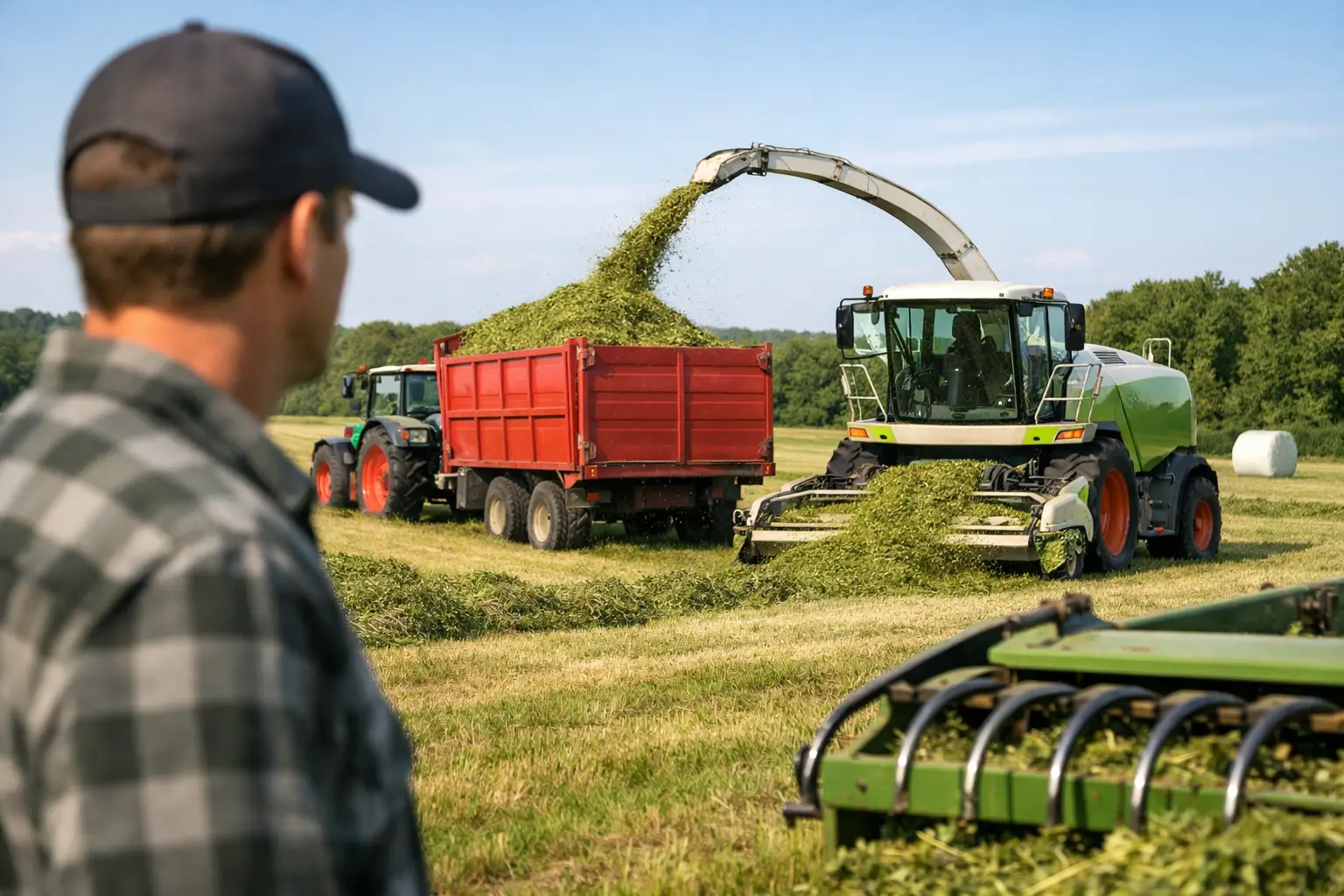
How to Choose Silage Equipment for Your Farm
A silage system can either protect the value of your forage or quietly drain it through field losses, slow harvest, spoilage, and costly downtime. Knowing how to choose silage equipment starts with the crop and ends with the feed face: every machine must work at the speed, scale, and storage method your operation can manage.
For commercial dairy, beef, and custom-harvest operations, the right purchase is rarely the machine with the highest capacity on paper. It is the machine that keeps forage moving during the right harvest window, produces the chop quality your ration requires, and has dependable parts and service support when timing matters most.
Start With Your Silage System, Not the Machine
Before comparing brands, map the full process from standing crop to feedout. Corn silage, haylage, sorghum, small-grain silage, and high-moisture grain can require different cutting, conditioning, processing, packing, and feeding approaches. A forage harvester that performs well in corn may need a different header, kernel processor setting, or crop-flow setup for alfalfa.
Your storage method also changes the equipment decision. A bunker or drive-over pile requires sufficient packing capacity and a coordinated unloading plan. A bagging system shifts the investment toward a bagger and suitable transport equipment. Wrapped bales offer flexibility for smaller lots and varied forage quality, but add handling and plastic costs.
Define the Operational Questions First
A useful equipment plan should answer these questions before you request quotes:
- How many tons or acres must be harvested each day during the target harvest window?
- Which crops will move through the system, and how often will you switch between them?
- Will forage be stored in a bunker, pile, bag, tower silo, or wrapped bale format?
- How far must chopped material travel from field to storage?
- How many trained operators, trucks, tractors, and packing machines are available?
- What local dealer can supply parts, knives, bearings, belts, and field service quickly?
This process prevents a common and expensive mistake: buying a high-capacity harvester while underestimating the wagons, trucks, packing tractors, or labor needed to keep it productive.
Match Capacity to Harvest Window
Capacity is the central calculation when choosing silage equipment. Crops do not wait for staffing gaps or mechanical repairs. If corn silage reaches the correct whole-plant moisture and the operation cannot harvest it promptly, feed quality and storage performance can suffer.
Estimate your required daily throughput by dividing expected crop volume by the number of realistic harvest days. Then allow room for weather interruptions, field distance, refueling, maintenance, and slower conditions in lodged or uneven crops. Avoid sizing equipment based only on ideal field capacity.
| Operation profile | Typical equipment approach | Main advantage | Watch-out | |—|—|—|—| | Small livestock farm | Pull-type forage harvester, wagons, bagger or bale wrapper | Lower initial investment and flexible ownership | Labor demand can be high during peak harvest | | Mid-sized dairy or beef operation | Self-propelled harvester or larger pull-type unit, multiple haul units, bunker packing tractor | Better harvest speed and crop quality control | Requires coordinated operators and maintenance planning | | Large commercial or custom operation | High-capacity self-propelled harvester, dedicated haul fleet, multiple packing units | High daily tonnage and fast response to crop maturity | Large capital commitment and high downtime cost |
A larger machine is not automatically the more profitable choice. If transport cannot clear the field fast enough, the harvester will sit idle. If the packing team cannot spread and compact incoming loads, the storage pile may develop poor density and spoilage risk. Capacity must be balanced across the entire chain.
Choose the Right Core Silage Equipment
Most silage systems include harvesting, transport, storage, packing, and feedout equipment. The exact mix depends on acreage, crop type, and how feed is managed after fermentation.
Harvesters and Headers
Pull-type forage harvesters can be a practical fit for farms with modest acreage, available tractor power, and a workable harvest schedule. They cost less than self-propelled machines but may have lower output, especially in heavy corn silage or long haul conditions.
Self-propelled forage harvesters deliver speed, operator visibility, and broad header options. They are often justified where crop volume is high, harvest windows are tight, or custom work creates enough annual utilization. Review horsepower, crop-flow design, knife sharpening, header compatibility, and dealer support rather than comparing engine power alone.
For corn silage, confirm whether a kernel processor is required for your ration and chop-length targets. Proper kernel processing can improve starch availability, but it also adds cost, maintenance, and setup requirements. For haylage, look closely at pickup performance, crop conditioning needs, and the machine’s ability to maintain a consistent chop in variable windrows.
Hauling Equipment
Forage wagons, dump trailers, and trucks each have a place. Wagons are common where field-to-bunker distances are short and tractor availability is strong. Trucks can improve road speed over longer hauls, while dump trailers may suit operations moving material between fields or storage sites.
The best choice depends on travel distance, road access, loading speed, local regulations, and unloading conditions. A transport unit with impressive volume is not useful if it cannot unload smoothly at the pile or safely operate on wet ground.
Packing and Storage Equipment
Silage density is built during storage, not after the pile is covered. Packing tractors need enough weight, traction, blade capacity, and operator time to spread forage in thin layers and compact it consistently. In a high-output system, one packing tractor may not be enough.
Bunkers and piles generally need a reliable blade tractor, suitable tires, and a clear traffic plan. Bagging systems require a compatible bagger, plastic supply, and disciplined loading to prevent uneven filling. Wrapped bale systems require a baler, wrapper, handling attachments, and protected storage for wrapped bales.
| Storage method | Best fit | Equipment priorities | Trade-off | |—|—|—|—| | Bunker or drive-over pile | Larger daily forage volumes | Packing tractors, blades, covers, safe traffic flow | Requires strong packing discipline and surface management | | Silage bags | Segregating crops, fields, or forage lots | Bagger, loader or haul units, quality bags | Ongoing bag cost and puncture management | | Wrapped bales | Smaller herds or multiple forage lots | Baler, wrapper, bale handler | More labor and plastic per ton | | Tower silo | Farms with existing infrastructure and specialized use | Blower or conveyor system, unloaders | Higher infrastructure and maintenance complexity |
Evaluate Chop Quality and Feed Goals
Equipment should support the ration, not just harvest the crop quickly. Chop length affects packing, fiber effectiveness, sorting behavior, and feedout handling. Kernel processing, knife condition, processor roll gap, and crop moisture all influence the final result.
Work with your nutritionist, agronomist, or forage consultant to set practical targets for the crops you grow. Then ask suppliers how their equipment maintains those targets in real field conditions. Demonstrations are valuable because they reveal crop flow, fuel use, operator comfort, unloading speed, and the quality of the harvested material.
Do not overlook feedout equipment. A facer, defacer, shear grab, mixer, or feed wagon should remove silage cleanly without loosening large areas of the face. Poor feedout management can expose forage to air and create losses even when the crop was harvested and packed well.
Compare Total Cost, Not Purchase Price
The lowest purchase price can become the highest operating cost if a machine has limited local support, poor parts availability, or excessive fuel and maintenance needs. Compare ownership on a cost-per-ton basis over expected annual use.
Include the initial price, financing, fuel, labor, consumables, routine service, wear parts, insurance, resale value, and likely downtime exposure. For imported equipment, confirm parts lead times, warranty coverage, operator training, and whether technicians are available in your region.
New equipment may offer efficiency, warranty protection, and modern crop-processing features. Used equipment can improve cash flow, particularly for farms with lower annual tonnage. However, inspect used harvesters carefully for cutterhead wear, gearbox condition, hydraulic leaks, processor roll condition, electronics, and maintenance records. A pre-purchase inspection from a qualified technician is money well spent.
Source Suppliers With Service in Mind
For a system that may run only a few intense weeks each year, support quality matters as much as machine specifications. Ask suppliers how quickly they can provide emergency parts during harvest, whether they stock common wear items, and who performs field service after hours.
When comparing suppliers through an agriculture-focused marketplace such as Agricial, request like-for-like quotes. Share your crop types, annual tonnage, storage setup, tractor fleet, transport distance, and service location. This gives suppliers enough context to recommend compatible equipment instead of offering a generic model.
Ask for references from farms with similar acreage and storage methods. Their experience can reveal whether stated capacity holds up in heavy crops, whether parts arrive on time, and how the supplier responds when a critical machine stops.
Make the Final Decision Around Bottlenecks
The best silage equipment purchase removes the bottleneck that is costing your operation the most. That may be faster harvest capacity, more reliable hauling, heavier packing, cleaner feedout, or stronger local service. Buying equipment as a connected system protects forage quality, labor efficiency, and the value of every acre you grow.
A well-matched silage line gives your business more than machinery. It gives you the confidence to harvest at the right moment, preserve more feed, and make each ton of forage work harder for the operation.