How to Calculate Irrigation Flow for Your Farm
A pump rated for 80 gallons per minute can still leave a field under-watered if the pipe, filters, elevation, and sprinkler zones are not matched to that capacity. Knowing how to calculate irrigation flow gives growers and irrigation buyers a practical way to size systems, compare supplier specifications, and avoid paying for equipment that cannot deliver the required water where it is needed.
For a commercial operation, flow is not just a technical number. It affects crop uniformity, pumping costs, labor scheduling, system expansion, and the return on every irrigation investment.
What Irrigation Flow Means
Irrigation flow is the volume of water moving through a system during a set period. In the United States, it is usually measured in gallons per minute (GPM). Larger agricultural systems may also use gallons per hour, acre-inches, cubic feet per second, or gallons per day.
Flow rate is different from pressure. Flow tells you how much water is available. Pressure, measured in pounds per square inch (PSI), tells you the force available to push that water through pipe, emitters, sprinklers, filters, and elevation changes. A system needs both adequate flow and adequate pressure.
A pump may produce a strong flow at low pressure, for example, but fail to operate a sprinkler package that needs 50 PSI at the sprinkler head. Always review pump curves and system requirements together.
How to Calculate Irrigation Flow: The Core Formula
The most useful field formula begins with the amount of water a crop or irrigation zone needs:
Flow (GPM) = Gallons required ÷ Irrigation time in minutes
To find the gallons required, use:
Gallons required = Area in square feet × Water depth in inches × 0.623
The factor 0.623 converts one inch of water over one square foot into gallons.
Example: Calculating Flow for One Irrigation Zone
Assume a 2-acre vegetable block needs 0.5 inch of water during an irrigation event and must be completed within 8 hours.
Two acres equal 87,120 square feet. The required water volume is:
87,120 × 0.5 × 0.623 = 27,127 gallons
Eight hours equal 480 minutes. The flow requirement is:
27,127 ÷ 480 = 56.5 GPM
This zone needs approximately 57 GPM delivered at the operating pressure required by its drip tape or sprinklers. In practice, allow a design margin for filter cleaning, pressure variation, minor leaks, and future changes. A 10% to 20% margin is common, but the right allowance depends on the site and equipment.
Start With Crop Water Demand
Before selecting a pump or pipe diameter, establish the irrigation depth and schedule. Crop demand changes by crop type, plant stage, weather, soil texture, and production method. Sandy soil often requires shorter, more frequent cycles because it stores less available water than loam or clay soil.
For planning purposes, many operators work from evapotranspiration data, known as ET. ET estimates water lost through evaporation and plant transpiration. Crop coefficients then adjust the reference ET for a specific crop and growth stage.
The practical question is simple: how many inches of water must the irrigation system replace each week, and how much of that amount will be applied in each set? Rainfall, irrigation efficiency, and usable root-zone moisture all affect the answer.
Calculate Flow From Emitters or Sprinklers
When designing or checking a zone, calculate the combined demand of all active outlets. This is often the fastest way to verify whether a pump can support the zone.
Drip Irrigation Flow Calculation
For drip systems, multiply the number of emitters by each emitter’s rated flow:
Zone flow = Number of emitters × Emitter flow rate
If 4,000 emitters each discharge 0.5 gallons per hour, the zone demand is 2,000 gallons per hour. Divide by 60:
2,000 ÷ 60 = 33.3 GPM
This calculation assumes each emitter is operating within its specified pressure range. Non-pressure-compensating drip tape can discharge unevenly on long runs, slopes, or poorly regulated systems. Pressure-compensating emitters cost more but can improve uniformity where terrain or row length creates significant pressure variation.
Sprinkler Irrigation Flow Calculation
For sprinklers, multiply the number of operating heads by the nozzle flow listed in the manufacturer specifications:
Zone flow = Number of sprinklers × GPM per sprinkler
If 18 sprinklers use 4.2 GPM each, total zone demand is 75.6 GPM. The pump must provide at least that flow at the pressure required at the sprinkler, plus enough pressure to overcome friction losses, filters, valves, and elevation.
| Irrigation method | Typical flow calculation | Key design concern | |—|—|—| | Drip tape | Emitters × gallons per hour | Pressure variation along laterals | | Micro-sprinklers | Heads × GPM per head | Filtration and nozzle clogging | | Solid-set sprinklers | Heads × nozzle GPM | Pressure at the farthest head | | Center pivot | Total package flow | Pump pressure and elevation | | Traveling gun | Nozzle GPM | High pressure and friction loss |
Account for Pipe Loss, Elevation, and Pressure
A flow calculation based only on emitters is incomplete. Water loses pressure as it travels through pipe, fittings, valves, filters, meters, and backflow devices. This is called friction loss. Smaller pipes, longer runs, rough pipe interiors, high flow velocity, and numerous fittings all increase it.
Elevation also matters. Raising water uphill requires pressure. A useful rule is that every 2.31 feet of elevation gain requires roughly 1 PSI. If the highest part of a field is 46 feet above the pump, the system needs about 20 PSI just to reach that elevation, before friction losses or emitter operating pressure are added.
Use total dynamic head, or TDH, when selecting a pump. TDH combines static lift, elevation change, friction loss, and the pressure needed at the application device. Pump suppliers should be able to provide a pump curve showing the GPM available at different head levels. Compare the calculated duty point to that curve, not just the pump’s maximum advertised GPM.
Measure Existing Irrigation Flow in the Field
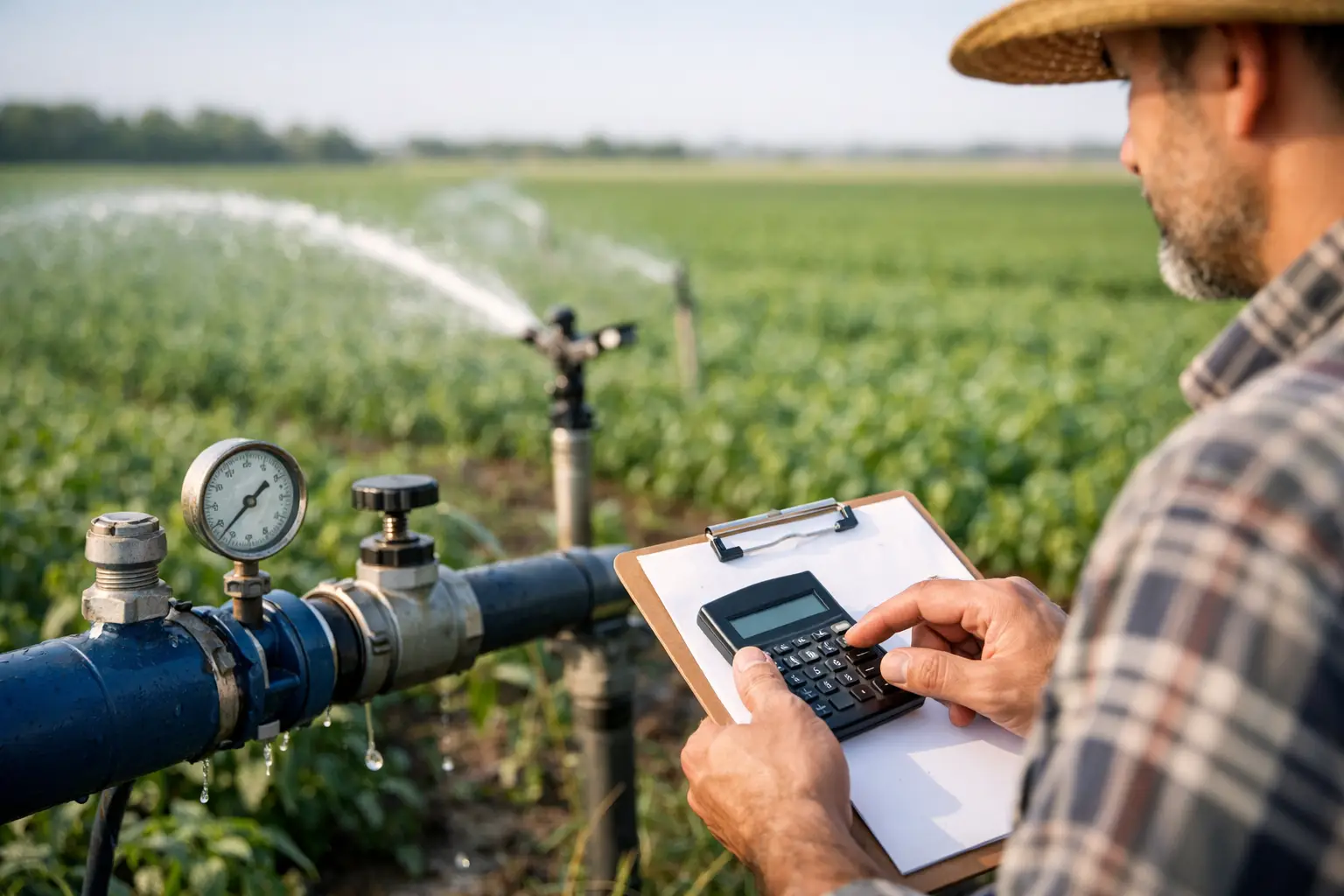
If a system already exists, field measurement can reveal whether actual performance matches the design. The most reliable option is a properly sized flow meter installed in the mainline. It provides ongoing data for scheduling, leak detection, and pump performance checks.
For smaller systems, a timed container test can provide a useful estimate. Fill a container with a known volume and record the time in seconds. Then calculate:
GPM = Container gallons × 60 ÷ Fill time in seconds
For example, if a 5-gallon container fills in 12 seconds, the flow is 25 GPM. Repeat the test several times, especially at different points in the system. A single test near the pump may not reflect the flow available at the far end of a zone.
Pressure gauges should be placed near the pump discharge and at the far end of representative zones. Comparing these readings helps identify excessive friction loss, blocked filters, undersized pipe, failing pressure regulators, or partially closed valves.
Size Zones to Match Available Capacity
When the water source cannot meet total demand at once, divide the field into irrigation zones. Each zone should stay within the available pump flow and pressure while allowing the farm to complete its schedule during the available pumping window.
For example, a well and pump delivering 60 GPM may not operate a 90 GPM sprinkler zone. The practical solution may be two 45 GPM zones, operated separately. This increases valve control and irrigation time, but it may be less expensive than installing a larger pump, mainline, electrical service, or filtration system.
| Decision | Benefit | Trade-off | |—|—|—| | Larger pump and mainline | Fewer, faster irrigation sets | Higher capital and energy cost | | More irrigation zones | Works with limited water supply | More valves, controls, and run time | | Larger pipe diameter | Lower friction loss and energy use | Higher material cost | | Pressure-compensating drip | Better uniformity on uneven land | Higher emitter cost |
Common Errors That Distort Flow Calculations
Several mistakes repeatedly cause underperforming irrigation systems. First, using pump nameplate capacity instead of the flow available at the required TDH can lead to major shortfalls. Second, ignoring filter pressure loss is especially risky in drip and micro-irrigation systems, where filtration is essential and filters become more restrictive as they load with debris.
Third, designing from average pressure rather than pressure at the farthest outlet can produce uneven application. Finally, do not assume that a larger pump automatically solves a water-delivery problem. Excessive velocity can increase friction losses, damage fittings, and create pressure spikes. The objective is a balanced system, not simply the highest possible flow.
Turn Flow Data Into Better Buying Decisions
Before requesting quotes from irrigation suppliers, prepare a clear specification: water source capacity, target GPM, required operating PSI, elevation difference, pipe distances and diameters, filtration needs, irrigation method, and planned operating hours. This lets suppliers quote comparable equipment instead of offering oversized or incomplete packages.
Agricial helps agricultural businesses compare irrigation equipment and connect with suppliers across markets, but the strongest inquiry starts with accurate field data. A well-defined flow requirement makes it easier to evaluate pumps, drip systems, filters, valves, and automation controls on performance as well as price.
The right irrigation flow calculation turns water from a variable expense into a managed production input. Measure the field, calculate the zone demand, verify pressure at the farthest point, and buy equipment for the duty it must actually perform.