
Hard Red Winter Wheat Faces Severe Losses in 2026
The U.S. hard red winter wheat crop is rapidly declining due to widespread drought and recent freeze events. Experts warn production losses could rival the devastating 2023 season.
Crop Conditions Decline Across Key Growing Regions
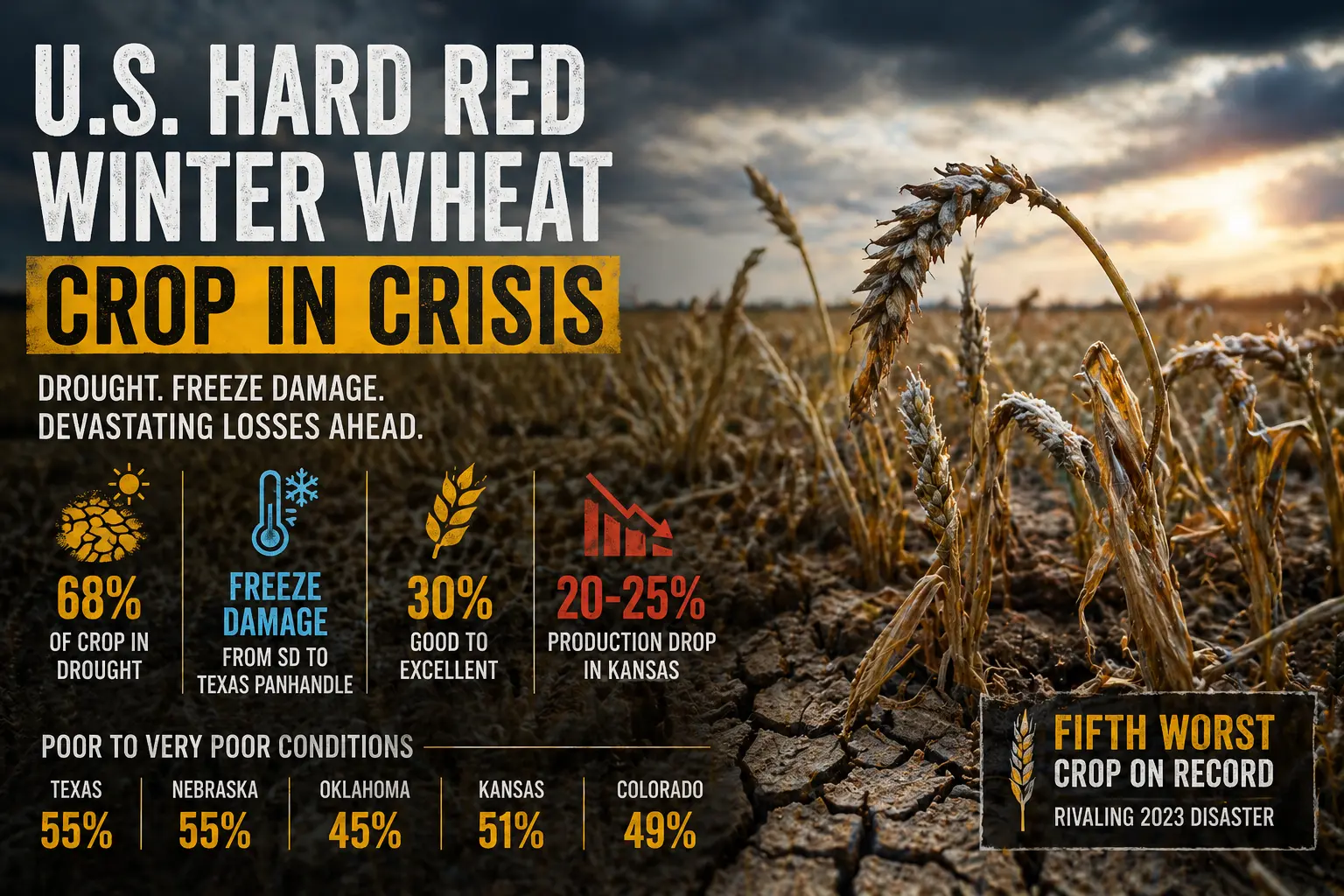
The U.S. hard red winter (HRW) wheat crop is slipping toward one of its weakest performances in decades, as drought stress and extreme weather continue to erode crop health. According to the latest USDA data, only 30% of the crop is rated in good to excellent condition, a decline of four percentage points from the previous week. Meanwhile, 33% falls into the poor to very poor category.
This sharp deterioration places the current crop among the five worst on record, raising concerns across major wheat-producing states.
Key Figures Snapshot
| Indicator | Current Status |
|---|---|
| Good-to-Excellent Rating | 30% |
| Poor-to-Very Poor Rating | 33% |
| Crop Under Drought Conditions | 68% |
| Estimated Kansas Production Drop | 20%–25% |
Drought Emerges as the Dominant Threat
The primary driver behind the declining crop is widespread drought, now affecting 68% of HRW wheat acreage. The Southern Plains—particularly Kansas, Oklahoma, Texas, Colorado, and Nebraska—are bearing the brunt of these dry conditions.
Early optimism surrounded the crop when it was planted in the fall, as initial establishment appeared strong. However, the absence of consistent rainfall has reversed those expectations.
In fact, when isolating hard red winter wheat from other wheat classes, the situation appears even more severe. Estimates suggest that less than 15% of HRW wheat is in good-to-excellent condition in the most affected regions—levels comparable to the drought-stricken 2023 crop.
Freeze Event Adds Further Damage
Compounding the drought stress, a recent freeze event swept across major wheat areas, stretching from South Dakota down to the Texas Panhandle. Temperatures plunged into the teens and 20s across parts of Nebraska, northeastern Colorado, and northwestern Kansas.
These regions had already experienced extreme cold earlier in the season, including subzero temperatures without protective snow cover. This combination has heightened concerns about irreversible crop damage.
Importantly, current crop condition ratings do not yet reflect the full impact of this freeze, suggesting further declines may appear in upcoming reports.
Extreme Temperature Swings Stress Crops
Beyond isolated freeze events, erratic temperature fluctuations have placed additional strain on wheat development. Fields have experienced repeated swings between high temperatures—reaching the 80s and 90s—and sudden returns to freezing conditions.
Such instability disrupts plant growth cycles and weakens crop resilience. Without adequate moisture to support recovery, the wheat is left increasingly vulnerable.
Rainfall Outlook Offers Limited Hope
Weather forecasts indicate that rainfall could arrive within the next 6 to 10 days, bringing some relief to parts of Nebraska, northern Kansas, and northeastern Colorado. However, timing is becoming a critical issue.
Much of the HRW crop is already ahead of its normal development stage. As the crop approaches its reproductive phase, late-arriving moisture may not be sufficient to reverse earlier damage.
Rising Risk of Abandoned Acreage
State-level data shows a significant share of wheat already rated in poor to very poor condition:
- Texas: 55%
- Nebraska: 55%
- Oklahoma: 45%
- Kansas: 51%
- Colorado: 49%
These figures point toward a likely increase in abandoned acreage. In Kansas, the largest HRW wheat producer in the country, abandonment could rise well above historical norms.
Typically, Kansas sees about 5% to 6% of wheat acres abandoned. This season, estimates suggest that figure could climb to between 10% and 15%, depending on how conditions evolve and how farmers assess damage in the coming weeks.
For comparison, during the disastrous 2023 season, roughly 30% of acres in Kansas went unharvested.
Production and Yield Outlook Turns Negative
Yield expectations are also trending downward across the HRW wheat belt. In Kansas alone, total production is projected to fall significantly compared to last year.
Current estimates indicate a decline of approximately 20% to 25%, driven by a combination of reduced acreage, poor crop conditions, and weather-related damage.
A Season on the Brink
Taken together, drought, freeze damage, and extreme weather variability are pushing the 2026 hard red winter wheat crop toward a near-crisis scenario.
While upcoming rainfall may provide limited relief, the overall outlook remains weak. With large portions of the crop already compromised and abandonment likely to rise, the season is shaping up to closely mirror the severe losses experienced in 2023.