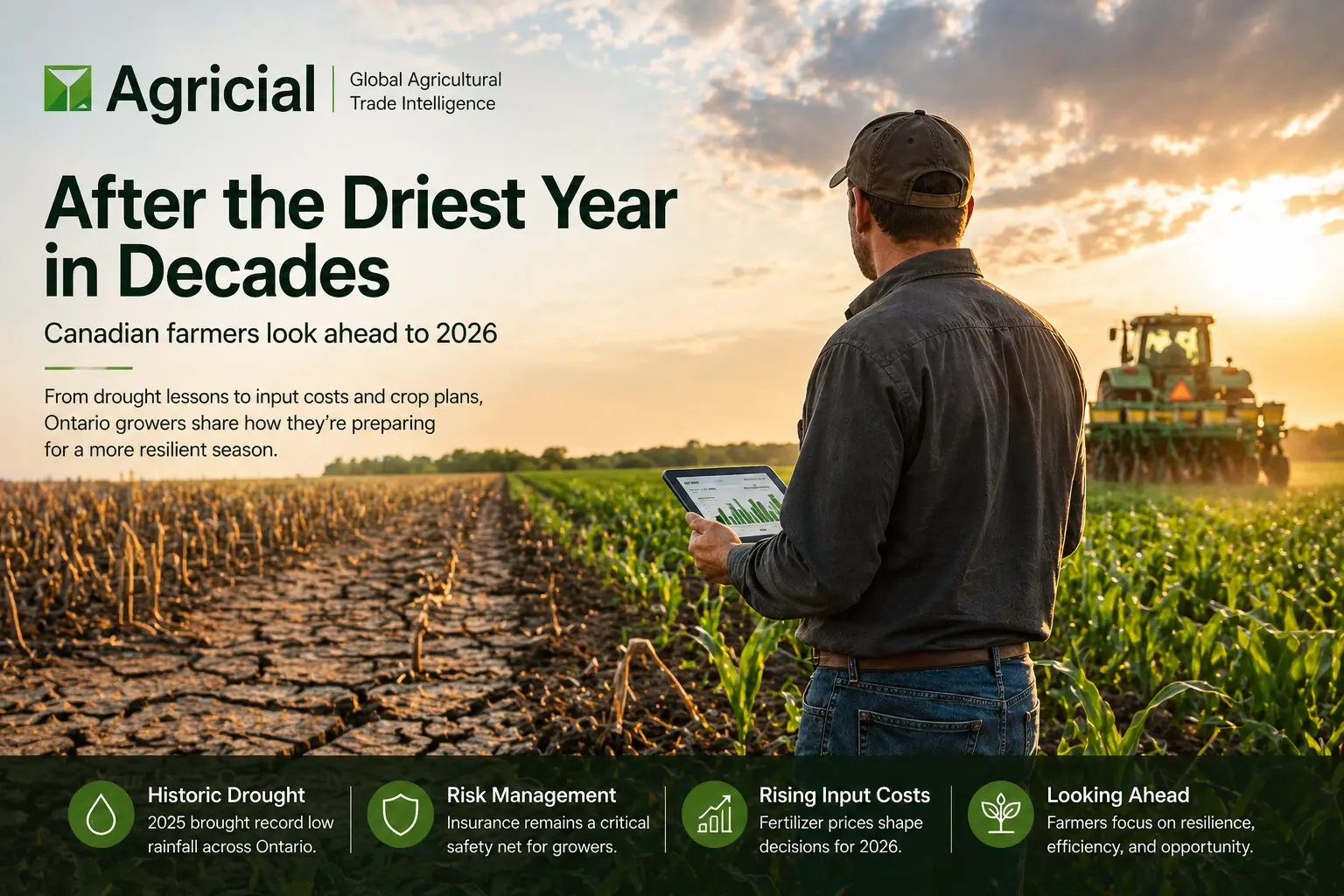
Canadian Farmers Reset After Historic 2025 Drought
After one of the driest seasons in decades, Ontario farmers are rethinking risk, inputs, and crop strategies. Hopes for 2026 hinge on normal rainfall and tighter cost control.
A Season That Tested Limits
Farmers across Ontario are entering the 2026 planting season with cautious optimism after enduring one of the harshest growing years in recent memory. In 2025, extreme heat combined with the lowest midsummer rainfall in decades left crops under severe stress.
Tim Webster, a sixth-generation farmer based near Lindsay, described the season as nearly catastrophic. Rainfall during July and August hit a 50-year low in his area, cutting corn and soybean yields to roughly half their usual levels. Despite just enough moisture to carry crops through to harvest, the financial impact was significant.
Steve Crothers, who farms along the northern shore of Lake Ontario east of Toronto, reported slightly better results—but still far below expectations. With over 40 years of farming experience, he called 2025 the driest season he has ever seen.
Key Impacts of the 2025 Drought
| Factor | Impact on Farms | Outcome |
|---|---|---|
| Rainfall | Lowest in 50 years (July–August) | Severe crop stress |
| Crop Yields | Corn & soybeans reduced significantly | ~50% (Webster), ~75% (Crothers) |
| Temperature | Above-normal heat | Accelerated crop stress |
| Financial Performance | Reduced farm income | Increased economic pressure |
Rethinking Risk After a Difficult Year
The drought forced farmers to confront how quickly yield potential can collapse under extreme weather. Both Webster and Crothers acknowledged that last year reshaped their expectations and planning approach.
While hoping for a return to more typical growing conditions, they are also preparing for continued volatility. Financial pressure from the previous season has made risk management a top priority heading into 2026.
Crop Insurance Gains Importance
One of the biggest takeaways from 2025 has been the value of crop insurance. Compared with the United States, where farmers often rely on layered insurance programs, Canadian producers operate within provincial systems that vary in coverage and participation.
Webster noted that although insurance helped offset losses, many farmers now feel they may have underinsured their crops.
Crothers highlighted that specialty crops—such as edible white beans and adzuki beans—are also covered under similar insurance programs, though at higher premium rates due to their market value.
These crops are largely grown for export:
- White beans are primarily shipped to the United Kingdom
- Adzuki beans are exported to Japan
This reliance on international markets increases exposure to both weather risks and market fluctuations, making insurance a critical safeguard.
Fertilizer Costs Add New Pressure
Beyond weather, rising input costs—especially fertilizers—are shaping decisions for the 2026 season.
Crothers pointed out that many farmers in his region have not prepaid fertilizer, leaving them vulnerable to price increases ahead of planting. Only certain inputs, such as 28% nitrogen solutions, are commonly secured in advance due to past supply challenges.
Webster has taken a more proactive approach:
- Purchased part of his nitrogen supply earlier in the year
- Shifted toward split fertilizer applications
- Reduced reliance on higher-cost, slow-release nitrogen products
For wheat production, he found that controlled-release fertilizers would add an additional $32 per acre compared to standard urea, making them difficult to justify economically.
With rising diesel, fertilizer, and operational costs, even small savings per acre are becoming essential for maintaining profitability.
Crop Planning: Stability vs. Adjustment
Despite the challenges, both farmers expect crop rotations in their region to remain largely stable. Corn, soybeans, and wheat continue to form the backbone of Ontario’s cropping systems.
Webster plans to maintain his existing rotation strategy, supported by a grain marketing approach that spreads sales over time to manage financial risk.
However, not all growers are taking the same path. Some are shifting acreage away from corn toward soybeans:
- Lower input costs make soybeans less risky
- Profit potential may be lower, but financial exposure is reduced
This cautious recalibration reflects broader uncertainty across the farming community.
Looking Ahead to 2026
As the new season approaches, farmers are balancing optimism with realism. The hope is simple: a return to average rainfall and manageable input costs.
Crothers emphasized that strong yields would help offset rising expenses, but another year like 2025 could put many operations under serious strain.
Both farmers shared their insights during a meeting organized by the Durham Soil and Crop Association, a local group focused on supporting farmers through knowledge sharing, conservation programs, and funding opportunities.
For now, Ontario growers are moving forward with measured adjustments—aiming not just to recover from last year’s losses, but to build greater resilience against whatever the next season may bring.