How to Choose Seed Suppliers for Agriculture
A seed order can shape an entire season before the first machine enters the field. If germination is inconsistent, varietal claims are unclear, or delivery slips past the planting window, the cost shows up fast – in yield, labor, and cash flow. That is why choosing seed suppliers for agriculture is not a routine purchasing task. It is a commercial decision with operational consequences.
For growers, distributors, and procurement teams, the challenge is rarely a lack of options. The real issue is separating dependable suppliers from sellers who look good on paper but create risk in practice. The best supplier is not always the cheapest, the largest, or the closest. It is the one that can consistently match product quality, documentation, timing, and support to your production goals.
What makes seed suppliers for agriculture worth trusting
- Provides full traceability (origin, lot number, testing data)
- Offers consistent quality across multiple orders
- Shares transparent and up-to-date technical documentation
- Clearly explains seed treatment and handling requirements
- Has a proven track record with repeat customers
- Communicates clearly and responds quickly to inquiries
These characteristics form the baseline of a reliable supplier, but in practice, consistency and transparency matter even more when evaluated over time.
A reliable seed supplier does more than ship bags or containers. They provide product consistency, clear technical information, and realistic commercial terms. In agriculture, that matters because seed performance is influenced by genetics, seed treatment quality, storage conditions, and handling before it ever reaches the farm.
Trust usually starts with traceability. A serious supplier should be able to identify seed origin, lot information, test results, and treatment details when relevant. If a supplier cannot explain where the seed came from, how it was tested, or what standards it met, that is not a small gap. It is a warning sign.
Consistency matters just as much as one-time quality. Many buyers have had the experience of receiving a strong first order and a weaker second one. That is why professional buyers look beyond the sample and ask how quality is maintained across lots, seasons, and destinations. A supplier that serves agriculture well should have systems, not just promises.
Start with the crop, market, and production system
The right supplier depends on what you are buying and how you plan to use it. A vegetable seed buyer for greenhouse vegetable production systems has very different needs from a grain producer sourcing open-field seed at scale. Export-oriented farms may need varieties aligned with buyer preferences, processing requirements, or phytosanitary standards. Local distributors may need packaging options and labeling that fit retail channels.
This is where many purchasing decisions go off track. Buyers compare prices across suppliers without first defining the exact technical and commercial requirement. Before you request quotes, be clear about crop type, target variety, maturity window, disease resistance, treatment preference, planting conditions, expected volume, and destination market. That clarity improves supplier comparison and reduces costly misunderstandings.
It also helps to separate must-haves from preferences. For one operation, early vigor may be essential because planting windows are tight. For another, shelf life and packaging format may matter more because seed will be stored and redistributed. The better your specifications, the easier it is to identify suppliers who actually fit the business.
How to evaluate seed quality before you buy
The table below summarizes the key seed quality parameters every buyer should verify before making a purchase:
| Quality Factor | What to Check | Why It Matters |
|---|---|---|
| Germination Rate | Latest lab test results (lot-specific) | Indicates basic viability and emergence potential |
| Seed Purity | Percentage of pure seed vs inert matter | Ensures uniform crop establishment |
| Vigor | Cold test, stress tolerance indicators | Critical for field performance under suboptimal conditions |
| Moisture Content | Storage moisture levels | Affects shelf life and seed stability |
| Genetic Integrity | Variety authenticity documentation | Prevents yield inconsistency and off-types |
| Seed Health | Disease-free certification | Reduces risk of crop contamination |
Seed quality is not one number. It is a combination of purity, germination, vigor, moisture, health status, and genetic integrity. Depending on the crop, additional traits may matter, including uniformity, seed size, pellet quality, or treatment performance.
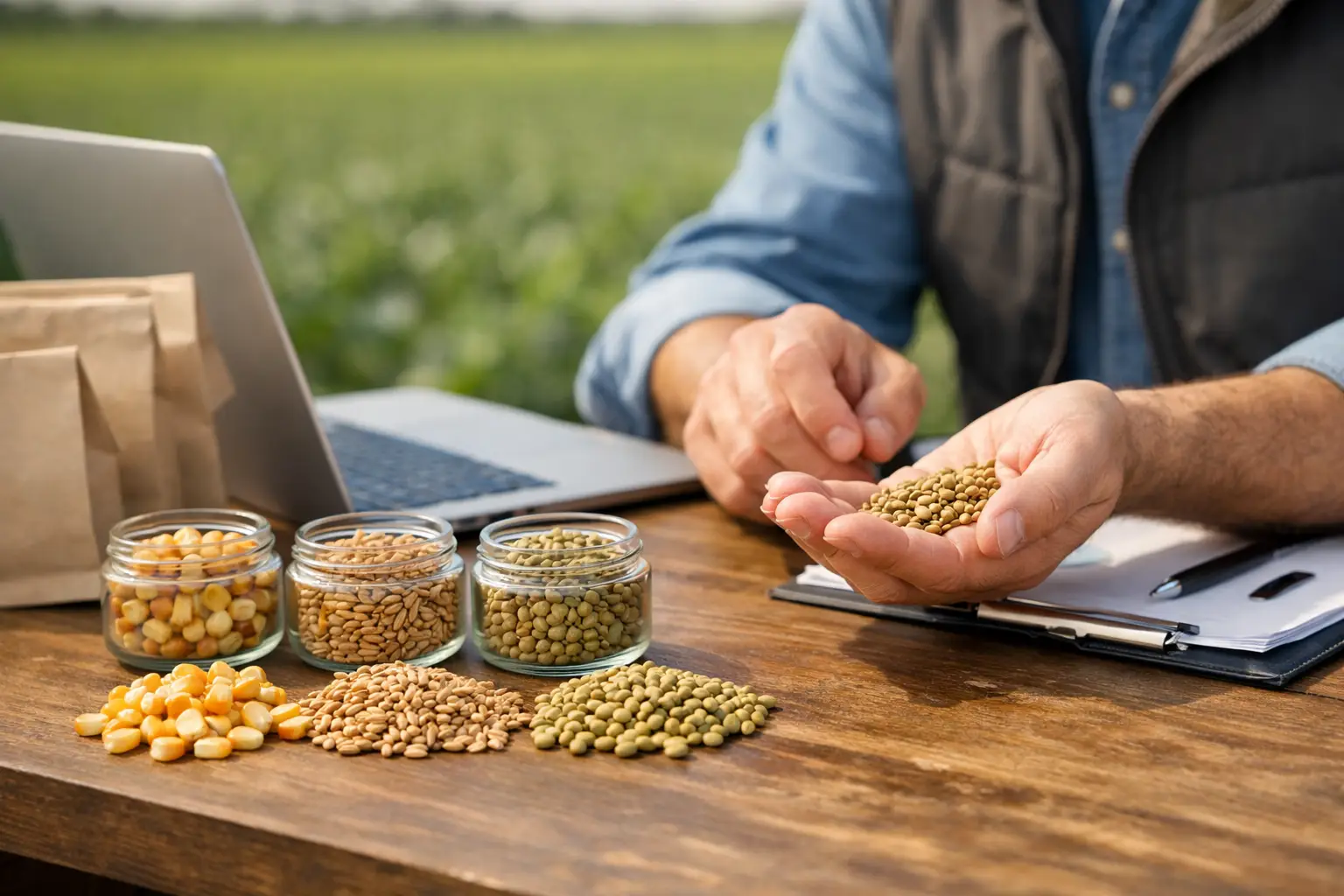
Ask for recent test data and make sure the document is relevant to the lot being offered. A polished catalog is useful for product discovery, but it should never replace technical proof. You want to know whether test methods are current, whether the seed was stored properly, and whether the results match the conditions your operation is likely to face.
There is also a practical trade-off here. A low-cost lot with acceptable lab germination may still underperform if vigor is weak or handling was poor. On the other hand, the highest-priced seed may not deliver enough added value for every farm. The goal is not to pay the most. The goal is to buy seed that performs predictably in your production environment and supports the economics of the crop.
Compliance, certification, and paperwork are part of the product
In domestic and cross-border trade, paperwork can be as important as the seed itself. Depending on the market, you may need phytosanitary certificates, variety registration details, treatment declarations, origin documents, or quality certifications. If those documents are incomplete or delayed, shipments can stall, and planting windows do not wait.
Strong seed suppliers for agriculture understand this. They know the compliance requirements attached to their products and can prepare documentation without confusion. That becomes especially important when you are sourcing internationally or buying for resale.
This is one area where experience matters. A supplier may offer attractive pricing, but if they regularly struggle with export documents, labeling rules, or import requirements, the hidden cost can outweigh the savings. Reliable paperwork reduces friction, protects timelines, and builds confidence across the supply chain.
Delivery performance can matter more than a discount
Seed is highly time-sensitive. A delayed spare part is frustrating. A delayed seed shipment can affect an entire crop cycle. That is why logistics should be part of supplier evaluation from the start, not an afterthought once the quote is accepted.
Ask direct questions about lead times, inventory availability, shipping methods, and contingency plans. If the supplier is importing, learn how they manage customs clearance and local delivery. If they claim year-round availability, ask whether stock is physically held or sourced after the order is placed.
Price still matters, of course. But a lower quote is not always the better deal when delivery reliability is weak. The true cost of seed includes timing, storage condition during transit, packaging integrity, and the supplier’s ability to communicate quickly when conditions change.
Support after the sale separates real partners from simple traders
A seed supplier should be able to support decision-making before purchase and problem-solving after delivery. That does not mean every supplier needs a large agronomy team. It does mean they should understand the product well enough to answer practical questions about use, handling, and expected performance.
This support becomes more valuable when buyers are trialing a new variety, entering a new region, or serving commercial customers who expect answers fast. If a germination issue appears, if a treatment question comes up, or if the delivered lot needs clarification, responsiveness matters.
Good support also improves growth. When suppliers share realistic guidance instead of overpromising, buyers make better decisions and build stronger long-term relationships. In B2B agriculture, that reliability often creates more value than a one-time pricing advantage.
Use comparison wisely when sourcing seed suppliers for agriculture
- Compare suppliers using the same technical specification sheet
- Evaluate total value, not just price
- Consider logistics, documentation, and support together
- Request sample orders before scaling
Comparing suppliers is smart, but only if the comparison is fair. Too often, buyers request several quotes and then compare them as if every offer represents the same product and service level. In reality, there may be major differences in lot quality, treatment type, compliance support, packing format, or delivery terms.
A better approach is to compare suppliers against a fixed requirement sheet. That lets you assess what each one can deliver against the same technical and commercial standard. You can then evaluate total value, not just the headline price.
Digital B2B marketplaces can make this process faster by helping buyers find supplier profiles, review product categories, and request quotes in one place. For businesses that need broader visibility across regions and supplier types, a specialized agriculture platform such as Agricial can reduce search time and make supplier discovery more focused on real sector needs.
Red flags buyers should not ignore
Some warning signs should immediately raise concern during supplier evaluation:
- Unclear or missing seed origin and lot information
- No recent or verifiable test results
- Inconsistent pricing without justification
- Delays in documentation or communication
- Overpromising performance across all conditions
- Pressure for fast payment without clear product details
Some supplier problems show up early if you know what to watch for. Vague answers on origin and testing are one. Inconsistent pricing with no explanation is another. Slow communication, missing documents, and aggressive promises without technical detail usually point to bigger issues later.
Be cautious when a supplier avoids sharing lot-specific information or pushes immediate payment without enough product clarity. The same goes for sellers who claim suitability across every climate, soil type, and production system. Agriculture does not work that way. Credible suppliers are specific about where a product fits and where it may not.
References, repeat business, and market reputation still matter. A newer supplier should not be dismissed automatically, but they should be evaluated with even more care around documentation, trial orders, and communication discipline.
Build supplier relationships, not just transactions
The strongest seed sourcing strategies are not built order by order. They are built through supplier relationships that improve forecasting, product planning, and issue resolution over time. When a supplier understands your crop calendar, quality standards, and volume patterns, procurement gets easier and risk drops.
That does not mean relying on a single source for everything. In many cases, dual sourcing or maintaining backup options is the safer move, especially for large acreage, specialized varieties, or international procurement. The right balance depends on crop risk, supply volatility, and your tolerance for disruption.
A good supplier relationship is commercial, not casual. It should be based on clear expectations, transparent performance, and mutual responsiveness. When that foundation is in place, seed sourcing becomes less reactive and more strategic.
The best time to improve your supplier network is before the next urgent order lands on your desk. Ask better questions, compare with discipline, and choose partners who can deliver more than product. In agriculture, better sourcing decisions have a long reach – from planting confidence to market results.