Center Pivot Versus Drip Irrigation: Which Fits?
A choice between center pivot versus drip irrigation can shape far more than a farm’s water bill. It affects crop selection, labor planning, fertilizer efficiency, field layout, maintenance demands, and the capital required to expand. For commercial growers and irrigation buyers, the right answer is rarely about which system is universally better. It is about matching the equipment to the land, water source, crop value, and operating model.
Center pivots remain a practical workhorse for broad-acre production. Drip irrigation gives growers precise control where each gallon and each acre carries a higher value. Understanding where each system performs best helps farms source equipment with confidence and compare supplier proposals on more than purchase price.
Center Pivot Versus Drip Irrigation at a Glance
| Factor | Center Pivot Irrigation | Drip Irrigation | |—|—|—| | Best fit | Large, relatively uniform fields | High-value crops, irregular fields, orchards, vineyards | | Water application | Sprinkler application over the crop canopy | Low-volume delivery at or near the root zone | | Initial investment | Moderate to high, depending on span and controls | Moderate to high, depending on filtration, tubing, and layout | | Water efficiency | Good, especially with low-pressure packages | Very high when designed and maintained correctly | | Labor needs | Low for routine operation | Higher for inspection, flushing, repairs, and seasonal handling | | Fertilizer application | Possible through fertigation | Highly precise fertigation capability | | Typical crops | Corn, soybeans, wheat, alfalfa, potatoes | Vegetables, fruit, nuts, berries, nursery crops | | Field shape | Works best in large circular or square areas | Flexible around blocks, rows, slopes, and irregular boundaries | | Main limitation | Unirrigated corners and evaporation losses | Clogging risk and more intensive maintenance |
How Center Pivot Irrigation Works
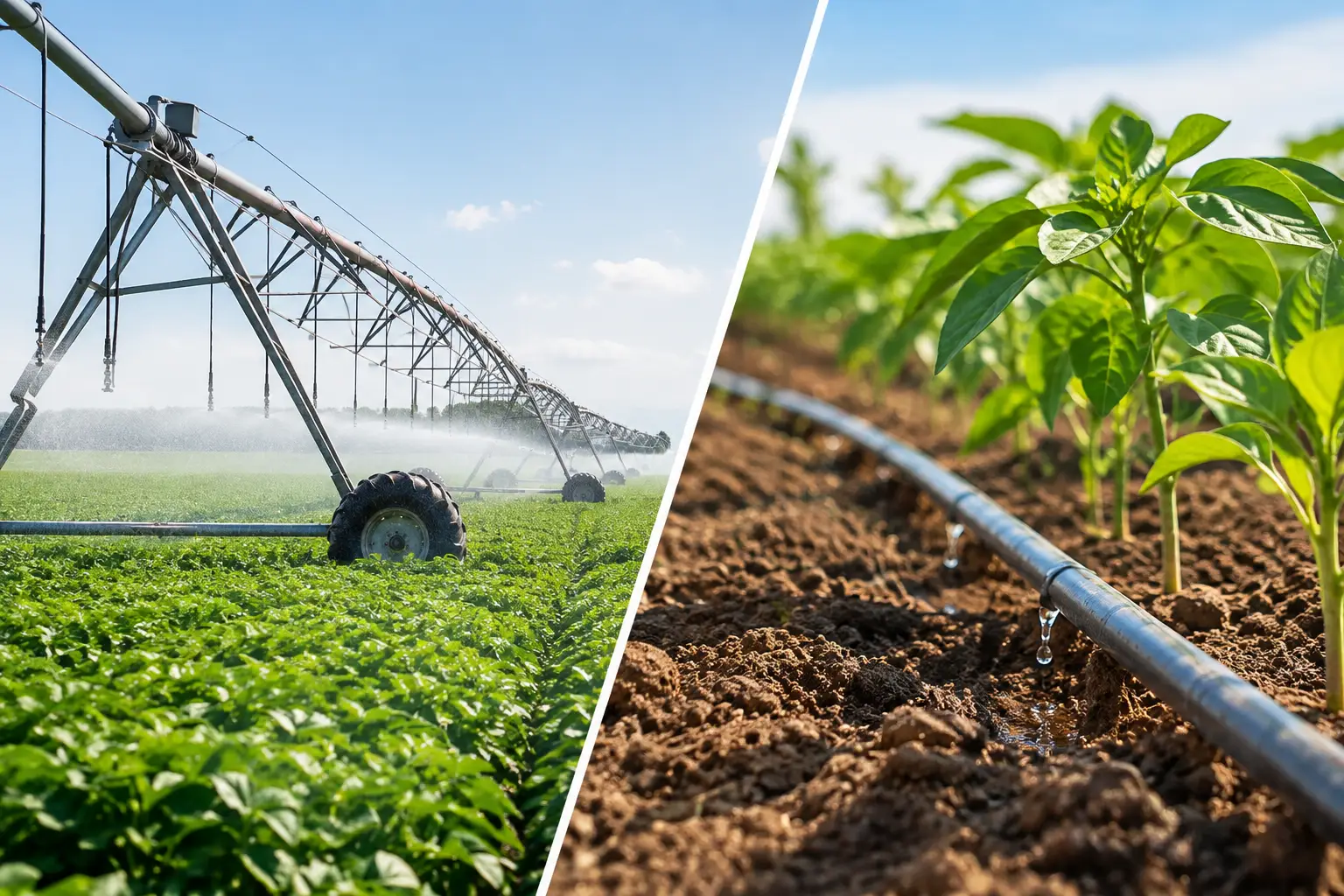
A center pivot system rotates around a fixed central point, applying water through sprinkler packages installed along a moving pipeline. It can cover a large acreage with relatively little day-to-day labor. Modern systems may include variable-rate irrigation, soil moisture integration, remote monitoring, and automated scheduling.
For row-crop operations, center pivots can provide a strong balance of coverage, scalability, and operational simplicity. A producer managing several hundred acres of corn, soybeans, forage, or potatoes can irrigate broad areas from a central water source without installing disposable or semi-permanent lines across every row.
Where center pivots create value
Center pivots are especially attractive when fields are flat to gently rolling, acreage is substantial, and crops can tolerate overhead watering. They are also a practical option where labor is limited. Once a pivot is commissioned and programmed, one operator can oversee a significant irrigated area.
The system can also support fertilizer application through the irrigation water. This gives growers a way to split nutrient applications during the season rather than relying entirely on pre-plant application. The result may be better timing and reduced passes across the field, although water quality and backflow protection must be managed carefully.
Center pivot trade-offs
The familiar circular pattern leaves corners outside the irrigated radius unless the system includes corner attachments. These attachments can improve coverage but add mechanical complexity and cost. Wind can also affect sprinkler distribution, while hot, dry conditions increase evaporation and drift losses.
Pivots are not automatically low-cost systems. The purchase price, pumping energy, electrical connection, water supply development, and control package all matter. A long pivot may be economical on a per-acre basis, but only when it serves enough usable acres and operates with adequate water pressure and flow.
How Drip Irrigation Works
Drip irrigation applies water slowly through emitters positioned along crop rows or near individual plants. Surface drip uses tubing on or near the soil surface. Subsurface drip irrigation places dripline below ground, delivering moisture directly into the root zone while keeping the soil surface and crop canopy drier.
This controlled application is a major advantage for farms growing high-value crops. Tomatoes, peppers, melons, strawberries, onions, vineyards, orchards, and greenhouse crops often benefit from frequent, small irrigation events that maintain a more stable root-zone moisture level.
Where drip irrigation creates value
Drip systems make it possible to irrigate shaped beds, narrow rows, blocks around buildings, sloped ground, and irregular field boundaries without wasting water on nonproductive areas. They are also highly effective for fertigation. Nutrients can be delivered in small, targeted doses at crop growth stages when demand is highest.
The dry canopy provided by drip can reduce conditions that favor some foliar diseases. It may also limit weed growth between rows because water is concentrated where the crop needs it rather than spread across the entire field surface.
For growers working under water restrictions, drip can turn limited allocations into more productive acreage. That benefit is strongest when the system is correctly designed, uses reliable filtration, and is paired with active moisture monitoring rather than guesswork.
Drip irrigation trade-offs
Drip is precise, but precision requires discipline. Sand, algae, mineral scale, and biological material can clog emitters. Every system needs appropriate filtration, pressure regulation, flushing points, and regular inspection. Fertilizer compatibility also matters because some materials can create precipitates that restrict flow.
Seasonal handling adds another consideration. Thin-wall drip tape may need replacement after each season, while permanent dripline requires careful winterization, rodent management, leak detection, and repairs. In large commodity-crop fields, those maintenance needs can outweigh the system’s water-efficiency advantage unless water scarcity or crop economics justify the investment.
Cost: Look Beyond the Initial Quote
Comparing equipment quotes only by price can lead to the wrong purchase. Center pivots concentrate much of their investment in the machine, pump capacity, power connection, and main water delivery system. Drip spreads investment across filtration, pumps, valves, mainlines, submains, laterals, emitters, controls, and installation labor.
Operating costs also differ. A well-designed low-pressure center pivot can reduce energy demand compared with older sprinkler packages, but it still requires pressure to throw water through nozzles. Drip usually operates at lower pressure, which can reduce pumping energy. However, filtration, flushing, chemical treatment, and repairs add recurring costs.
When reviewing supplier offers, commercial buyers should request a full system scope. That means asking what is included for pumping, filtration, automation, installation, training, spare parts, warranty support, and after-sales service. A lower equipment quote can become expensive if critical components or local technical support are missing.
Water Efficiency Is Not the Only Efficiency
Drip usually provides the highest application efficiency because it places water close to roots and avoids much of the evaporation associated with overhead sprinklers. Yet a center pivot can still be an efficient investment when it irrigates a large field consistently with limited labor.
The more useful question is: how much marketable crop is produced per unit of water, energy, labor, and capital? A pivot may produce stronger returns on a large alfalfa or corn operation because it covers many acres efficiently. Drip may produce stronger returns on peppers or almonds because uniform moisture and targeted nutrition support quality, yield, and water savings.
Field management determines real performance. Poor scheduling can waste water under either system. A drip system with clogged emitters is not efficient, and a pivot applying the right amount at the right time can outperform an inadequately managed drip installation.
Selecting by Crop, Field, and Business Model
Use center pivot irrigation when the operation has large, open fields; row or forage crops; a dependable central water supply; and a need to minimize routine labor. It is often the practical choice for farms expanding irrigated acreage across uniform parcels.
Choose drip irrigation when crops have high value per acre, water is constrained, field geometry is irregular, or precise fertigation is central to the production plan. It is often the stronger fit for specialty crop growers, permanent plantings, intensive vegetable operations, and farms seeking tighter root-zone control.
For some businesses, the best solution is both. A diversified operation may use pivots for commodity acreage and drip for vegetables, seed production, orchards, or trial blocks. This approach aligns irrigation investment with crop margin rather than forcing one technology across every acre.
Questions to Ask Irrigation Suppliers
Before committing to a system, clarify the water source flow rate, pressure, quality, and seasonal reliability. Then assess field dimensions, elevation changes, soil texture, drainage, crop rotation, power availability, and local service access.
Ask suppliers to provide a hydraulic design rather than a generic equipment list. For center pivots, review span configuration, nozzle package, end gun requirements, pressure regulators, controls, and expected application rate. For drip, review filtration micron rating, emitter spacing and flow, zone size, flushing design, pressure regulation, and replacement schedule.
International buyers should also confirm parts availability, technical documentation, shipping terms, installation support, and compatibility with local power standards and water regulations. Reliable sourcing matters because irrigation equipment is a long-term production asset, not a one-season purchase.
Agricial helps agricultural businesses compare irrigation equipment suppliers and service providers across markets, making it easier to identify solutions that fit specific crop and field requirements.
The strongest irrigation decision starts with the farm’s limiting factor. If water is scarce, precision may lead the decision. If acreage and labor are the constraint, coverage may matter more. Build the system around the constraint that most affects your returns, then choose suppliers equipped to support it for the seasons ahead.