How to Find the Best Livestock Feed Suppliers
Feed problems rarely start in the feed bin. They start earlier – with a supplier that looked competitive on price but could not hold quality, timing, or product consistency when your operation needed it most. For farms, feedlots, dairies, poultry businesses, and livestock distributors, choosing the best livestock feed suppliers is a purchasing decision with direct impact on animal performance, margins, and operational risk.
This is not just about finding a company that sells feed. It is about finding a supplier that can support your production goals, match your species requirements, deliver reliably, and communicate clearly when markets shift. The right supplier helps protect feed conversion, growth rates, milk yield, flock health, and inventory planning. The wrong one creates hidden costs that rarely show up on the first quote.
What the best livestock feed suppliers actually do well
The strongest suppliers are not defined by size alone. A large manufacturer may offer broad product lines and stronger logistics, while a regional supplier may outperform on responsiveness and local formulation knowledge. What separates reliable partners from risky ones is consistency.
A good supplier provides feed that performs the same way from batch to batch within an acceptable tolerance. They can explain ingredient sourcing, nutrient targets, quality control procedures, and how they handle substitutions when raw material markets tighten. That matters because livestock operations do not run well on surprises. Even a modest change in formulation, palatability, moisture, or particle size can affect intake and performance.
The best livestock feed suppliers also understand that commercial buyers are managing more than nutrition. They are managing storage, transport, labor, production schedules, and cash flow. Suppliers who can coordinate delivery windows, maintain documentation, respond to complaints quickly, and offer useful technical support are usually worth more than a lower-priced option that creates friction every month.
Start with your operation, not the supplier list
Before comparing vendors, get specific about what your business needs. A dairy operation buying high-volume ration inputs has a different risk profile than a poultry farm sourcing complete feed, and both differ from a distributor serving mixed livestock customers across several counties.
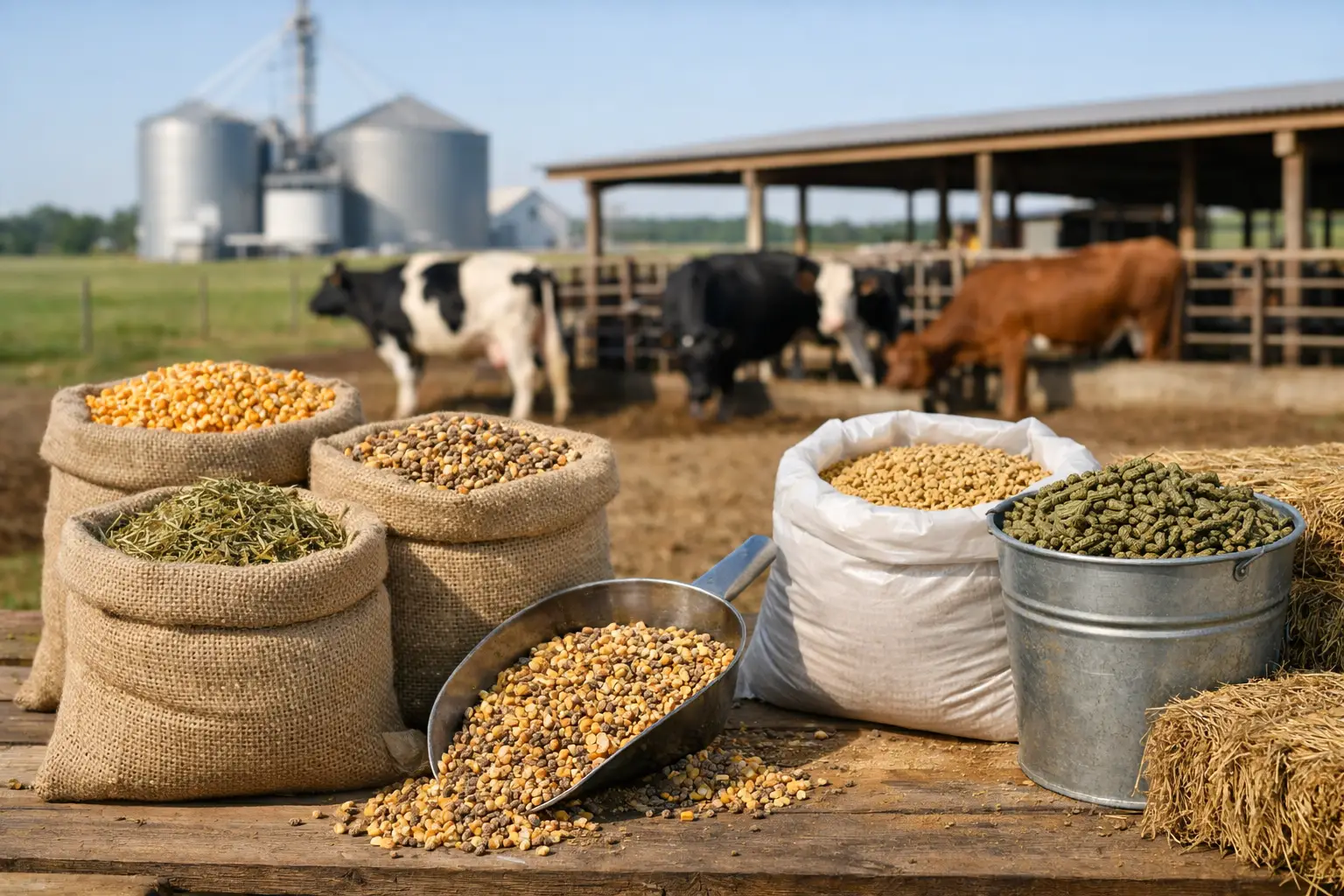
Define the basics first. Which species and production stages are you feeding? Do you need complete feed, premixes, concentrates, protein meals, mineral blends, or custom formulations? Are you buying for performance optimization, maintenance feeding, or cost control during a difficult season? These answers shape what a good supplier looks like.
This is also where many buyers make avoidable mistakes. They ask for quotes before setting acceptable standards. Without clear specifications, one feed offer can look cheaper simply because it is not truly comparable. Price only becomes meaningful when nutrient profile, ingredient quality, packaging, freight terms, and delivery frequency are aligned.
How to compare livestock feed suppliers fairly
A fair comparison starts with product fit. The supplier may have a strong reputation, but that does not guarantee the right feed for your animals, climate, or production system. Ask for product specifications that match the class of livestock you are feeding, then compare formulation intent as well as headline numbers.
The next step is quality assurance. Serious suppliers should be able to discuss testing, traceability, storage standards, contamination prevention, and batch controls. If the conversation stays vague, that is a warning sign. You do not need a polished sales pitch. You need evidence that they can manage feed quality under real commercial conditions.
Then look at service reliability. Can they supply year-round volume? What happens during ingredient shortages, transport disruptions, or seasonal spikes in demand? A supplier that performs well in normal months but struggles when pressure rises may not be the right long-term partner.
Commercial terms matter too. Some buyers focus almost entirely on price per ton, but freight structure, payment terms, minimum order quantities, packaging format, and lead times can change the real cost significantly. Two similar offers can produce very different outcomes once logistics and inventory holding costs are included.
Best livestock feed suppliers and the price-quality trade-off
Every buyer wants competitive pricing, but low price is not the same as good value. Feed that looks cheaper can end up costing more if it reduces average daily gain, weakens feed efficiency, increases waste, or creates health issues linked to poor consistency.
That does not mean the most expensive supplier is the best choice either. Premium branding sometimes hides average service or unnecessary formulation complexity. The goal is to find the point where nutritional performance, commercial reliability, and delivered cost make sense for your operation.
In practical terms, ask what you are paying for. Better raw materials, tighter quality control, stronger logistics, and technical support can justify a higher price. On the other hand, if a supplier cannot show how their offer improves outcomes, a higher quote may simply reflect overhead.
For many operations, the smartest move is to compare suppliers on cost per unit of production rather than price per bag or ton. That shifts the discussion toward business performance, where it belongs.
Questions worth asking before you commit
The strongest supplier conversations are direct. Ask where ingredients are sourced, how often formulations change, what testing is performed, and how customer complaints are handled. Ask whether they can share references from operations similar to yours. Ask who you call when a load arrives late or feed quality seems off.
It is also smart to ask how flexible they are. Some businesses need custom mixes, phased delivery schedules, or support across multiple locations. Others need a simple, repeatable supply arrangement with predictable invoicing. Neither model is better by default, but the supplier should fit your operating reality.
Transparency is a major advantage here. Suppliers who answer clearly and document what they sell are usually easier to work with over time. If too many answers depend on verbal promises, your risk goes up.
Why logistics often decide the best supplier
Feed is one of those categories where logistics can quietly become the deciding factor. A supplier with excellent products can still be the wrong choice if delivery is inconsistent, transit times are too long, or packaging does not match your handling system.
This matters even more for businesses operating across regions or managing high-throughput feeding programs. Delays can force ration changes, emergency purchases, or uneven feeding schedules. Those disruptions have operational costs that are easy to underestimate.
Look closely at warehouse location, trucking capacity, route coverage, and order lead times. If your business has seasonal peaks, confirm that the supplier can scale with you. If your operation is remote, check whether freight makes the quoted price unrealistic. A dependable regional supplier may outperform a larger distant option purely because they can keep product moving.
Digital sourcing makes supplier selection faster
Feed sourcing used to depend heavily on local networks, trade contacts, and time-consuming outreach. That still has value, but digital sourcing now gives buyers a faster way to compare supplier profiles, product categories, and commercial options across markets.
For agriculture professionals trying to save time and reduce search friction, a focused B2B marketplace can make the process far more efficient. Instead of starting from scattered searches and incomplete information, buyers can review relevant suppliers in one place, compare offerings, and move toward direct conversations with more confidence. That is especially useful when you are expanding your supplier base, entering new regions, or looking for alternatives to reduce dependency on a single vendor.
Agricial supports that kind of sourcing by helping agricultural businesses discover suppliers, compare commercial options, and connect with partners built around real farm and agribusiness needs.
Red flags you should not ignore
Some warning signs show up early. If a supplier cannot provide clear specifications, struggles to explain quality controls, avoids discussing ingredient changes, or responds slowly before the sale, those issues rarely improve after onboarding.
Another concern is overpromising. Be cautious with claims that sound absolute, especially around performance gains or uninterrupted availability in volatile markets. Good suppliers understand agriculture well enough to speak in realistic terms. They know performance depends on management, environment, animal health, and ration context – not feed alone.
It is also worth watching how suppliers handle smaller accounts. Even if your current volume is modest, a serious partner should still communicate professionally and set expectations clearly. Growth-minded businesses need suppliers that can support them now and scale with them later.
Choosing a supplier for the long term
The best supplier relationship is not built on one good shipment. It is built on repeat performance, clear communication, and shared commercial understanding over time. Start with a manageable order if possible, evaluate delivery and product consistency, and track results against your normal benchmarks.
If the supplier performs well, deepen the relationship gradually. Strong supplier partnerships often lead to better planning, improved service, and more stable purchasing conditions. They also make it easier to respond when markets tighten, because both sides already understand the operating priorities.
Finding the best livestock feed suppliers is really about reducing uncertainty in one of the most important inputs your business buys. Choose the partner that helps you feed animals well, manage costs realistically, and keep your operation moving when conditions are less than ideal.