What Makes Irrigation Parts Compatible in the Field?
A 2-inch fitting that looks right can still stop an irrigation project cold if its thread standard, pressure class, or pipe material does not match the system. For growers, contractors, distributors, and buyers, understanding what makes irrigation parts compatible prevents leaks, poor uniformity, delayed installations, and costly replacement orders.
Compatibility is not a single product feature. It is the ability of pipes, fittings, valves, filters, pumps, emitters, controllers, and sensors to connect safely and operate together at the required flow and pressure. The most reliable sourcing decisions come from comparing specifications, not appearances or nominal sizes alone.
What Makes Irrigation Parts Compatible?
Irrigation parts are compatible when their physical connection, hydraulic capacity, material properties, and control requirements align. A fitting may physically connect to a pipe but remain unsuitable if it cannot handle the operating pressure. Likewise, a valve may be correctly sized but fail to respond to the available controller voltage.
For commercial irrigation systems, compatibility should be checked at three levels: the connection point, the operating conditions, and the complete system design. This matters whether a buyer is replacing a damaged coupling in a greenhouse or sourcing a container load of drip irrigation equipment for a large farm development.
The core compatibility checks
Before purchasing, confirm the following specifications across every component group:
- Nominal diameter and actual outside diameter
- Connection type, thread standard, and gender
- Working pressure and surge-pressure tolerance
- Pipe and fitting material
- Flow-rate range and pressure-loss limits
- Filtration requirements for emitters and valves
- Electrical voltage, wiring, and controller protocol where applicable
A supplier listing that states only “1-inch irrigation connector” leaves too much room for error. Buyers should request the pipe standard, connection detail, material grade, and pressure rating before comparing offers.
Pipe Size Is More Than the Number on the Label
The most common compatibility mistake is assuming that nominal pipe size is universal. It is not. A 1-inch pipe can have different outside dimensions depending on whether it is PVC, polyethylene, steel, or a regional standard. Pipe wall thickness also changes the inside diameter, which affects flow and the fitting design.
Polyethylene irrigation pipe is often identified by outside diameter, while PVC systems may use nominal pipe size. Drip tubing can be sold in millimeters, inches, or tape-specific dimensions. A 16 mm drip fitting, for example, is not automatically suitable for every product described as 5/8-inch tubing.
| Component | Specification to compare | Common sourcing risk | |—|—|—| | PVC pipe | Nominal size, schedule, outside diameter | Mixing fittings designed for another schedule or standard | | HDPE/PE pipe | Outside diameter, SDR or wall thickness | Buying insert fittings that do not match pipe wall thickness | | Drip tubing | Outside diameter, wall thickness, manufacturer tolerance | Loose barbed connections or tubing splits | | Layflat hose | Diameter, wall thickness, operating pressure | Clamps or couplings that cannot seal under pressure |
When importing parts from different markets, ask for a dimensional drawing or technical data sheet. A measurement in inches may be a nominal designation rather than the actual mating diameter.
Threads and Connection Styles Must Match Exactly
Thread compatibility is especially critical for pumps, filters, valves, hose adapters, and manifold assemblies. National Pipe Thread, or NPT, is common in the United States, but BSP threads are widely used in many international irrigation markets. They are not interchangeable, even when the diameter appears similar.
NPT threads are tapered and seal through thread interference, usually with an appropriate thread sealant. BSP may be parallel or tapered depending on the type. Attempting to join mismatched threads can create a connection that feels tight but leaks, cross-threads, or fails under pressure.
Common irrigation connection types
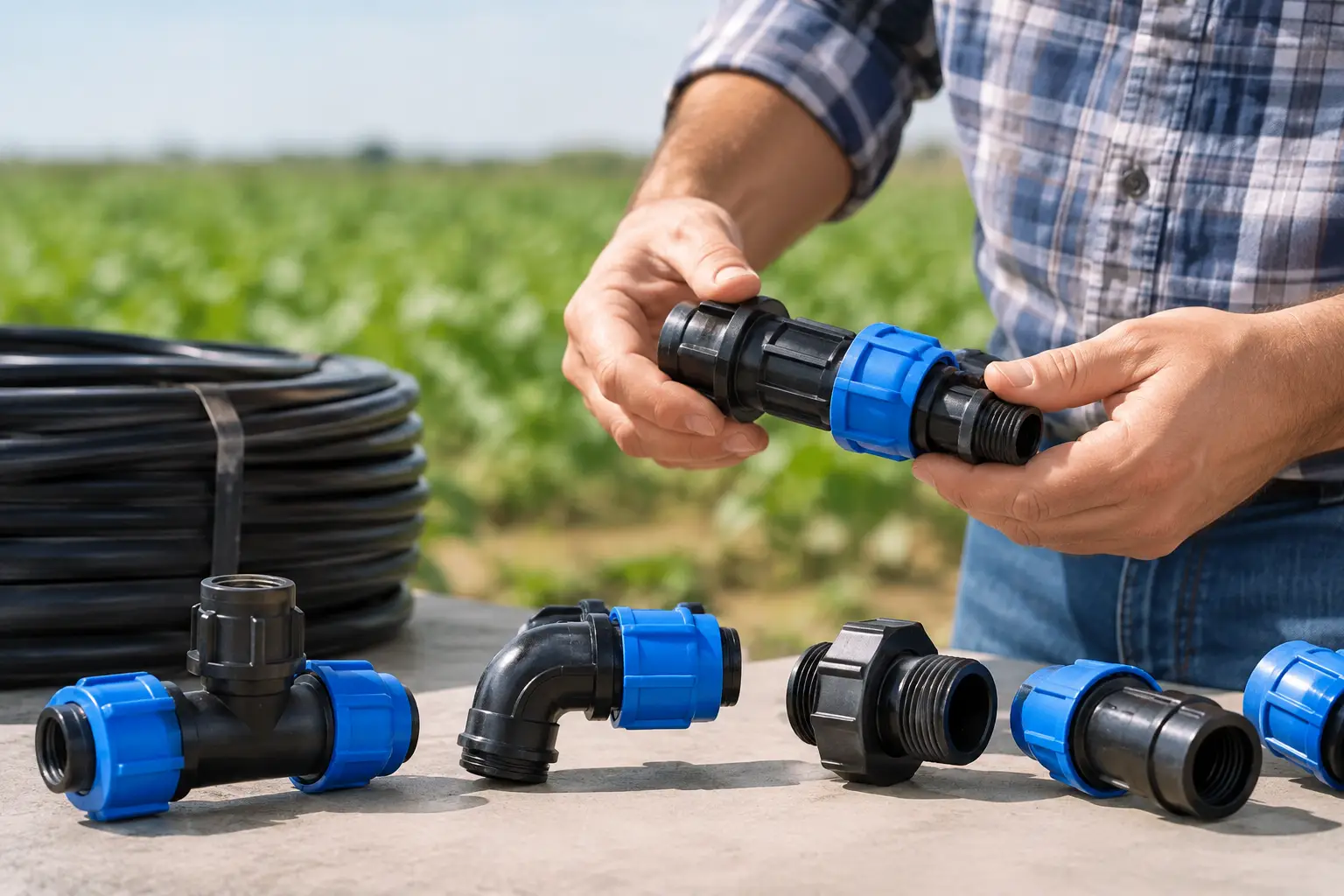
Threaded systems are useful for serviceable pump stations and filtration assemblies. Solvent-weld socket connections are common in rigid PVC systems but become permanent after installation. Compression fittings allow PE pipe connections without heat or adhesives, while barbed fittings are widely used with drip tubing and flexible hose.
Each style has a different purpose. A barbed adapter may be quick and economical for a low-pressure drip lateral, but it is not a substitute for a rated compression fitting on a pressurized HDPE mainline. Selection should reflect the application, not only the lowest unit cost.
Pressure, Flow, and Hydraulic Performance
A system can have perfectly matched fittings and still perform poorly if the components are not hydraulically compatible. Every part creates some pressure loss. Filters, control valves, backflow devices, long pipe runs, and undersized fittings can reduce pressure at the far end of a field, causing uneven irrigation.
Drip emitters are particularly sensitive. Pressure-compensating emitters are designed to deliver a more consistent flow over a stated pressure range. If the inlet pressure is below that range, or far above it, application uniformity can suffer. Spray heads and sprinklers also require a specific nozzle pressure to achieve their intended radius and distribution pattern.
| System component | Compatibility question | Why it affects performance | |—|—|—| | Pump | Can it supply required flow at total dynamic head? | Determines whether the entire system reaches operating pressure | | Filter | Is its flow capacity above peak demand? | Prevents excessive pressure loss and emitter clogging | | Pressure regulator | Does its outlet setting match the zone requirement? | Protects drip lines and supports uniform output | | Valve | Is its flow range suitable for the zone? | An oversized or undersized valve can operate poorly | | Emitter or sprinkler | Does available pressure match its rated range? | Controls application rate, throw, and uniformity |
Buyers should compare maximum working pressure, not just burst pressure. Burst pressure describes a failure threshold, not a safe daily operating condition. Systems also experience pressure spikes when valves close quickly, so surge allowance matters on long mains and pump-fed systems.
Material Compatibility Protects System Life
Materials must work with the water, weather, soil conditions, and nearby components. PVC, HDPE, polypropylene, brass, stainless steel, and rubber seals all have different strengths. The right choice depends on installation conditions and the chemicals moving through the system.
For example, PVC is widely used for rigid mains because it is corrosion-resistant and cost-effective, but it can become more vulnerable to impact in cold conditions and may need UV protection if exposed. HDPE provides flexibility and performs well in many buried and agricultural applications, but fittings must match its diameter and pressure class.
Chemical compatibility becomes more significant in fertigation. Fertilizers, acids, and water-treatment products can affect seals, metals, and plastics. A component that works well with clean water may not be appropriate for repeated acid injection or high-salinity water. Request chemical-resistance information when sourcing venturi injectors, dosing pumps, filter housings, valve diaphragms, and gaskets.
Do not overlook metal-to-plastic connections
Metal threads can damage softer plastic female fittings if overtightened. Brass and stainless components may be useful at pump stations or high-wear points, but the connecting adapter still needs the correct thread standard and pressure rating. Use only compatible sealants and avoid forcing a connection that does not engage smoothly by hand.
Filtration Determines Whether Drip Components Work Together
In drip and micro-irrigation, filtration is part of compatibility. The filter must remove particles large enough to clog the smallest passage in the system while still providing the necessary flow with manageable pressure loss.
Screen filters are often effective for relatively clean water, while disc filters can handle organic contaminants more effectively in many applications. Sand media filtration may be required where surface water carries algae or heavy organic load. The correct choice depends on water source, emitter design, and peak zone flow.
A high-quality emitter cannot compensate for inadequate filtration. When comparing suppliers, match the filter mesh or micron rating to the emitter manufacturer’s requirements and confirm that the filter housing, ports, and flush arrangement support the planned flow rate.
Electrical and Smart Irrigation Compatibility
Modern irrigation systems increasingly include solenoid valves, controllers, flow meters, pressure sensors, weather stations, and remote communication modules. These parts need electrical and digital compatibility as well as hydraulic compatibility.
Most residential and light commercial valves use low-voltage alternating-current solenoids, but specifications vary. Some systems use latching DC solenoids for battery-powered or solar-powered controllers. Connecting the wrong solenoid type can prevent valve operation or damage the controller.
For smart systems, confirm the controller’s supported sensor inputs, communication method, power supply, and software ecosystem. A flow meter may have a pulse output, while another requires a proprietary input or gateway. Where reliable connectivity is limited, a buyer may prioritize controllers with local scheduling and manual override rather than relying entirely on cloud-dependent functions.
A Practical Compatibility Process for Buyers
The best procurement process starts with a system schedule rather than a product search. List each zone’s flow, pressure, pipe size, water source, filtration level, and control method. Then request matching technical specifications from suppliers.
For replacement parts, identify the manufacturer, part number, connection style, dimensions, and working pressure from the existing component. Photos help, but a photo should support the specification check, not replace it. For larger projects, order samples or build a small test assembly before committing to a full shipment.
Agricial helps agricultural businesses compare irrigation suppliers and product categories in one focused marketplace. Whether sourcing locally or across borders, buyers can use detailed specifications and direct supplier conversations to reduce mismatches before an order is placed.
The Cost of “Close Enough” Irrigation Parts
Choosing a near-match may save a small amount at purchase, yet create much larger costs in labor, downtime, crop stress, and emergency freight. A leaking manifold wastes water and pressure. A poorly matched emitter line can leave sections of a crop under-irrigated. An incompatible controller and valve combination can delay an entire installation.
The practical standard is simple: every part should fit mechanically, perform hydraulically, tolerate the operating environment, and communicate correctly where automation is involved. Make those checks part of every quote request, and irrigation sourcing becomes a controlled business decision rather than a field-side guess.