Tractor Attachments Buying Guide for Farms
A tractor that spends half the year switching between jobs can either save labor or create expensive bottlenecks. The difference usually comes down to attachment choice. This tractor attachments buying guide is built for farmers, machinery buyers, importers, and agricultural businesses that need equipment to perform across real working conditions, not just look good on a spec sheet.
The market is full of options, from loaders and mowers to tillers, seeders, sprayers, and bale handlers. Buying the right attachment is less about finding the biggest or cheapest tool and more about matching task, tractor, soil, operating hours, and service support. A good purchase increases field efficiency. A poor one leads to underperformance, excess fuel use, drivetrain strain, and downtime when you can least afford it.
What this tractor attachments buying guide should help you decide
Most buyers start with the attachment category. Experienced buyers start with the job. That distinction matters because one implement can perform well in one production system and become a poor investment in another.
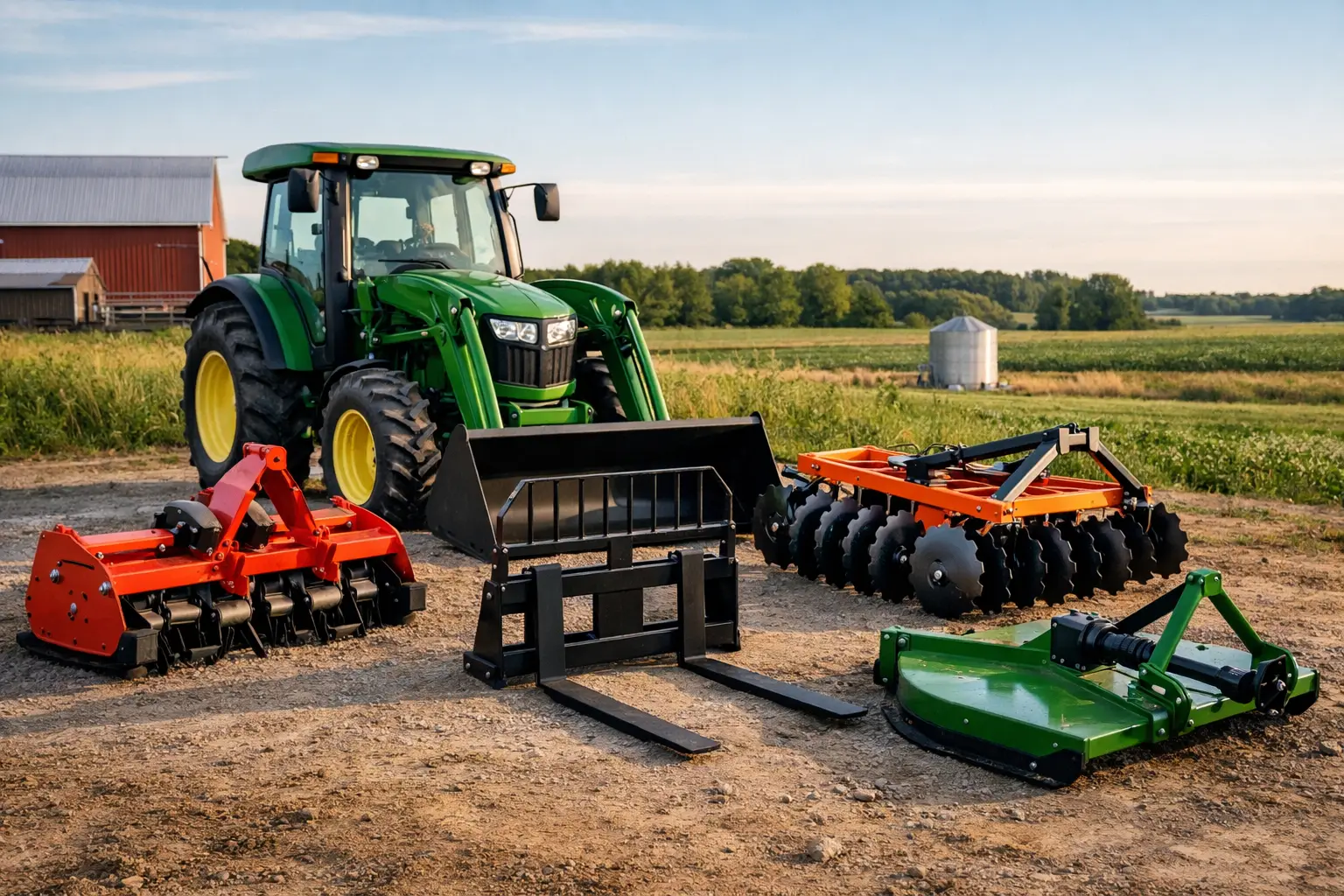
If your operation is focused on land preparation, a rotary tiller or disc harrow may offer more value than a rear blade. If material movement is your daily priority, a front-end loader or pallet fork may return more than a mower. For mixed farms, versatility often matters more than specialization, especially when one tractor is expected to cover transport, field prep, and maintenance.
Before comparing brands or prices, define four basics: the main task, annual hours of use, field conditions, and the tractor specifications already in your fleet. Those four points narrow the buying decision faster than any catalog.
Start with tractor compatibility
Attachment fit is the first commercial filter. Many buying mistakes happen because the implement looks suitable, but the tractor cannot power it safely or efficiently.
PTO power and hydraulic capacity
PTO-driven implements such as mowers, tillers, and spreaders require adequate horsepower at the PTO, not just engine horsepower. A tractor rated at 75 engine hp may deliver much less at the PTO, which affects performance under load.
Hydraulic attachments such as loaders, post drivers, and some folding implements depend on flow rate and pressure. Low hydraulic output can slow cycle times, reduce lifting efficiency, or prevent full operation altogether.
Hitch category and lift capacity
Three-point hitch category, lift arm geometry, and rear lift capacity must align with the implement. Even if an attachment connects physically, improper weight distribution can reduce steering control, increase axle stress, and create safety issues on slopes or during transport.
Width and field match
Wider is not always better. A mower or cultivator that exceeds the tractor’s stable working range may reduce productivity instead of improving it. In heavy soils or uneven terrain, a slightly narrower attachment often delivers better real-world output with lower wear.
Common attachment types and where they fit best
The right choice depends on crop system, livestock needs, acreage, and labor availability. The table below gives a practical comparison for common categories.
| Attachment type | Primary use | Best fit | Main advantage | Main limitation |
|---|---|---|---|---|
| Front-end loader | Material handling | Mixed farms, feed yards, landscaping, logistics | High versatility | Adds front weight and needs strong hydraulics |
| Rotary cutter | Grass and brush control | Pastures, roadsides, orchard edges | Fast area coverage | Rough finish quality |
| Finish mower | Fine turf mowing | Estates, parks, specialty grounds | Clean cut | Less suitable for brush or rough fields |
| Rotary tiller | Seedbed prep | Vegetable farms, horticulture, smaller plots | Fine soil finish | High power demand in hard ground |
| Disc harrow | Residue and soil mixing | Broadacre and mixed field prep | Good for tougher residue | Less fine finish than tiller |
| Seeder or planter | Crop establishment | Grain, forage, row crop systems | Better placement and consistency | Requires correct calibration |
| Sprayer | Crop protection or foliar feeding | Field crops, orchards, horticulture | Efficient application | Needs strict nozzle and rate control |
| Bale spear or grab | Hay handling | Livestock and forage operations | Faster bale movement | Limited use outside forage work |
For smaller farms, a loader, rotary cutter, and tiller often create the strongest base package. For commercial row crop businesses, planter, sprayer, and tillage tools usually drive greater returns. For distributors and importers, local demand patterns should shape inventory more than global popularity.
Buying by application, not by catalog
Land preparation
For primary soil work, buyers usually compare tillers, harrows, plows, and cultivators. The best option depends on soil texture, residue load, moisture conditions, and finish requirements. Tillers create a fine finish but can require more power and maintenance in rocky or compacted ground. Disc harrows handle residue better and usually suit broader acreage, but they may need follow-up passes for seedbed quality.
Mowing and vegetation control
Rotary cutters are built for field edges, pasture recovery, and rough vegetation. Finish mowers are designed for appearance and uniformity. If your operator will face saplings, stones, and uneven terrain, buying a finish mower to save upfront cost is usually a mistake.
Material handling
A loader can transform daily operations, especially in livestock, feed, compost, and yard management. But buyers should evaluate lift height, breakout force, bucket capacity, counterweight needs, and quick-attach compatibility. A loader that lifts enough but cycles too slowly may still limit throughput.
Planting and application
Seeders and sprayers deliver value through precision. Here, calibration matters as much as hardware. A lower-cost unit with uneven seed placement or poor spray distribution can cost more over a season than a better-built machine with stronger control and parts support.
Cost, durability, and support – the real buying equation
Price matters, but landed value matters more. For many agricultural businesses, the total cost of ownership includes freight, setup, spare parts, wear items, service response, and seasonal downtime risk.
This is especially relevant in cross-border sourcing. Importers and commercial buyers should ask whether replacement blades, tines, bearings, hoses, and seals are easy to source locally. A competitively priced attachment with weak after-sales support can become a costly asset once peak season begins.
Here is a practical way to compare buying factors:
| Buying factor | What to check | Why it matters |
|---|---|---|
| Build quality | Frame thickness, weld quality, gearbox brand, steel grade | Affects lifespan and heavy-use reliability |
| Parts availability | Common wear parts, lead times, local stock | Reduces downtime during peak work |
| Dealer or supplier support | Setup help, warranty clarity, troubleshooting response | Improves purchase confidence and service continuity |
| Operating cost | Fuel demand, maintenance intervals, consumables | Shapes long-term profitability |
| Resale value | Brand reputation, market demand, condition retention | Supports future fleet upgrades |
Questions every buyer should ask before purchase
A strong machinery deal starts with sharper questions. Buyers should ask suppliers for operating requirements, implement weight, service intervals, consumable parts lists, and recommended tractor range. If the answer is vague, that is useful information.
It also helps to ask how the attachment performs in conditions close to your own. Light sandy soils, heavy clay, orchard rows, livestock yards, and broadacre systems all place different demands on equipment. One attachment may test well in ideal conditions and struggle in commercial use.
Ask for documentation on warranty coverage, included components, and setup requirements. Some attachments are sold with key items excluded, such as hoses, PTO shafts, mounting hardware, or control kits. That can distort price comparisons if you only look at base quotes.
Red flags that usually signal a poor buy
Some warning signs are consistent across categories:
- The attachment is too heavy for the tractor’s lift and balance.
- The quoted working width is unrealistic for your soil or crop conditions.
- Hydraulic or PTO requirements are not clearly stated.
- Spare parts availability is uncertain.
- The supplier cannot explain wear points or maintenance schedules.
- The unit is cheaper because key components are lighter duty.
None of these automatically rule out a purchase, but each one deserves closer review before money changes hands.
Sourcing tractor attachments across markets
For farms and agribusinesses buying locally, dealer access may be the main advantage. For importers, distributors, and larger commercial operators, wider sourcing can improve price, specification choice, and supplier competition. The trade-off is that procurement becomes more document-heavy and support must be checked more carefully.
This is where a sector-focused marketplace can save time. Platforms such as Agricial help buyers compare agricultural suppliers in one place, review category-specific offerings, and move faster from search to quote request without relying on scattered directories or general-purpose listings.
Final checks before you commit
Before approving the order, confirm attachment dimensions, shipping configuration, mounting standards, power requirements, included accessories, and warranty terms in writing. If possible, compare at least two similar models side by side using the same criteria, not just the same price range.
The best attachment is rarely the one with the most features. It is the one that fits your tractor, your workload, your operators, and your support network well enough to keep work moving when timing matters most. Buy for the field, not the brochure, and the return tends to show up quickly.