
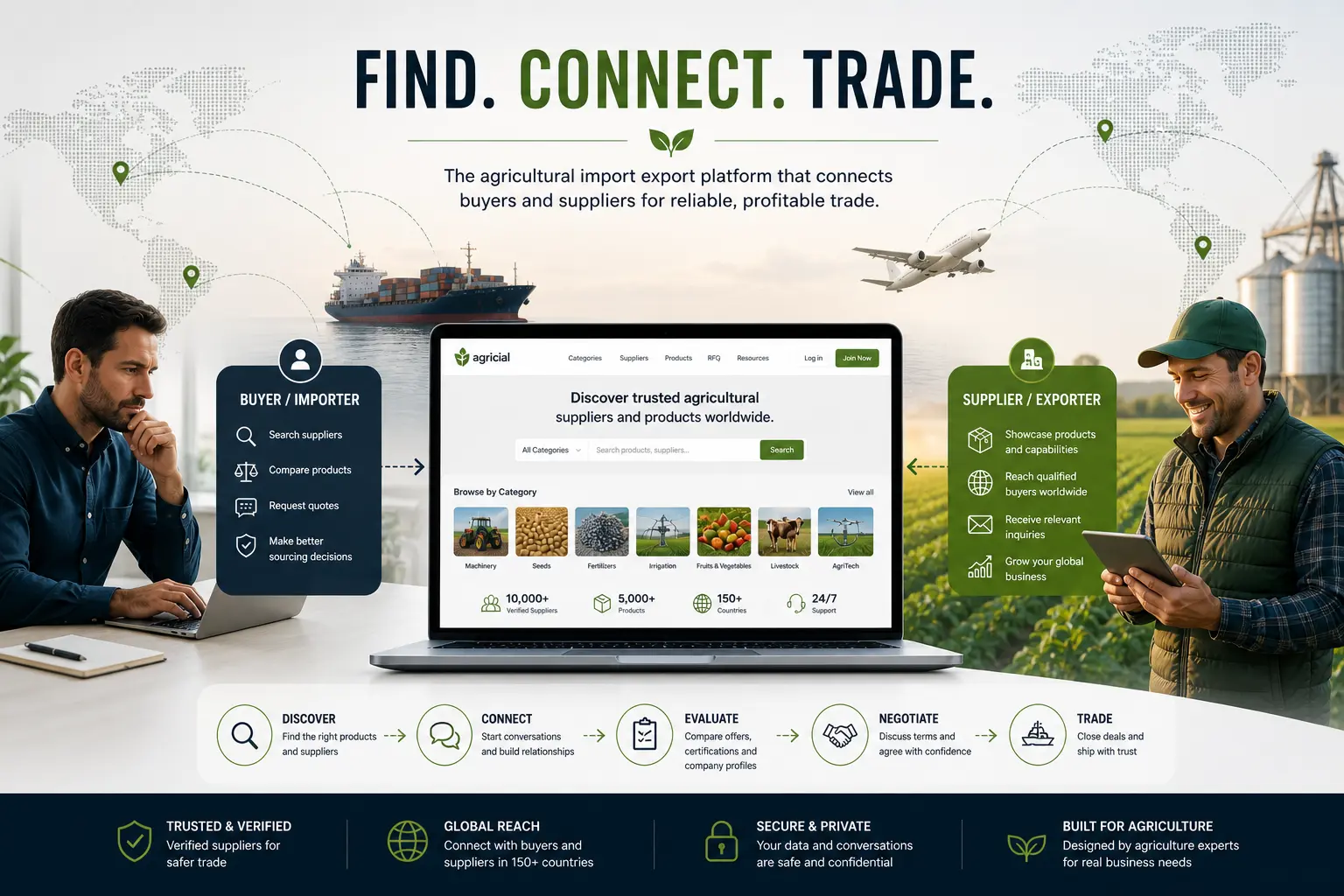
What Makes an Agricultural Import Export Platform Work
A soybean buyer in one market, an irrigation supplier in another, and a freight-sensitive shipment window in between – that is where trade either moves fast or gets stuck. An agricultural import export platform matters because agricultural commerce is rarely just about finding a product. It is about finding the right supplier, in the right region, with the right capacity, timing, documentation readiness, and commercial credibility.
For agricultural businesses, the challenge is not a lack of options. It is too many disconnected options spread across trade shows, personal referrals, search engines, messaging apps, and general business directories that were never built for real agricultural sourcing. A specialized platform brings that activity into one place and makes buying, selling, and partner discovery more practical.
Why a general marketplace is often not enough
Agriculture has its own buying logic. A livestock producer sourcing feed inputs is not evaluating suppliers the same way a greenhouse operator compares irrigation systems or a distributor looks for bulk fertilizer partners. Product specifications, seasonality, shipping constraints, certifications, and after-sales support all shape the buying decision.
That is why a general B2B website often creates more noise than value. You may find a large volume of listings, but not enough context to judge whether a supplier actually fits your operation. In agriculture, the details matter. Buyers need to compare products by application, production category, and business role. Sellers need to show more than a company name – they need to show what they supply, who they serve, and where they can deliver.
A focused agricultural import export platform is more useful because it reflects how agricultural trade actually happens. It organizes businesses around sectors such as machinery, seeds, irrigation, fertilizers, horticulture, livestock, and AgriTech. That structure saves time, but it also improves decision quality.
To better understand the difference, here is a direct comparison:
General Marketplace vs Agricultural Platform: Key Differences
| Criteria | General B2B Marketplace | Agricultural Import Export Platform |
|---|---|---|
| Industry Focus | Generic, multi-sector | 100% agriculture-focused |
| Supplier Relevance | Low filtering accuracy | Highly targeted suppliers |
| Product Categorization | Broad and unclear | Sector-based (fertilizer, seeds, irrigation) |
| Decision Support | Limited | Structured comparison and evaluation |
| Trust & Credibility | Unclear profiles | Verified and detailed business info |
| Trade Efficiency | Time-consuming | Faster sourcing and communication |
What buyers need from an agricultural import export platform
Buyers want speed, but not at the expense of trust. If a sourcing tool helps a buyer find ten companies in five minutes but gives no clear way to compare relevance, it has not solved much. The strongest platforms reduce search friction while still supporting commercial evaluation.
In practice, buyers typically look for:
- Quick access to relevant and verified suppliers
- Clear product categorization and filtering options
- Ability to compare suppliers based on capability and region
- Simple RFQ (Request for Quote) and inquiry system
- Access to supplier profiles with certifications and details
- Flexible sourcing (local and international options)
At a practical level, buyers need visibility into supplier profiles, product categories, and service capabilities. They also need a simple way to send inquiries, request quotes, and narrow down options without starting the research process from scratch every time. For importers and distributors, this is especially valuable when entering a new market segment or testing new supplier relationships.
The best results come when the platform helps buyers move from browsing to action. That means product discovery should lead naturally to supplier contact. Category pages should help users compare vendors quickly. Business profiles should answer the first commercial questions before a message is ever sent.
There is also a regional trade-off to consider. Some buyers want local or nearby sourcing to reduce lead times and logistics risk. Others are specifically looking overseas for pricing, capacity, or product availability. A good platform supports both paths without forcing buyers into a one-size-fits-all search experience.
What suppliers and exporters need from the platform
For suppliers, exporters, and service providers, visibility is only useful when it reaches the right audience. Being listed in front of general traffic is not the same as being discovered by buyers who actually source agricultural products and services.
- Visibility in front of real agricultural buyers
- Access to international markets without high costs
- Ability to showcase products and capabilities clearly
- Direct inquiry flow from interested buyers
- Positioning within relevant agricultural categories
- Lower dependency on exhibitions and intermediaries
That is the commercial advantage of a sector-specific marketplace. It puts exporters and suppliers in front of users who are already searching with agricultural intent. A machinery company can present its equipment to farm operators and distributors. A fertilizer supplier can show up where buyers are actively comparing input sources. A consultant can reach agribusinesses that need practical expertise, not just a generic contact database.
An agricultural import export platform should also lower the cost of market access. Not every agricultural business has the budget or infrastructure for international sales teams, major exhibitions, or broad digital campaigns. A searchable listing, supported by product exposure and inquiry tools, gives small to mid-sized companies a practical entry point into wider trade networks.
That matters because many agricultural businesses are strong operationally but underexposed commercially. They know their products, know their production, and know their local markets. What they often need is a faster route to qualified attention.
The features that make the platform commercially useful
A platform does not become valuable just because it contains listings. It becomes valuable when those listings are structured to support real transactions and real business development.
The following features directly impact commercial performance:
Key Features of an Effective Agricultural Import Export Platform
| Feature | Why It Matters | Business Impact |
|---|---|---|
| Company Profiles | Showcase capabilities and regions | Better supplier evaluation |
| Category-Based Search | Faster product discovery | Reduced sourcing time |
| RFQ System | Direct communication | Faster deal-making |
| Product Listings | Specification-based search | More accurate decisions |
| Verification Signals | Build trust | Higher conversion rate |
Searchable company profiles are one of the foundations. Buyers need to understand what a business offers, where it operates, and which categories it serves. Category-based browsing matters just as much, especially in agriculture where procurement decisions often start with a product need rather than a known supplier name.
Quote request functionality adds another layer of value. It gives buyers a direct path to compare responses and gives suppliers a chance to engage with clear buying intent. This is often more efficient than open-ended email outreach because the inquiry starts inside a commercial context.
Product visibility is also critical. In agriculture, many purchases are specification-driven. Buyers want to see the relevant products, not just a broad corporate description. A platform that supports product discovery alongside supplier discovery helps users move faster and ask better questions.
Verification and credibility signals matter too. Agricultural trade depends heavily on reliability. Even when a platform is not acting as the contracting party, it can still improve confidence by organizing business information clearly and creating a more professional discovery environment.
Why trust is the real growth engine
In cross-border agriculture, trust is not a branding extra. It is part of the transaction itself. A buyer is often making decisions across distance, time zones, crop calendars, and logistics variables. If the supplier looks uncertain, incomplete, or hard to verify, the opportunity slows down.
That is why the strongest platform experience combines accessibility with credibility. Businesses should be easy to find, but they should also be easy to assess. Clear profiles, relevant categories, and direct inquiry channels all reduce uncertainty.
Trust also grows when the platform feels purpose-built for agriculture rather than loosely adapted to it. Buyers and sellers notice when the structure reflects real agricultural workflows. They can tell the difference between a directory that simply hosts company names and one that helps organize sourcing by how the sector actually buys and sells.
This is where a platform like Agricial fits naturally. It brings together agricultural businesses, products, and service providers in one specialized marketplace built around practical sourcing and partner discovery.
Where the biggest gains usually happen
The biggest gains are not always dramatic. Often, they come from reducing wasted time. A buyer spends less effort chasing unqualified suppliers. A seller receives inquiries that are more relevant. A consultant or service provider becomes visible to businesses outside their immediate network. Those efficiencies add up quickly.
There is also a strategic upside. A business that uses a dedicated agricultural import export platform well can spot new category demand, test new market reach, and build relationships earlier than it could through offline channels alone. The platform becomes more than a listing space. It becomes part of the company’s commercial workflow.
That said, results depend on how the platform is used. A weak profile with vague descriptions will not perform like a complete, category-aligned listing. Buyers who send generic inquiries may get slower responses than those who specify product needs, quantities, and destination markets. The tool helps, but execution still matters.
Choosing the right platform for your business
If you are evaluating options, start with relevance. Does the platform focus on agriculture, or is agriculture only one small section of a larger directory? Then look at structure. Can buyers browse by category? Can suppliers present products clearly? Is there a direct path to request quotes or make contact?
When selecting a platform, consider the following:
- Check if the platform is agriculture-focused
- Evaluate category structure and navigation
- Analyze the quality of listed suppliers
- Look for built-in communication tools (RFQ, messaging)
- Assess international vs local sourcing capabilities
- Ensure profiles provide real commercial value
Next, consider audience quality. A large platform is not automatically a better one if the traffic is unfocused. For most agricultural businesses, a qualified niche audience is more commercially valuable than broad visibility with low intent.
Finally, think about fit. An exporter looking for distributor connections may prioritize international visibility. A farmer sourcing irrigation systems may care more about product comparison and response speed. A consultant may value discoverability across service categories. The right platform aligns with the type of business relationship you are trying to build.
Agricultural trade works best when search, trust, and communication are not scattered across ten different places. A good platform brings them together and gives agricultural businesses a clearer path to opportunity. If your next supplier, buyer, or partner matters to your growth, it is worth choosing a marketplace built for how agriculture actually does business.
If you are looking to connect with reliable agricultural suppliers or expand your global reach, explore platforms like Agricial and start building your network today.