Top Greenhouse Equipment Suppliers Compared
A delayed ventilation shipment in peak season can cost more than the fan itself. That is why choosing from the top greenhouse equipment suppliers is not just a procurement task – it is an operational decision that affects yield, labor efficiency, energy use, and delivery reliability.
For commercial growers, distributors, and importers, the right supplier is rarely the one with the longest catalog alone. It is the one that can match your climate, crop system, technical requirements, service expectations, and purchasing model. A supplier that works well for a small propagation house in one region may be the wrong fit for a multi-bay vegetable project in another.
What sets top greenhouse equipment suppliers apart
The best suppliers compete on more than equipment. They compete on availability, technical clarity, after-sales support, and their ability to help buyers make fewer costly mistakes.
At a practical level, top-performing greenhouse suppliers usually stand out in five areas:
- Product range across core systems such as structure, covering, climate control, irrigation, fertigation, benches, lighting, and automation
- Technical support for sizing, layout, installation, and system compatibility
- Consistent manufacturing quality and parts availability
- Export readiness, including documentation, packaging, and shipping coordination
- Commercial responsiveness, especially for quote turnaround, customization, and post-sale communication
This matters because greenhouse systems do not work in isolation. Ventilation affects humidity control. Irrigation design affects disease pressure and fertilizer efficiency. Covering materials influence light transmission and cooling demand. A supplier that understands system interaction creates more value than one that simply ships components.
How to evaluate top greenhouse equipment suppliers
Before comparing brands or listings, define the greenhouse operation you are buying for. Start with the crop, production scale, climate, and business model.
A flower grower focused on visual quality may prioritize shading, light diffusion, and bench systems. A tomato producer may focus more heavily on fertigation, climate automation, and trellising support. A nursery with multiple propagation cycles may care most about uniform watering, heating reliability, and spare parts access.
Key buying criteria for commercial greenhouse sourcing
Use the following criteria to compare suppliers in a way that reflects real operating conditions rather than marketing claims.
| Criteria | Why It Matters | What to Check |
|---|---|---|
| Product specialization | Some suppliers are strong in structures, others in climate or irrigation | Ask whether they manufacture, assemble, or resell |
| System compatibility | Mixed-brand systems can create installation or control issues | Confirm fittings, voltage, control integration, and dimensions |
| Climate fit | Equipment must match local heat, humidity, wind, and crop pressure | Request sizing guidance for your region and crop |
| Service and parts | Downtime is expensive during production cycles | Check spare parts lead time and technical support process |
| Export capability | Cross-border buying adds risk if paperwork is weak | Confirm packing standards, HS codes, certificates, and shipping terms |
| Scalability | Your first order may not be your last | Evaluate whether the supplier can support expansion phases |
Questions worth asking before requesting a quote
A serious buyer should ask how the supplier handles installation guidance, replacement parts, warranty claims, and control system compatibility. If the answers are vague, the relationship will likely become expensive later.
It also helps to ask whether the quote includes accessories, mounting hardware, controllers, sensors, and calibration items. Greenhouse procurement often goes over budget because buyers compare incomplete quotes that look cheaper at first glance.
Main supplier categories in the greenhouse market
Not every buyer needs the same type of supplier. In many projects, the best sourcing strategy involves a mix rather than a single vendor.
Full-system greenhouse suppliers
These companies offer structures, climate control, irrigation, and sometimes automation in one package. They are often the strongest option for new builds, large expansions, and buyers who want fewer coordination points.
The trade-off is flexibility. Full-system providers may offer smoother integration, but they can be less competitive on individual component pricing.
Specialized equipment suppliers
These suppliers focus on one area such as ventilation fans, pad-and-fan cooling, drip irrigation, LED grow lighting, heating systems, or fertigation units. They can be a strong choice when you already have an existing greenhouse and need to upgrade a specific function.
The trade-off here is integration risk. Specialized suppliers may know their product deeply, but they may not fully account for how it performs with your existing systems.
Regional distributors and import partners
Regional distributors often add value through local stock, faster delivery, installation support, and easier communication. For many commercial buyers, that local presence offsets a higher unit price.
This route is especially useful when spare parts access is critical or when labor teams need local technical guidance.
Comparison table for greenhouse supplier types
| Supplier Type | Best For | Advantages | Limitations |
|---|---|---|---|
| Full-system supplier | New greenhouse projects, commercial expansions | Integrated design, fewer vendors, coordinated support | Less flexibility on component sourcing |
| Specialized manufacturer | Upgrading one system, technical performance focus | Deep product expertise, strong specification detail | Integration depends on your team |
| Regional distributor | Fast fulfillment, local support, smaller projects | Better service access, local inventory, easier warranty handling | Narrower catalog, margin added to price |
| Marketplace and directory sourcing | Comparing options across regions | Faster discovery, broader supplier access, quote comparison | Requires buyer-side screening and specification discipline |
Equipment categories that reveal supplier quality fast
If you want to identify strong suppliers quickly, look at how they handle the most failure-sensitive categories. These areas usually expose whether a company understands commercial greenhouse operations.
Climate control systems
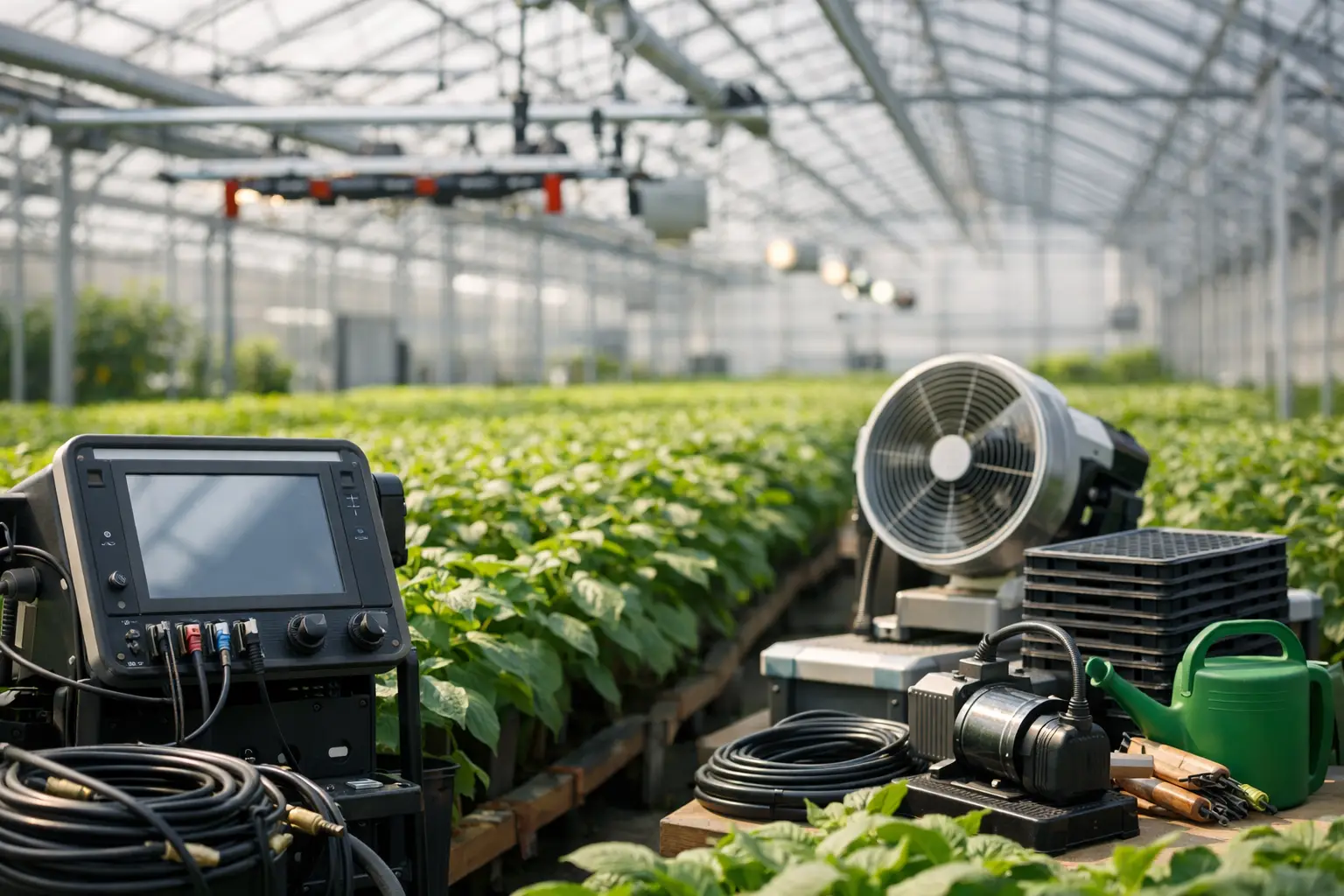
Ventilation fans, evaporative cooling, thermal screens, heaters, circulation fans, vents, and climate controllers are central to greenhouse performance. A good supplier should be able to explain capacity calculations, not just product features.
If a vendor cannot discuss air exchange rates, humidity management, or heating load assumptions, that is a warning sign. Climate equipment is where poor sizing turns into chronic crop stress.
Irrigation and fertigation
Reliable suppliers should offer clarity on pump sizing, filtration, injector options, pressure requirements, and water quality considerations. This is particularly important for high-value crops where uniformity affects both yield and marketability.
The cheapest irrigation package often becomes the most expensive when clogging, uneven flow, or fertilizer incompatibility appears mid-season.
Greenhouse coverings and structural components
Suppliers in this category should be precise about material life span, UV stability, light transmission, diffusion properties, corrosion resistance, and wind-load performance. Marketing language is common here, but measurable specifications matter more.
For importers and distributors, packaging quality also matters. Bent profiles, damaged films, and incomplete fastening kits can delay installation and erode margin.
Red flags when comparing greenhouse suppliers
Some supplier problems are obvious. Others only show up after payment or during installation.
Watch for inconsistent specification sheets, unclear warranty terms, slow quote revisions, or incomplete bills of materials. If the sales team cannot provide structured answers before the order, support after the order is unlikely to improve.
Another common issue is overpromising on lead times. Greenhouse equipment is often project-based, and delays in one component can stall an entire installation. A trustworthy supplier will discuss realistic lead times, production schedules, and shipping constraints even if the answer is less appealing.
Where buyers gain an edge in supplier selection
The strongest buyers do not only compare price. They compare total procurement risk.
That includes freight efficiency, replacement part access, training requirements, installation complexity, energy consumption, and compatibility with future upgrades. A lower upfront price can make sense for simple projects, but for commercial operations with tight planting windows, reliability usually wins.
This is where a specialized agriculture marketplace can help. Instead of searching scattered websites and generic directories, buyers can compare agriculture-focused suppliers, product categories, and commercial profiles in one place. For teams trying to save time and reduce sourcing friction, that kind of visibility improves the shortlisting process before formal quote negotiations begin.
How to choose the right supplier for your operation
For growers
Prioritize fit over brand recognition. The right supplier is the one that understands your crop cycle, local climate, labor model, and maintenance capacity. If your team is small, simpler systems with strong support may outperform highly advanced setups that require constant technical intervention.
For importers and distributors
Look closely at packaging discipline, parts consistency, private label options, and documentation quality. A supplier may have good products but still be a poor export partner if they are weak on shipping coordination or batch consistency.
For contractors and greenhouse project developers
Choose suppliers that can support phased delivery, technical drawings, and cross-system coordination. Project success depends on timing as much as equipment quality.
Final thought on sourcing greenhouse equipment
The market for greenhouse systems is broad, but the gap between a usable supplier and a valuable supplier is wide. The best partnerships are built on technical clarity, realistic delivery, and equipment that performs as promised in real growing conditions. When you evaluate suppliers through that lens, better sourcing decisions tend to follow – and so do better crops, smoother projects, and stronger margins.