How to Compare Irrigation Filters for Your Farm
A blocked dripline rarely starts at the emitter. It usually begins with a filter that was selected by connection size or purchase price rather than the actual water source, contaminant load, and irrigation demand. Knowing how to compare irrigation filters helps growers, irrigation contractors, and buyers protect uniformity, reduce labor, and avoid replacing damaged equipment before its time.
The right choice is not always the finest filter. A very fine filter can create unnecessary pressure loss and cleaning cycles if the system does not need it. The objective is to match filtration performance to your water, irrigation method, flow rate, and operating conditions.
Start With the Water Source and Irrigation Method
Filter comparisons should begin upstream. Water from a deep well behaves differently from surface water, a reservoir, a canal, or reclaimed water. Each source carries a different mix of sand, silt, algae, organic matter, and mineral particles. A filter that works well on relatively clean well water may foul quickly when used with algae-rich pond water.
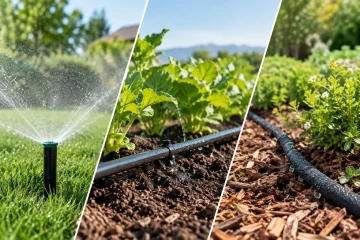
Irrigation equipment also determines the level of protection required. Drip tape and small-orifice drip emitters need finer filtration than many sprinkler systems. Micro-sprinklers sit between the two: they can tolerate some particles but may clog where nozzles are small or water contains fibrous debris.
| Water source or application | Common contaminants | Primary filtration need | Typical solution | |—|—|—|—| | Deep well water | Sand, grit, mineral scale | Remove inorganic particles | Hydrocyclone plus screen or disc filter | | Pond, canal, or river water | Algae, leaves, silt, organic matter | Capture organic and mineral debris | Media filter followed by screen or disc filter | | Reservoir water | Fine sediment, algae | Manage seasonal changes in water quality | Media or disc filtration, sized for peak conditions | | Drip irrigation | Small particles that block emitters | Fine, consistent filtration | Disc or screen filter, often after primary filtration | | Sprinklers and pivots | Sand, scale, larger debris | Protect nozzles and valves | Screen or disc filter, depending on water quality |
Ask for a water analysis and, where possible, inspect a sample during the dirtiest part of the season. Clear-looking water can still carry fine particles, dissolved iron, or biological material that creates problems after pressure and chemical reactions change inside the system.
How to Compare Irrigation Filters by Performance
A useful comparison considers the complete operating picture, not just the filter body. Focus on filtration rating, usable flow capacity, pressure loss, cleaning method, and construction materials. Suppliers should be able to provide performance information for each of these points.
Compare micron rating with emitter requirements
A micron rating describes the approximate particle size a filter is designed to retain. Smaller micron numbers mean finer filtration. In agricultural irrigation, ratings are also frequently stated in mesh, but micron values are generally easier to compare across product types.
Do not choose a rating in isolation. Start with the smallest passage in the equipment you need to protect, such as a drip emitter labyrinth, nozzle, valve, or injector. A common planning rule is to filter particles to a size significantly smaller than the smallest water passage. The correct margin depends on the manufacturer’s specifications and the shape of the particles involved.
Fine filtration is valuable for drip systems, but it comes with a trade-off. Tighter filtration can increase pressure differential, shorten intervals between cleaning, and require more filter area. If organic material is the problem, adding a properly sized media filter may perform better than simply installing a finer screen.
Check flow capacity at the actual pressure drop
A filter’s advertised maximum flow can be misleading if it is measured under ideal conditions. Compare flow rates at a stated clean pressure loss and ask what happens as the filter accumulates debris. A unit that supports the required gallons per minute when clean may restrict the system after only a short operating period.
Calculate demand using the highest-flow irrigation zone, not the farm’s average demand. Include future expansion if additional blocks, zones, or fertigation equipment are likely. Undersizing can cause uneven application, while extreme oversizing can add unnecessary capital cost and may reduce effective cleaning performance in some designs.
Look at pressure differential as a management signal. A clean filter has a normal pressure drop. As contaminants build up, the pressure difference between the inlet and outlet rises. Automatic backflush systems commonly trigger cleaning based on a preset differential pressure, time interval, or both.
Compare filter technologies for the contaminant load
Different filter types solve different problems. Many commercial systems use more than one stage because no single technology handles every contaminant efficiently.
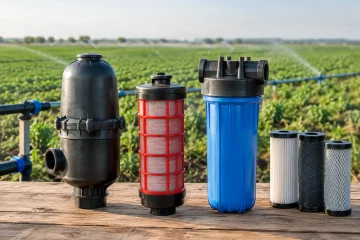
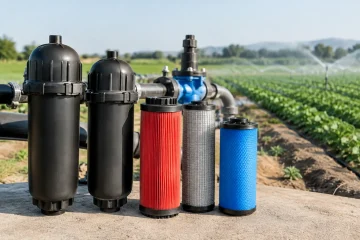
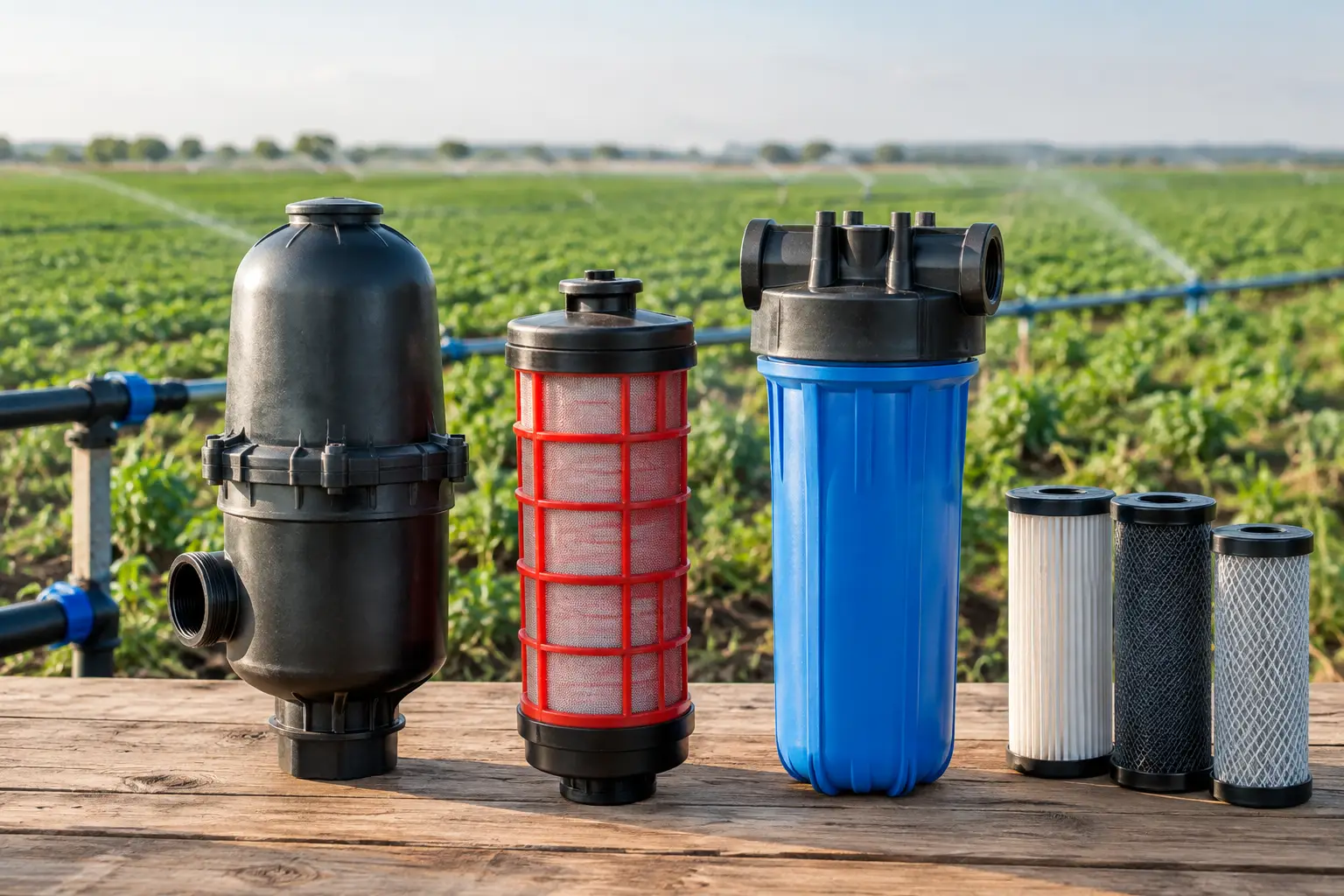
| Filter type | Best suited for | Advantages | Limitations | |—|—|—|—| | Screen filter | Sand, scale, and hard inorganic particles in relatively clean water | Simple, economical, easy to inspect | Can blind quickly with algae or organic matter | | Disc filter | Mixed fine particles and moderate organic loading | High surface area, compact design, effective depth filtration | Requires effective backflushing and correct disc rating | | Media filter | Algae, organic matter, slime, and variable surface water | Strong performance on biological contaminants | Larger footprint, higher cost, needs backwash water | | Hydrocyclone separator | Heavy sand from wells | Removes sand before the main filter and reduces wear | Does not replace fine filtration |
Screen filters are often an efficient choice for clean groundwater with hard particles. Disc filters offer a larger filtration surface and can handle a broader mix of fine contaminants. Media filters are often the better investment for surface water with algae, organic material, and seasonal variability. Hydrocyclones are valuable pretreatment devices where wells produce noticeable sand.
Evaluate Cleaning, Labor, and Water Use
The lowest-priced filter can become the most expensive choice if it demands frequent manual cleaning during peak irrigation. Compare how each unit is cleaned, how long the cycle takes, what water is used, and whether cleaning interrupts irrigation delivery.
Manual filters suit small systems, remote fields with limited automation, or applications where water remains consistently clean. They also give operators direct visibility into debris. However, manual cleaning depends on disciplined labor. If the filter is not serviced on time, pressure loss rises and distribution uniformity falls.
Automatic backflush systems can reduce labor and support large, continuous operations. They require reliable pressure, correctly sized valves, a controller, and enough clean water for backflushing. In areas with unstable power or limited water supply, a fully automatic system should be assessed carefully rather than assumed to be the answer.
When requesting quotes, ask suppliers to state the following operating details:
- Clean and dirty pressure-loss ranges at your required flow rate
- Recommended backflush trigger pressure and cleaning-cycle duration
- Backflush water volume per cycle and expected frequency
- Maximum working pressure, temperature range, and chemical compatibility
- Required maintenance parts, local service availability, and warranty terms
These details convert a product quote into an operating-cost comparison. They also reveal whether two filters with similar connection sizes are genuinely comparable.
Compare Construction and Commercial Fit
Filter housing material affects durability, corrosion resistance, transport weight, and price. Plastic or composite filters are common for many farm systems and resist corrosion well. Metal bodies may be preferred for high-flow installations, demanding pressures, or long-term fixed infrastructure. The better material depends on water chemistry, climate, ultraviolet exposure, installation location, and maintenance practices.
Also compare inlet and outlet sizes, flange standards, pressure gauges, flushing ports, and access to replacement elements. A filter that is technically capable but uses hard-to-source cartridges, discs, seals, or valves can create costly downtime in a critical irrigation window.
For importers, distributors, and project buyers, request a clear specification sheet rather than relying on catalog labels such as “high capacity” or “heavy duty.” Confirm manufacturing lead time, pallet configuration, spare-parts availability, and whether the supplier can support the required certification or documentation for your market.
Build a Like-for-Like Supplier Comparison
A consistent quote request makes supplier evaluation faster and fairer. Provide your water source, target flow in gallons per minute, irrigation type, desired filtration rating, inlet pressure, available backflush pressure, and expected operating hours. Include whether the water contains sand, algae, iron, or fertilizer residue.
| Comparison point | What to request from suppliers | Why it matters | |—|—|—| | Filtration rating | Micron rating and disc or screen specification | Confirms protection for emitters and nozzles | | Hydraulic performance | Flow chart with clean and dirty pressure loss | Protects application uniformity | | Cleaning system | Manual, semi-automatic, or automatic backflush details | Determines labor and water requirements | | System configuration | Number of units, manifold layout, bypasses, and controls | Shows whether the quoted solution is complete | | Lifecycle support | Spare parts list, service interval, and warranty | Reduces downtime and replacement risk |
Agricial can help buyers compare irrigation suppliers and product options in one agriculture-focused marketplace, but the strongest inquiry is still a specific one. A supplier can size equipment accurately only when the operating conditions are clear.
Validate Before You Commit
Before placing a large order, review drawings, confirm pressure and flow assumptions, and ask how the system will perform at peak demand. For high-value drip crops, difficult surface water, or large irrigation projects, a field test or engineering review is often worthwhile. It can expose issues that product brochures do not show, such as inadequate backflush flow, poor drain capacity, or filters located where maintenance access is difficult.
The best irrigation filter is the one that keeps water moving, protects the most sensitive component in the system, and fits the labor and water resources available on your operation. Compare it on those terms, and the purchase becomes a long-term operating decision rather than a short-term equipment expense.