How to Choose Irrigation Filters for Your Farm
A clogged dripline rarely begins at the dripline. It usually starts with a filter that was undersized, specified for the wrong contaminant, or neglected because it was difficult to clean. Knowing how to choose irrigation filters gives growers and irrigation buyers a practical way to protect uniform water delivery, crop quality, labor time, and replacement budgets.
For commercial farms, the right filter is not simply the finest screen available. It must match the water source, irrigation method, operating flow, contaminant load, and the maintenance capacity of the operation. A filter that is too fine can create excessive pressure loss. One that is too coarse can leave emitters exposed. The best choice is the one that keeps the system clean without restricting the flow your crop requires.
Start With Your Water Source and Contaminants
Water quality determines the type of filtration required. Before comparing suppliers or requesting quotes, identify where the water comes from and what it carries. Surface water from rivers, canals, ponds, and reservoirs commonly contains algae, organic debris, silt, and sand. Well water may look clean while carrying fine sand, iron, manganese, or mineral deposits that can block small passages over time.
A laboratory water test is worthwhile for high-value crops, large drip systems, and sites with recurring clogging. It helps distinguish between physical particles, biological material, and chemical precipitation. Filters remove suspended solids, but they do not solve every water-quality issue. For example, dissolved iron or calcium may require water treatment, injection management, or periodic acidification in addition to filtration.
Match the filter to the contaminant
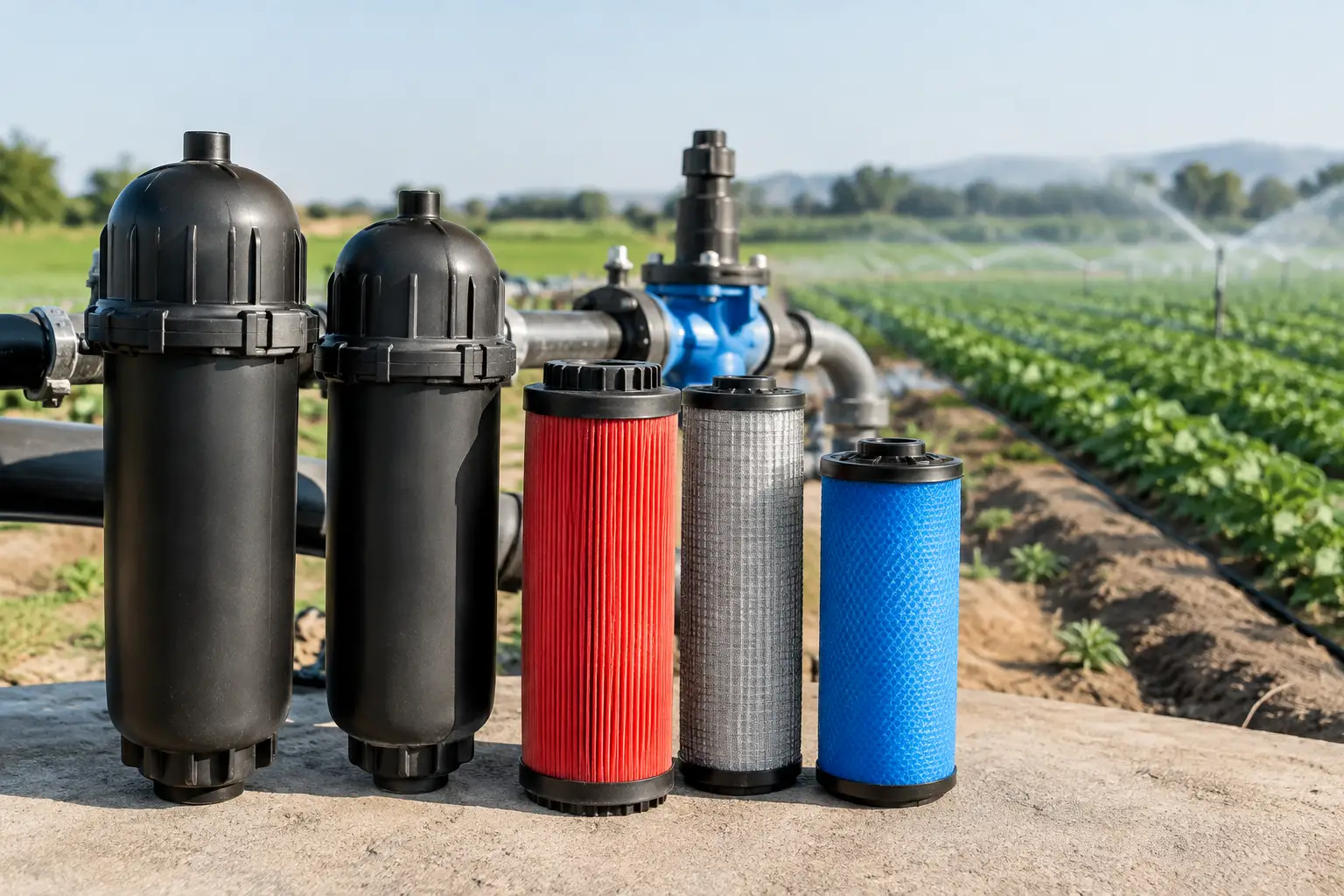
Different filter designs handle different particle types. Screen filters are efficient for inorganic particles such as sand and grit in relatively clean water. Disc filters provide depth filtration and are often better for mixed loads, including fine sediment and some organic material. Media filters, sometimes called sand media filters, are generally the preferred primary option for algae, slime, and heavy organic loads from surface water.
| Filter type | Best suited for | Advantages | Limitations | |—|—|—|—| | Screen filter | Well water, low organic loads, sand | Simple, compact, economical | Can clog quickly with algae or organic debris | | Disc filter | Mixed sediment, fine particles, moderate organic matter | High holding capacity, effective depth filtration | Requires correct disc rating and regular flushing | | Media filter | Ponds, canals, reservoirs, algae-heavy water | Strong performance on organic matter and large loads | Higher cost, larger footprint, backflush water required | | Hydrocyclone separator | Sand-heavy well water | Removes heavier sand before fine filtration | Not a replacement for a final screen or disc filter |
A common commercial setup uses a hydrocyclone first where sand is present, followed by disc or screen filtration. Farms drawing from open water may use media filters as the primary stage, with a screen or disc filter downstream as a safety filter. This staged approach costs more upfront, but it can reduce emitter failures and cleaning labor across a large acreage.
How to Choose Irrigation Filters by System Flow
Every filter has a rated flow range, and the rating should be evaluated at an acceptable pressure loss. This is where many purchasing decisions go wrong. A filter may technically pass the required gallons per minute, but only with a pressure drop that compromises irrigation uniformity or triggers frequent cleaning cycles.
Calculate the maximum flow your system needs when all relevant irrigation zones are operating. Then select a filter sized for that demand, with capacity for seasonal expansion and changing water conditions. If the system serves multiple blocks, consider whether filtration is centralized at the pump station or installed at individual zone manifolds.
For most pressurized systems, buyers should ask suppliers for the clean and dirty pressure-loss curves, not only the maximum flow figure. The filter needs enough capacity to operate efficiently as contaminants accumulate before the backflush or cleaning cycle begins.
Account for pressure and backflush requirements
Manual filters can work well for smaller farms, nurseries, and low-contaminant water sources where staff can inspect and clean them consistently. Automatic self-cleaning filters are often justified when flow is high, labor is limited, or irrigation runs overnight. They use pressure differential, timers, or controllers to initiate backflushing.
Automatic equipment has trade-offs. It reduces routine labor and protects system consistency, but it requires sufficient pressure and a reliable source of backflush water. Confirm the minimum operating pressure, backflush flow demand, valve configuration, power requirements, and controller compatibility before purchase.
Select the Correct Mesh or Micron Rating
The filtration rating must protect the smallest water passage in the irrigation system. Drip emitters, micro-sprinklers, foggers, and some fertigation equipment need finer protection than impact sprinklers or large-bore pivots.
Mesh measures the number of openings per linear inch, while microns measure opening size directly. A higher mesh number generally means a finer opening. Because product specifications may use either measurement, buyers should confirm the actual micron rating rather than relying on mesh alone.
| Irrigation application | Typical filtration target | Why it matters | |—|—|—| | Center pivots and large sprinklers | 80-120 mesh | Protects nozzles from larger debris without unnecessary pressure loss | | Drip irrigation | 120-150 mesh, or manufacturer recommendation | Helps protect small emitter paths and maintain uniform application | | Micro-sprinklers | 120-150 mesh | Reduces nozzle blockage and uneven wetting patterns | | Misting and greenhouse systems | 150-200 mesh or finer when specified | Protects very small orifices and sensitive components |
These are working ranges, not universal rules. Always use the emitter or nozzle manufacturer’s filtration recommendation as the final specification. If water contains sticky organic material, choosing a finer screen alone may not solve the problem. A media filter or disc filter may perform better because it captures material throughout the filter body rather than only on a flat surface.
Evaluate Installation, Maintenance, and Operating Cost
The purchase price of a filter is only one part of its cost. A lower-priced unit that requires daily manual cleaning, causes frequent shutdowns, or needs early replacement can become the more expensive option. Review the full operating picture before selecting a model.
Key questions to ask a supplier include:
- What flow rate does the filter deliver at the expected clean and dirty pressure loss?
- What is the recommended cleaning or backflush trigger pressure?
- How much water does each backflush cycle use?
- Which parts wear most often, and are replacement elements readily available?
- Is the housing rated for the system’s working pressure and local climate?
- Can the unit accommodate future zone expansion or higher pump capacity?
Placement also matters. Install the primary filter after the pump and before fertilizer injection, unless the equipment manufacturer specifies another arrangement. Fertilizer injectors and chemical tanks should be protected from backflow, while downstream safety filtration can be useful where precise emitters are especially vulnerable.
Use pressure gauges before and after the filter. The difference between those readings is one of the clearest indicators of filter condition. When differential pressure reaches the manufacturer’s cleaning threshold, clean or backflush the unit. Waiting until emitters visibly clog means irrigation uniformity may already be compromised.
Compare Suppliers Beyond the Product Specification
For importers, distributors, and commercial farm buyers, filtration sourcing should include supplier capability as well as filter performance. Two products with similar housings and ratings can differ significantly in seal quality, controller reliability, media grade, warranty coverage, and spare-parts availability.
Request a clear technical data sheet, including connection size, flow range, pressure rating, filtration grade, body material, cleaning method, and recommended application. For international purchasing, confirm packaging standards, lead times, spare-part availability, and support for installation documentation. It is also smart to compare whether the supplier can provide complete filtration stations, valves, controllers, fertigation components, and replacement elements rather than a single standalone unit.
Agricial helps agricultural businesses compare irrigation suppliers and product options in one marketplace built for professional sourcing. A focused request for quotes should state the water source, required flow, irrigation type, filtration target, working pressure, and whether manual or automatic cleaning is preferred. That information makes supplier responses more relevant and easier to compare.
Build Filtration Into the Whole Irrigation Plan
A filter cannot compensate for every design issue. Poorly sized pipework, inconsistent pressure regulation, inadequate flushing points, and unmanaged fertigation can still create blockage and uneven application. Treat filtration as part of a complete water-management plan that includes source assessment, pump selection, pressure control, line flushing, and seasonal maintenance.
The strongest buying decision is usually not the filter with the highest rating or lowest quoted price. It is the system that fits your water, protects your irrigation hardware, and can be maintained reliably during the busiest weeks of the growing season. Specify those conditions clearly, compare qualified suppliers carefully, and let the filter earn its value in cleaner lines and more uniform crops.