Irrigation Systems: How to Choose for Profit
A missed irrigation window can reduce marketable yield long before a crop looks stressed. The right irrigation systems help growers apply water when and where it produces the strongest return, while helping agribusinesses control pumping costs, labor, nutrient use, and production risk. The right choice is not always the system with the highest efficiency rating. It is the system that matches the crop, field layout, water source, labor capacity, and budget.
For commercial farms, irrigation is both a production decision and a sourcing decision. Equipment quality, spare-part availability, filtration support, installer capability, and supplier responsiveness can matter as much as the pipe or emitter specification.
Why Irrigation Systems Are a Business Decision
Water management affects crop uniformity, harvest timing, grade quality, and input efficiency. A system that applies water unevenly can leave some plants under-watered while wasting water and fertilizer in other areas. That creates variable crop growth, more field labor, and less predictable output for buyers.
Well-designed irrigation also supports better planning. Growers can irrigate according to crop stage, soil moisture, weather conditions, and nutrient programs rather than relying on fixed schedules. For exporters and contract growers, that consistency can support more reliable volumes and quality specifications.
The trade-off is capital and operational complexity. Drip irrigation may reduce water use substantially, but it needs filtration, pressure management, flushing, and regular inspection. A center pivot can cover large acreages efficiently, but it requires suitable field geometry, reliable energy, and a higher initial investment. The best system is the one a farm can operate and maintain correctly through the season.
Main Types of Irrigation Systems
The most common commercial options differ in their water application method, cost profile, and fit for specific crops. This comparison gives buyers a practical starting point.
| System type | Best applications | Key advantages | Main limitations | |—|—|—|—| | Drip irrigation | Vegetables, orchards, vineyards, berries, greenhouses | Precise root-zone application, lower evaporation, compatible with fertigation | Requires filtration and regular maintenance; emitters can clog | | Sprinkler irrigation | Pasture, vegetables, nurseries, field crops | Flexible coverage and useful for cooling or frost protection | Wind can reduce uniformity; evaporation losses may be higher | | Center pivot | Large, relatively level field-crop acreage | Lower labor needs, broad coverage, automation options | Not suitable for irregular fields; significant capital requirement | | Surface irrigation | Rice, forage, some row crops on level ground | Simple equipment needs and lower initial cost | Can use more water and requires careful land leveling | | Micro-sprinkler irrigation | Orchards, tree crops, nurseries | Covers a larger wetted area than drip and can support young trees | Higher evaporation than drip; nozzles need maintenance |
Drip Irrigation for High-Value Crops
Drip systems deliver water through mainlines, submains, laterals, and emitters placed near the crop root zone. They are widely used in vegetables, fruit production, vineyards, protected cultivation, and permanent crops because they allow targeted irrigation and fertigation.
For an orchard, drip can reduce weed growth between rows and limit leaf wetness, which may help with disease management. For intensive vegetable production, it can make frequent, small water applications practical during critical growth periods. Subsurface drip can further reduce surface evaporation, though it adds installation and repair complexity.
Buyers should assess emitter flow rate, spacing, wall thickness, pressure-compensating performance, filtration requirements, and expected service life. Low-cost drip tape may be appropriate for a single annual crop cycle. Permanent installations need stronger materials and a dependable source of fittings, valves, filters, and replacement components.
Sprinkler and Pivot Systems for Broad Acreage
Sprinkler systems apply water through nozzles under pressure. They range from portable pipe and hose-reel units to solid-set systems and large center pivots. Their flexibility makes them suitable for many crops, particularly where drip installation is impractical or where cooling and frost protection are needed.
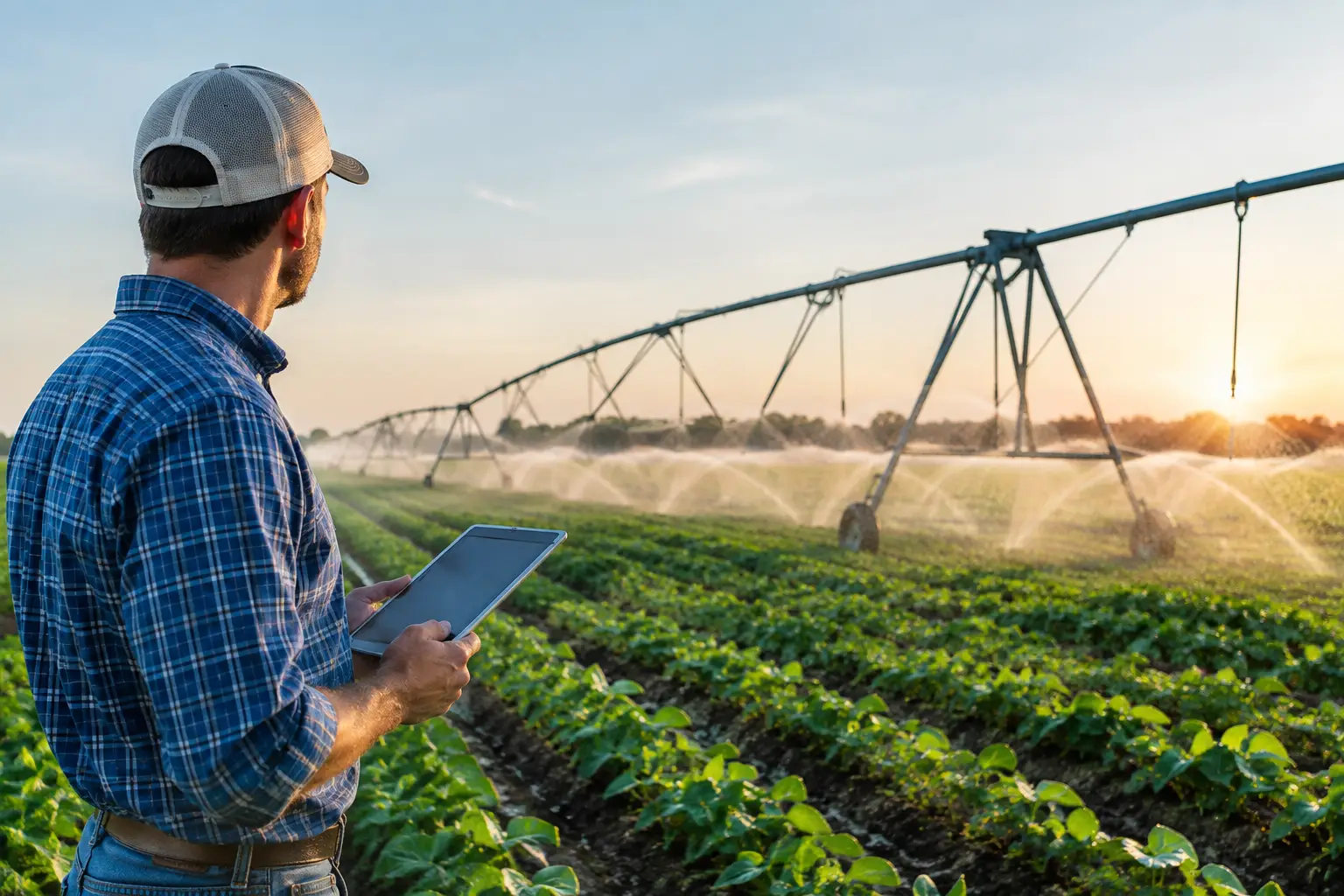
Center pivots are often a strong option for large blocks of corn, soybeans, potatoes, alfalfa, and other field crops. Modern units can use variable-rate irrigation, remote controls, and flow monitoring to improve precision. However, a pivot leaves corners outside its circular coverage area unless the system includes special corner attachments.
Wind is a major consideration. Fine droplets can drift, while hot and dry conditions increase evaporative loss. Selecting nozzle packages, operating pressure, and application timing should be part of the system design, not an afterthought.
How to Select an Irrigation System
Start with the farm’s production goal rather than a product catalog. A system that works well for a high-density apple orchard may be inefficient for a broad-acre grain operation. Review these factors before requesting quotes:
- Crop value and crop cycle: High-value, water-sensitive crops can often justify precision equipment. Short-season field crops may require lower-cost, scalable solutions.
- Water source and quality: Test for sand, sediment, iron, algae, salinity, and chemical contaminants. Poor water quality raises filtration and maintenance needs.
- Field shape, slope, and soil type: Irregular fields, rolling terrain, and variable soils may favor zone-based designs or pressure-compensating components.
- Energy and labor availability: Pumping head, power cost, fuel access, and daily labor capacity affect the real operating cost.
- Expansion plans: Size mainlines, pumps, and control systems with future acreage or additional zones in mind when growth is likely.
Design Details That Protect Performance
Irrigation performance depends on hydraulic design, not simply the choice of drip, pivot, or sprinkler equipment. Undersized pipe can cause pressure loss. Inadequate filtration can clog emitters. A pump that is too large can waste energy, while an undersized pump may prevent the system from reaching required pressure.
Ask suppliers for a design that states flow rate, operating pressure, pump duty point, filtration level, zone layout, and expected application rate. For drip systems, request distribution uniformity data when available. For pivots and sprinklers, confirm nozzle configuration and application depth at the planned travel speed.
Automation can improve control, but it should fit the operation. Soil-moisture sensors, flow meters, pressure gauges, weather-based controllers, and remote valves can reduce unnecessary irrigation. On smaller farms, a simple system with visible gauges and clearly labeled valves may deliver more value than technology that is difficult to service locally.
Costs: Look Beyond the Purchase Price
Comparing quotes only by total equipment price can lead to expensive decisions. The initial purchase is one part of the ownership cost. Farms should consider installation, earthworks, electrical connections, pumping energy, filtration, labor, repairs, seasonal retrieval, and replacement parts.
Drip irrigation commonly has lower water and energy use than overhead systems, but annual tape replacement can be a material cost in row-crop operations. Surface systems may have a lower equipment cost, yet land leveling and water losses can be significant. Center pivots can reduce labor on large farms, but financing, maintenance, and power requirements must be included in the return calculation.
A useful quote comparison should separate equipment from installation and identify what is excluded. Confirm whether the proposal includes pumps, filters, controllers, injectors, pipe fittings, electrical panels, freight, commissioning, training, and warranty support.
What to Ask Irrigation Suppliers Before Buying
A capable supplier should ask questions about your crop, water source, acreage, field map, elevation, power supply, and production targets. If a vendor recommends a system without these details, the proposal may be based on assumptions that create problems later.
For international sourcing, verify technical standards, product documentation, manufacturing lead times, shipping terms, spare-part availability, and after-sales support. Importers and distributors should also confirm packaging specifications, minimum order quantities, private-label capability, and local demand for replacement components.
Use a consistent request-for-quote process so each supplier prices the same scope. This makes it easier to compare materials, capacities, warranties, and service terms fairly. A specialized agriculture marketplace such as Agricial can help buyers identify relevant irrigation suppliers and compare commercial options by category rather than searching through general directories.
Installation and Maintenance Priorities
Even premium equipment will underperform if installation and maintenance are neglected. Before the first irrigation cycle, inspect pressure at key points, verify valve operation, check filters, and flush lines. Record baseline flow and pressure readings so future problems are easier to diagnose.
During the season, monitor four practical signals: pressure changes, flow changes, wetting patterns, and crop uniformity. A pressure drop may indicate a clogged filter or pump issue. A sudden flow increase can signal a leak. Uneven crop growth may reveal a blocked zone, poor system design, or soil-related variability.
At season end, drain vulnerable components, clean filters, flush laterals, inspect pumps, and store portable equipment correctly. In freezing climates, winterization protects pipes, valves, and control equipment from costly damage.
The strongest irrigation investment is one that makes every unit of water, energy, and labor work harder. Build the system around real field conditions, insist on clear technical documentation, and choose partners who can support the equipment long after it is installed.