
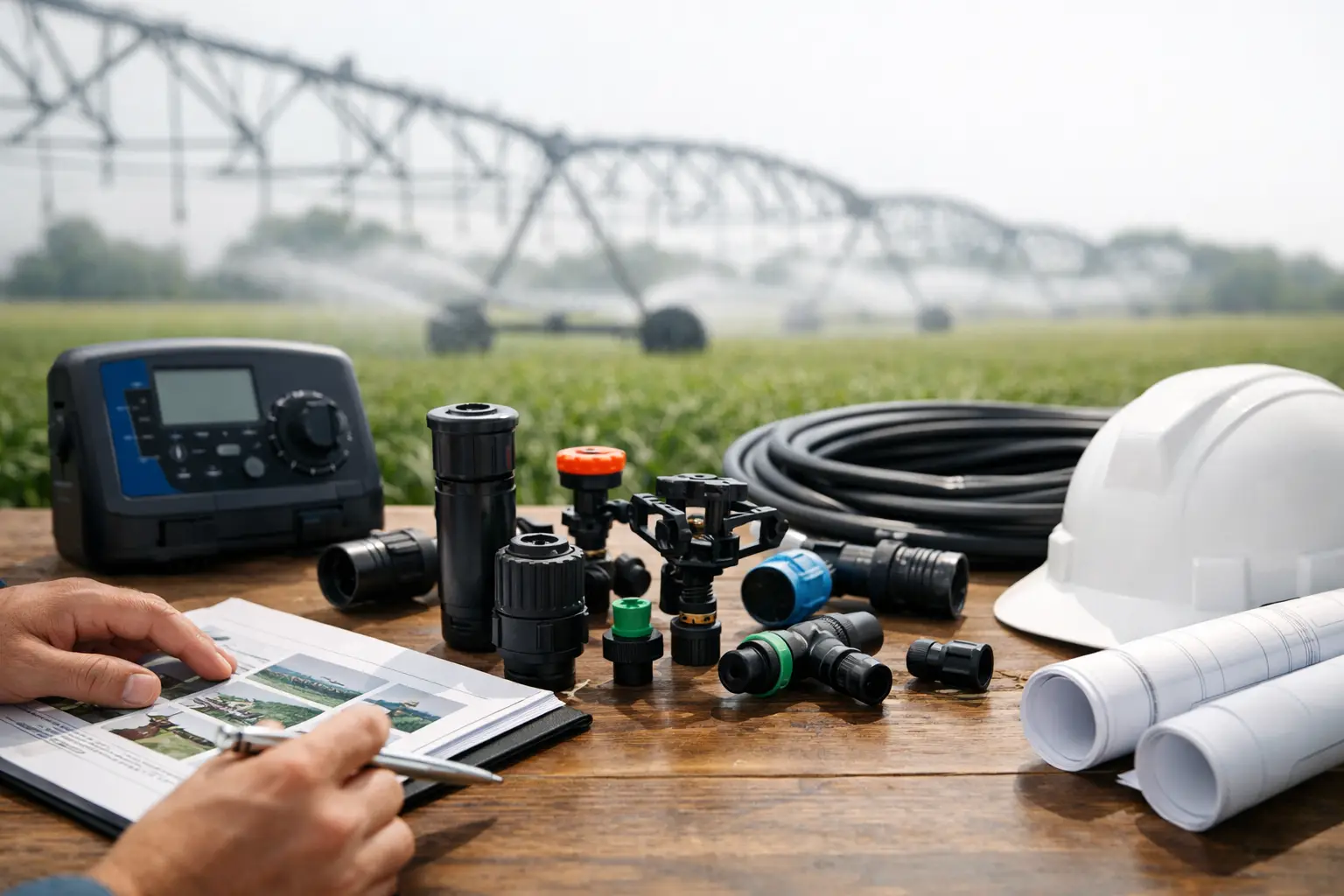
Irrigation Supplier Selection Example
A low unit price can look excellent on a quote sheet and still become the most expensive irrigation decision of the season. Delayed parts, weak after-sales support, poor pressure matching, or unclear warranty terms can stall installation and cut field performance fast. That is why an irrigation supplier selection example matters – it gives buyers a practical way to compare vendors beyond headline pricing.
For growers, importers, distributors, and project managers, supplier selection is not just a procurement task. It affects water efficiency, labor planning, crop consistency, maintenance costs, and the speed of future expansion. A better supplier relationship often creates better field results, especially when replacement parts, design support, and product availability matter as much as the initial purchase.
Why an irrigation supplier selection example helps
Irrigation sourcing usually involves more complexity than buying a single input. Buyers may need pumps, filters, valves, drip lines, sprinklers, controllers, fittings, and technical guidance as one coordinated package. If one part underperforms or arrives late, the whole system can be affected.
An irrigation supplier selection example gives structure to that decision. Instead of comparing vendors casually, you score them against the same commercial and technical factors. This reduces bias, helps internal teams align, and gives a clearer basis for quote review.
It also improves negotiations. When a supplier sees that service coverage, lead time, spare parts access, and compliance all matter, the discussion moves beyond discounting and toward total value.
The supplier scenario
Consider a 250-acre vegetable operation in California planning a new drip irrigation installation for tomatoes, peppers, and leafy greens. The business needs a supplier that can provide core components, support system sizing, deliver within four weeks, and maintain spare parts availability during peak season.
The farm receives offers from three suppliers:
- Supplier A is the lowest-cost option with imported components and limited local support.
- Supplier B is a mid-priced regional supplier with technical assistance and stocked replacement parts.
- Supplier C is a premium brand with strong engineering support, longer warranties, and the highest upfront cost.
At first glance, this looks like a simple price comparison. In reality, it is a risk and performance decision.
Irrigation supplier selection criteria
A useful evaluation model should balance technical fit, commercial terms, and operational reliability. Weighting matters because not every farm or buyer has the same priorities. A greenhouse operator may value automation support more than a broad-acre grower. An importer may care more about documentation and container planning.
Core criteria for evaluation
For this example, the buyer uses seven criteria:
- Product quality and system compatibility
- Price and payment terms
- Lead time and delivery reliability
- Technical support and installation guidance
- Availability of spare parts
- Warranty and after-sales service
- Supplier reputation and references
The buyer assigns weights based on project risk. Product quality gets the highest weight because poor emitter uniformity or mismatched filtration can create long-term field losses. Technical support and spare parts also score high because downtime during irrigation windows is costly.
Irrigation supplier selection example scoring table
Below is a simple weighted score model using a 1 to 5 rating scale, where 5 is best.
| Criteria | Weight % | Supplier A | Supplier B | Supplier C |
|---|---|---|---|---|
| Product quality and compatibility | 25 | 3 | 4 | 5 |
| Price and payment terms | 20 | 5 | 4 | 2 |
| Lead time and delivery reliability | 15 | 2 | 4 | 4 |
| Technical support | 15 | 2 | 4 | 5 |
| Spare parts availability | 10 | 2 | 5 | 4 |
| Warranty and after-sales service | 10 | 2 | 4 | 5 |
| Reputation and references | 5 | 3 | 4 | 5 |
| Total weighted score | 100 | 2.95 | 4.15 | 4.20 |
In this case, Supplier C finishes slightly ahead of Supplier B on weighted score, while Supplier A falls behind despite its attractive price.
What the numbers actually mean
A table helps, but it should not replace judgment. Supplier C earns the top score because it offers the strongest technical performance, best warranty, and high service confidence. That can make sense for projects where uniformity, automation, and long-term reliability are critical.
Supplier B, however, is very close and may be the better commercial choice. Its score reflects a stronger balance between cost, support, and local parts availability. If the farm values rapid replacement during harvest periods, Supplier B could be the smarter supplier even with a slightly lower total score.
Supplier A shows the most common procurement trap. The quote is competitive, but support risk is high. If a filter assembly fails, if fittings are hard to source locally, or if pressure losses were not properly accounted for in system design, that initial savings can disappear quickly.
Comparing the suppliers beyond price
A second table can make the trade-offs clearer for internal decision-makers.
| Supplier | Main advantage | Main risk | Best fit |
|---|---|---|---|
| Supplier A | Lowest upfront cost | Weak support and slower issue resolution | Budget-driven projects with low complexity |
| Supplier B | Best balance of cost and service | May not offer the most advanced premium components | Commercial farms needing dependable support |
| Supplier C | Highest technical assurance and warranty value | Highest capital cost | High-performance systems and larger projects |
This kind of comparison is especially useful when a finance team is focused on purchase cost while operations teams are focused on uptime and maintenance.
Questions buyers should ask before choosing
The strongest supplier evaluations usually come from the quality of the questions, not just the number of quotes collected. Buyers should verify whether the supplier can match hydraulic requirements, provide design assistance, document product specifications clearly, and support commissioning.
It is also worth asking how warranty claims are handled in practice. A long warranty period sounds good, but a fast and local claims process is often more valuable than a longer promise with slow execution.
For international buyers, shipping reliability and documentation quality matter even more. HS codes, packing accuracy, product labeling, and replacement shipment policies can affect lead times and customs clearance. A supplier with moderate pricing and strong export discipline can outperform a cheaper but disorganized source.
Red flags in irrigation supplier selection
Some supplier offers should trigger extra review.
- Incomplete bills of materials
- Vague technical specifications
- No pressure-loss or flow-rate guidance
- Limited parts stocking for core items
- Slow response during the quote stage
- Unclear warranty exclusions
If communication is already inconsistent before the order is placed, service after payment is unlikely to improve. In irrigation projects, response speed often predicts support quality.
How to adapt this example for your business
Not every buyer should use the same scorecard. A distributor sourcing for resale may give more weight to margin, packaging consistency, and brand recognition. A farm manager replacing a damaged block may care most about immediate availability and compatibility with existing lines. A contractor bidding on commercial installation may prioritize project support and delivery certainty.
The better approach is to keep the framework and adjust the weights. If downtime is your biggest risk, raise the value of spare parts and service. If you are standardizing one irrigation brand across multiple sites, technical consistency and training support may deserve more weight than unit price.
This is where a specialized agriculture marketplace can save time. Instead of pulling data from scattered websites, trade contacts, and partial catalogs, buyers can compare supplier profiles, product categories, and commercial visibility in one place. For businesses that source internationally or need multiple quote options, that faster filtering can shorten the path from research to decision.
A practical decision rule
If two suppliers score within a narrow range, do not force the decision on total score alone. Use a tie-breaker based on your highest operational risk. For some buyers, that is lead time. For others, it is service coverage, engineering guidance, or local stock.
A good rule is simple: choose the supplier that reduces the most expensive failure you cannot afford. That may not be the cheapest option, and it may not be the most premium one either. It is the one that fits your crops, your schedule, your technical needs, and your ability to maintain the system over time.
Strong irrigation procurement creates value long after installation day. The right supplier supports water efficiency, protects crop performance, and gives your business more room to scale with confidence. When you evaluate suppliers with a clear framework instead of a quick price glance, better purchasing decisions become much easier to repeat.