
How to Evaluate Fertilizer Suppliers Before You Buy
A low fertilizer price can disappear quickly when nutrient analysis is inconsistent, delivery misses the planting window, or documentation fails at the border. Knowing how to evaluate fertilizer suppliers is therefore a purchasing decision, a crop-risk decision, and, for importers and distributors, a reputation decision. The right supplier helps protect yield potential and working capital. The wrong one creates problems that can last well beyond a single season.
Start With Your Fertilizer Requirement
Supplier evaluation should begin with a clear specification, not a broad request for “fertilizer prices.” Define the crop, acreage, soil condition, application method, seasonal timing, target nutrient rate, and preferred product form. A greenhouse operation buying water-soluble NPK needs a different supplier profile than a grain farm purchasing bulk urea or a distributor importing coated controlled-release products.
Your requirement should state the expected nutrient grade, such as 46-0-0 or 20-20-20, the acceptable moisture range where relevant, granule size, packaging, annual volume, delivery destination, and required compliance documents. Without these details, quotes may appear comparable while covering very different products and terms.
Match the Supplier to the Product Type
Not every fertilizer business is equipped for every requirement. A local blender may offer speed and customized formulations, while a large manufacturer may offer volume consistency and export documentation. A trading company can provide access to several origins, but it may have less direct control over production.
| Supplier type | Best suited for | Main advantage | Main consideration | |—|—|—|—| | Manufacturer | Large-volume, repeat purchases | Direct production control and supply continuity | May require higher minimum order quantities | | Local blender | Custom blends and regional delivery | Flexible formulations and local agronomic knowledge | Quality control can vary between facilities | | Distributor | Smaller volumes and mixed input orders | Stock availability and convenient purchasing | Added margin may increase total cost | | Trading company | International sourcing and multiple origins | Wider product access and price options | Verify product origin and quality controls carefully |
How to Evaluate Fertilizer Suppliers on Product Quality
The nutrient label is a starting point, not proof of product quality. Ask suppliers for a recent certificate of analysis for the exact grade and production batch being offered. The document should identify total nitrogen, available phosphate, soluble potash, secondary nutrients or micronutrients where applicable, moisture content, and any relevant physical properties.
For granular fertilizers, assess particle-size distribution, hardness, dust level, and caking resistance. Uniform granules generally improve spreading accuracy and reduce segregation during handling. For soluble products, confirm dissolution speed, insoluble matter, chloride content, sodium content, pH, and compatibility with your irrigation or fertigation system.
A reliable supplier should be willing to explain how its quality-control process works. That may include raw-material testing, in-process checks, retained samples, third-party laboratory analysis, and batch traceability. If the supplier cannot provide basic technical documents promptly, that is a commercial warning sign as well as a quality concern.
Request Samples Before Committing at Scale
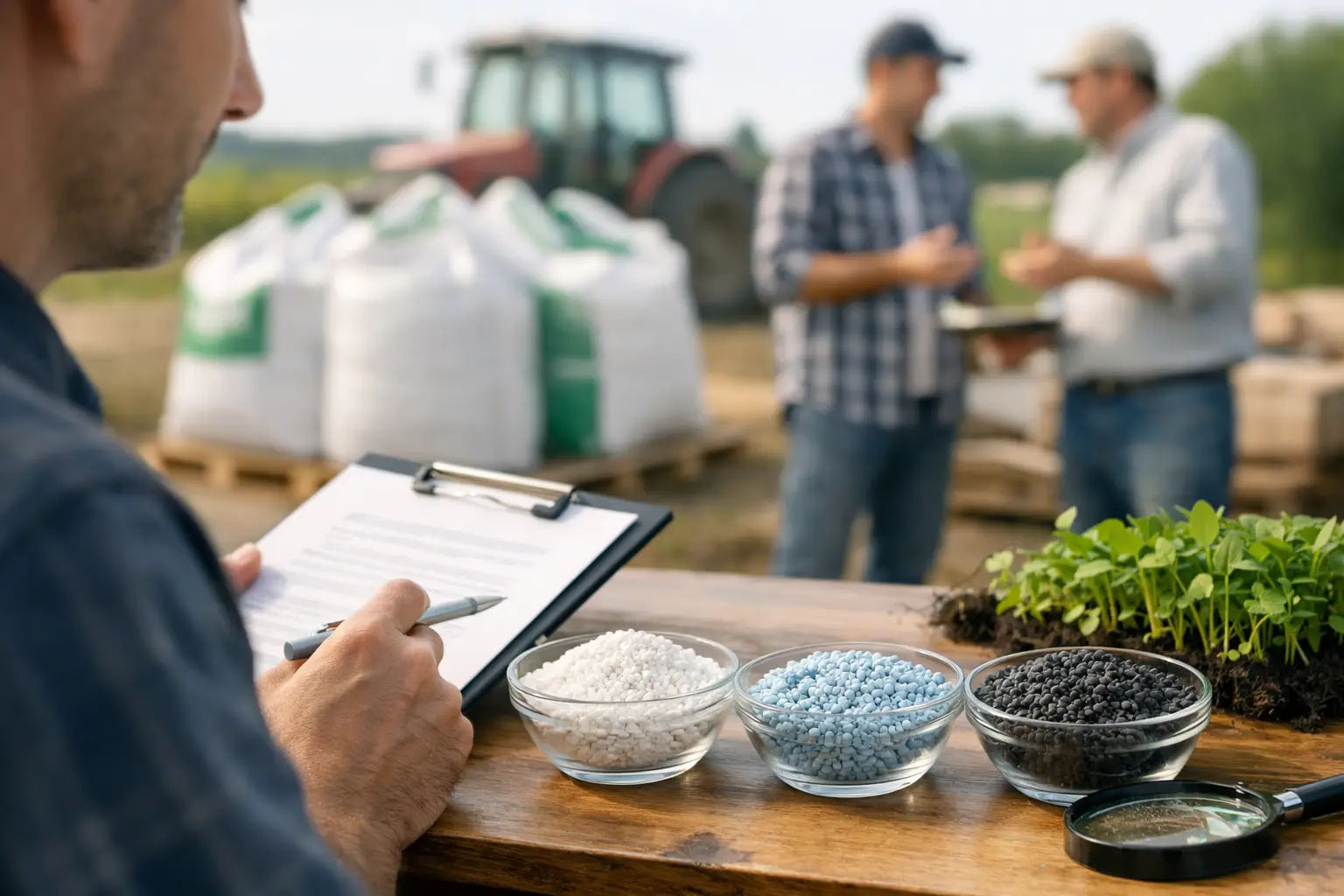
A sample cannot guarantee the performance of a future shipment, but it can expose obvious issues before a major purchase. Compare the sample against the declared specification and, when the purchase value justifies it, use an independent laboratory. For specialty fertilizers, test solubility and compatibility in the same water source, tank mix, or application equipment you use in the field.
Samples should be labeled with a lot number and tied to the offered product. An untraceable sample has limited value because there is no assurance that the delivered goods will match it.
Verify Compliance, Registration, and Traceability
Fertilizer rules vary by country and, in the United States, often by state. Buyers should confirm that the product can legally be imported, sold, stored, and applied in the destination market. Ask for registrations, safety data sheets, labeling details, product technical sheets, and any certificates required by local authorities or buyers.
For international shipments, also verify the exporter’s ability to prepare commercial invoices, packing lists, certificates of origin, bills of lading, and any inspection or phytosanitary-related documentation that applies to the product. Fertilizer is not a one-document commodity. Requirements depend on the formulation, origin, packaging, transport mode, and destination.
Traceability matters when there is a dispute. The supplier should be able to connect a shipment to a production date, batch number, plant or warehouse location, and quality records. This protects both parties if a customer reports poor spreading, nutrient deficiency, contamination, or damaged packaging.
Compare Total Landed Cost, Not the Quoted Price
A quote with a low per-ton price may still cost more after freight, port charges, inland transport, insurance, financing, customs processing, storage, and product losses. Compare suppliers on a consistent delivered basis, such as cost per ton delivered to your warehouse or cost per pound of actual nutrient delivered to the farm.
For example, a 15-15-15 formula may appear cheaper than a higher-analysis product, yet require more tons to provide the same nutrient rate. Similarly, a low-cost imported material may lose its advantage if it arrives late or incurs demurrage at port.
When reviewing offers, compare the details below rather than focusing on one headline number:
- Product grade and guaranteed nutrient analysis
- Incoterm and point where risk transfers
- Packaging type, palletization, and net weight tolerance
- Minimum order quantity and production lead time
- Freight, insurance, duties, and destination charges
- Payment terms, currency exposure, and credit requirements
- Claims process for short weight, damage, or off-spec product
A transparent quote makes comparison easier. Be cautious when essential costs are described as “to be advised” or when the supplier will not confirm whether the quoted price includes packaging, export handling, or loading.
Assess Supply Reliability and Logistics Capability
Fertilizer has a narrow window of value. A shipment delivered after application timing may be technically compliant but commercially useless. Ask suppliers how they manage peak-season demand, raw-material shortages, vessel delays, and warehouse capacity.
For recurring programs, request realistic lead times rather than optimistic ones. Confirm whether the supplier holds inventory, manufactures to order, or purchases from a third party after receiving your order. Each model can work, but buyers need visibility. A supplier that openly communicates constraints is often safer than one that guarantees every request without evidence.
Questions That Reveal Operational Strength
Ask where the product is manufactured, where it will ship from, and whether the proposed volume is currently available. Confirm the loading capacity per day, typical transit time, and contingency plan for delayed transport. For bagged fertilizer, inspect bag quality, liner protection, pallet configuration, and container loading method. Torn bags and moisture exposure can turn saleable inventory into a costly claim.
For bulk product, clarify weighing procedures, sampling points, discharge requirements, and responsibility for losses during transport. These practical details often determine whether a supplier relationship runs smoothly.
Evaluate Commercial Reputation and Support
A professional supplier should provide more than a sales contact. Look for a clear company identity, operating history, physical address, product range, export markets, and responsive technical or customer-service contacts. Reference checks remain valuable, particularly for high-value or first-time international transactions. Ask references about product consistency, documentation accuracy, delivery performance, and how the supplier handled a problem.
Also assess whether the supplier understands your market. A partner selling fertilizer to an irrigated vegetable operation should be able to discuss solubility, injection systems, and crop timing. A supplier serving distributors should understand labeling, inventory turns, and channel margins. Technical advice should support the product specification, not replace independent agronomic judgment.
Digital agriculture marketplaces and industry directories can shorten the initial search by helping buyers compare supplier profiles, categories, locations, and product offerings in one place. Agricial helps agricultural businesses identify relevant fertilizer partners and begin more focused commercial conversations.
Use a Controlled First Order
Even a supplier that looks strong on paper should earn larger volume through performance. Start with a trial order that is meaningful enough to test production, paperwork, shipping, arrival condition, and product results, but not so large that one issue puts the season at risk.
Set acceptance criteria in writing before payment and shipment. Define the agreed nutrient analysis, tolerance limits, packaging condition, delivery schedule, inspection method, claim deadline, and remedy for nonconforming goods. If a third-party inspection is needed, determine who appoints and pays for it before the goods are loaded.
The best fertilizer supplier is rarely just the lowest bidder. It is the partner that can repeatedly deliver the right analysis, in the right condition, with the right documents, at the moment your operation needs it. Build your supplier list with that standard, and every quote becomes easier to judge.