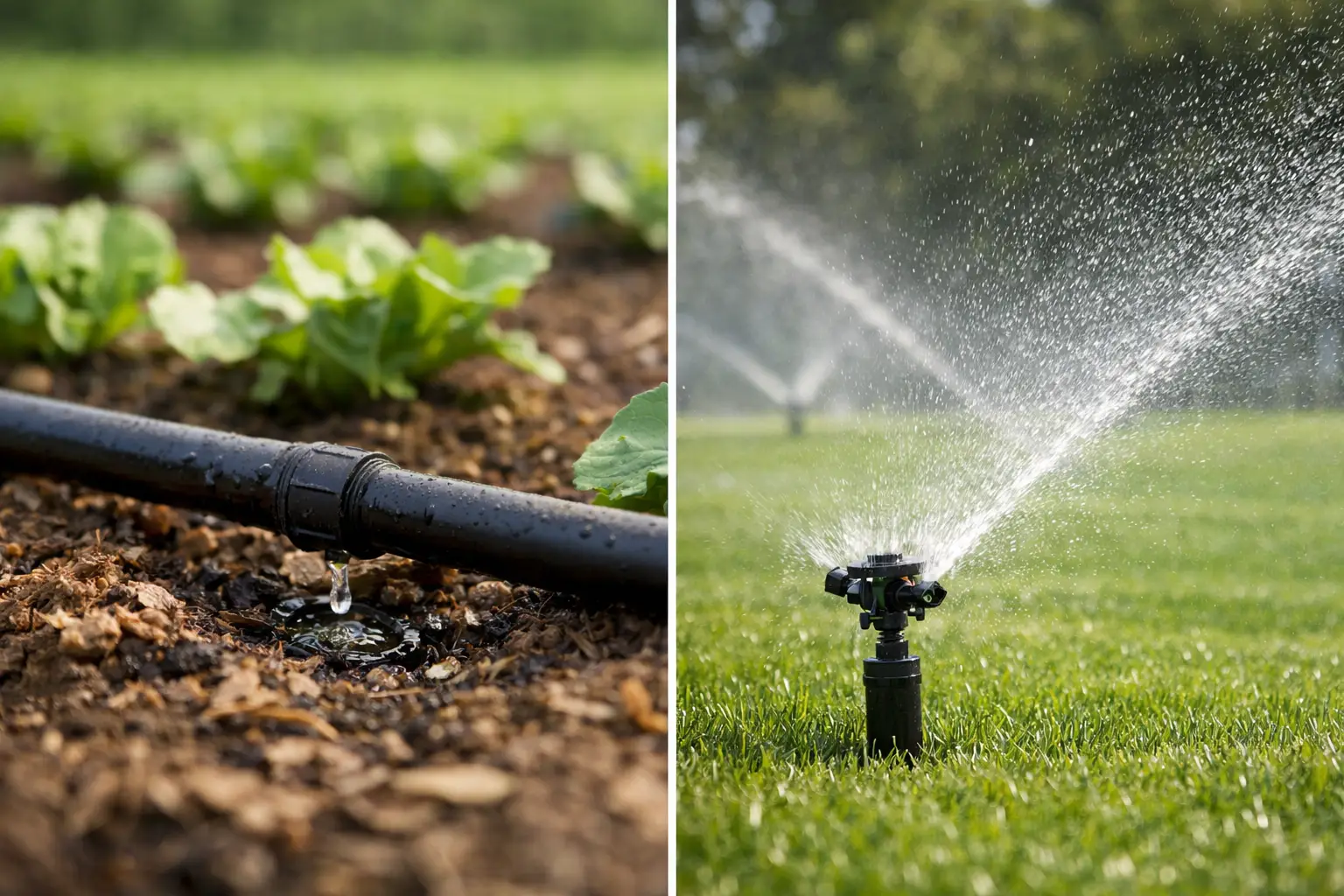
Drip Irrigation vs Sprinklers: Which Pays?
Water delivery decisions show up fast on the balance sheet. In the drip irrigation vs sprinklers debate, the right choice affects yield consistency, labor, energy use, disease pressure, and how efficiently every acre turns water into marketable output.
For growers, suppliers, and irrigation buyers, this is not a style preference. It is a system decision tied to crop value, field layout, water availability, and operating costs. Some farms gain more from precise root-zone application. Others need broad coverage, lower setup complexity, or the flexibility to move equipment across blocks and seasons.
Drip irrigation vs sprinklers at a glance
The most practical way to compare these systems is to look at how water reaches the plant, what that means for the crop, and what it costs to run over time.
| Factor | Drip Irrigation | Sprinklers |
|---|---|---|
| Water delivery | Applies water directly near the root zone | Sprays water over the crop and soil surface |
| Water efficiency | Usually higher | Usually lower due to evaporation and drift |
| Upfront cost | Often higher per acre | Often moderate, depending on system type |
| Operating pressure | Lower | Higher in many setups |
| Weed pressure | Lower between rows | Often higher because more soil gets wet |
| Disease risk | Lower foliage wetting | Higher foliage wetting in many crops |
| Coverage | Very targeted | Broad and uniform when designed well |
| Best fit | High-value row crops, orchards, vineyards, greenhouse use | Pasture, turf, field crops, germination, cooling |
| Maintenance focus | Filtration, emitter clogging, line inspection | Nozzles, pressure regulation, wind performance |
Drip irrigation moves water slowly and precisely. Sprinklers distribute it across a larger area, which can be an advantage when full-surface wetting is useful or when crop spacing does not suit drip lines.
How drip irrigation works
Drip systems deliver water through tubing and emitters placed along crop rows or near individual plants. The goal is simple: keep moisture available in the active root zone without wetting unnecessary ground.
That precision makes drip attractive for operations where water is limited, fertilizer efficiency matters, or crop quality drives profit. Orchards, vineyards, vegetable production, berries, and greenhouse operations often benefit because irrigation can be matched closely to crop stage and soil condition.
Where drip irrigation performs best
Drip usually performs best where each gallon needs to count. In sandy soils, frequent low-volume irrigation can reduce leaching losses. In high-value crops, fertigation through drip also improves nutrient placement and timing.
It is also useful where disease management matters. Because foliage stays drier, crops that are sensitive to leaf wetness often see fewer problems than they would under overhead irrigation.
Common drip limitations
Precision comes with management demands. Poor filtration, sediment, algae, or dissolved minerals can clog emitters and create uneven application. Line damage from field traffic, rodents, or sun exposure can also add maintenance.
For some broad-acre crops, drip may not make financial sense unless water scarcity, yield gains, or crop value justify the investment. Installation and system design also need more attention than many basic sprinkler setups.
How sprinkler irrigation works
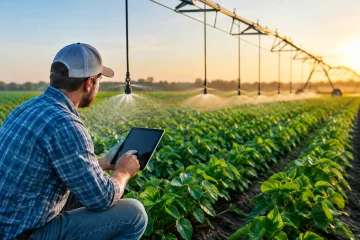
Sprinkler systems apply water above the crop or soil using pressure and nozzles. This category includes portable sprinklers, solid-set systems, center pivots, lateral moves, and smaller field or nursery installations.
Their main advantage is coverage. Sprinklers can irrigate large areas with relatively uniform application when pressure, nozzle selection, and spacing are correct. They also support crop establishment in situations where the whole soil surface needs moisture.
Where sprinklers make sense
Sprinklers are often a strong fit for forage crops, turf, some cereals, nurseries, and mixed-use operations that need flexibility. A farm managing different fields or rotating crops may prefer a system that is easier to adapt across changing layouts.
They can also serve secondary goals beyond irrigation. Some growers use overhead systems for cooling, frost protection, or washing salts below the root zone, depending on local conditions and crop tolerance.
Common sprinkler limitations
The trade-off is lower water-use efficiency in many climates. Wind drift and evaporation can reduce how much water actually reaches the root zone. Wet foliage may increase disease pressure, especially in dense canopies or humid environments.
Energy demand can also be higher because many sprinkler systems require greater operating pressure than drip. That matters when pumping costs are rising or power supply is limited.
Cost comparison: upfront price vs lifetime return
Buyers often focus first on installation cost, but irrigation systems should be judged on total economic impact. That includes capital expense, pumping energy, labor, repairs, filtration, replacement parts, water cost, and yield response.
| Cost Area | Drip Irrigation | Sprinklers |
|---|---|---|
| Initial equipment cost | Moderate to high | Low to high depending on type |
| Installation complexity | Higher | Moderate |
| Energy use | Often lower | Often higher |
| Maintenance cost | Regular monitoring and filtration needs | Nozzle, pipe, and pressure maintenance |
| Replacement cycle | Drip tape may need seasonal replacement in some systems | Longer life for many fixed components |
| ROI potential | Strong in high-value crops and water-limited regions | Strong in broad coverage applications |
Drip can deliver a stronger return where water savings, fertigation efficiency, and quality improvements are measurable. Sprinklers may deliver better economics where crop value is lower, acreage is larger, and broad application is more practical.
This is where commercial sourcing decisions matter. Buyers comparing systems should request more than a unit price. They should compare pressure requirements, filtration needs, expected lifespan, spare part availability, and after-sales technical support.
Water efficiency and crop response
If water is the main constraint, drip usually has the edge. Because it targets the root zone, less water is lost to evaporation, runoff, and overspray. That can be decisive in regions with limited allocation, declining groundwater, or high pumping costs.
Sprinklers can still perform well when scheduled properly, but they are more exposed to weather losses. In windy or hot conditions, application efficiency drops. On the other hand, for seed germination or crops that need uniform surface moisture, sprinklers may support better early-stage establishment.
Soil type matters more than many buyers expect
On heavy soils, both systems can work well if run times are managed carefully. On sandy soils, drip often gives better control because water can be applied in smaller, more frequent doses.
Field slope also changes the equation. Drip systems need pressure-compensating design in uneven terrain, while sprinkler systems can struggle with runoff if application rate exceeds infiltration. Good design matters more than system label.
Maintenance, reliability, and labor
No irrigation system is truly low-maintenance. The better question is what kind of maintenance your team can handle consistently.
Drip requires disciplined filtration and routine flushing. Operators need to check for clogged emitters, leaks, pressure variation, and damaged lines. If management is weak, the promised precision can disappear quickly.
Sprinklers are easier to understand visually because coverage problems are often obvious. But they still require nozzle checks, pressure monitoring, leak repair, and alignment control. Wind-related inconsistency can also create hidden under-watered zones unless performance is monitored carefully.
For labor, drip can reduce time spent moving equipment in fixed installations, but it may increase inspection time. Portable sprinklers can be labor-intensive, while mechanized systems such as pivots reduce manual work but raise capital needs.
Which system fits which operation?
The strongest buying decision starts with the business model of the farm, not just the irrigation catalog.
Choose drip first when the operation grows high-value crops, manages expensive water, needs fertigation precision, or sells into quality-sensitive markets. It is especially attractive for orchards, vineyards, vegetables, berries, and protected cultivation.
Choose sprinklers first when broad, flexible coverage matters more than pinpoint delivery. They are often a practical fit for pasture, turf, some row crops, crop establishment, and large fields where equipment mobility or overhead application adds value.
A hybrid approach is often the smart commercial answer
Many operations do not need to choose only one system. A farm may use drip in permanent crops and sprinklers in open field blocks. A nursery may rely on overhead irrigation for establishment and shift to drip for later production stages.
That blended approach can improve resource use without forcing one system to solve every irrigation challenge. For buyers and distributors, it also means product selection should align with actual crop zones and water goals, not generic recommendations.
Key questions before you buy
Before sourcing equipment or requesting quotations, clarify these points:
- What is your crop value per acre, and how sensitive is margin to water use?
- Is your water supply limited by cost, volume, pressure, or regulation?
- Do you need full-surface wetting, or only root-zone moisture?
- Can your team manage filtration and regular monitoring?
- How important are fertigation, frost protection, or crop cooling?
- Are spare parts and technical service available in your market?
For agribusinesses comparing suppliers, these questions reduce risk and help avoid buying a system that looks competitive on paper but underperforms in the field. Platforms such as Agricial make that comparison process faster by helping buyers review irrigation suppliers, product categories, and commercial options in one agriculture-focused environment.
The best irrigation system is the one that matches your crop, your water reality, and your operating model. When those three align, both drip and sprinkler systems can create strong returns – but only one will usually fit your farm profitably right now.