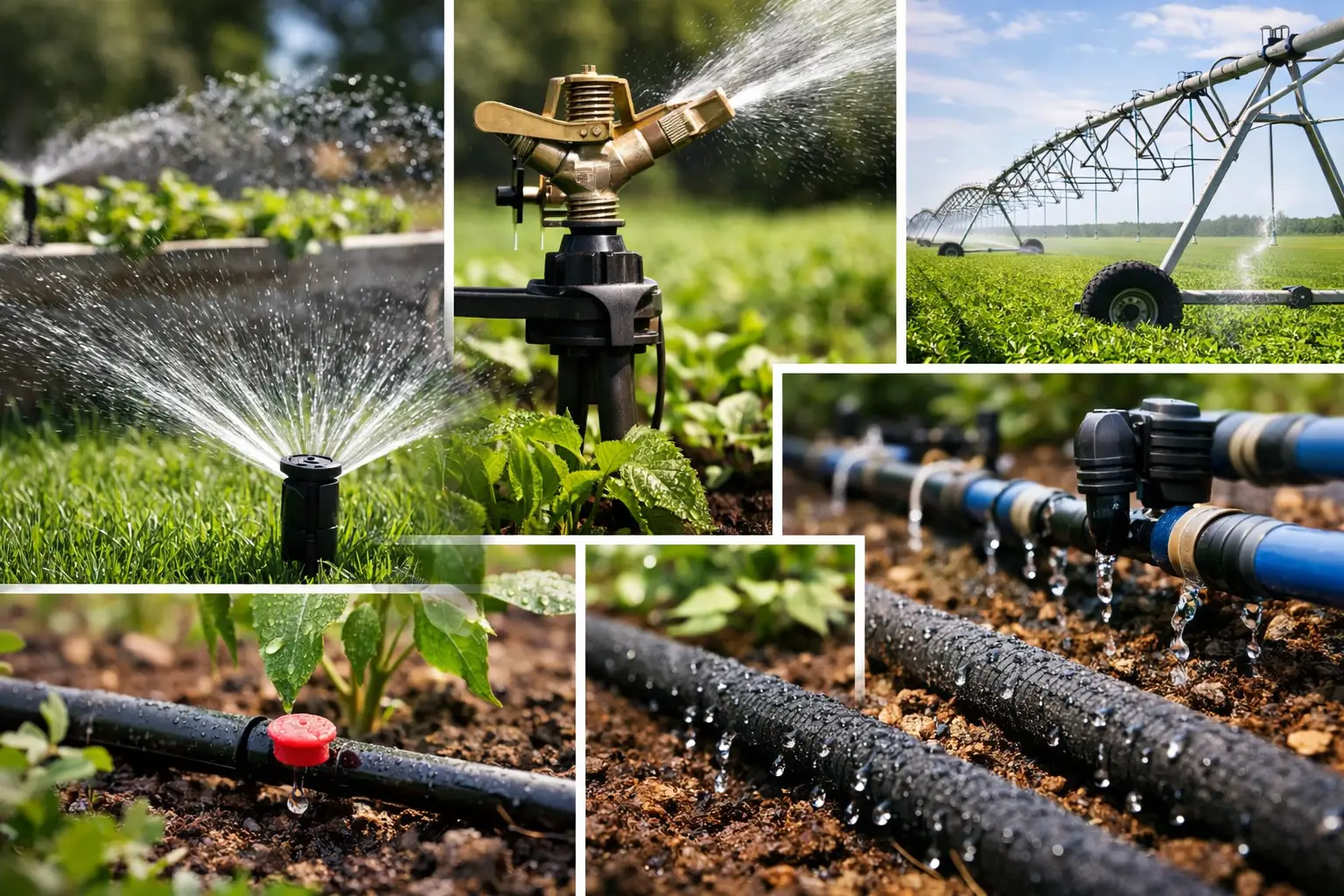
7 Best Irrigation System Types Compared
Water costs rarely stay still, and neither do crop margins. Choosing among the best irrigation system types is not just a technical decision – it affects yield consistency, labor planning, energy use, fertigation options, and long-term return on investment. For growers, dealers, and agricultural buyers, the right system is the one that fits field conditions, crop value, water quality, and operating scale.
Why irrigation system choice matters commercially
An irrigation system is a production asset, not just a way to move water. A poor match can create uneven application, disease pressure, runoff, clogged emitters, or higher pumping costs. A good match improves water use efficiency, supports uniform crop growth, and reduces avoidable labor.
That is why comparing irrigation types by real-world fit matters more than chasing a single “best” option. Row crops, orchards, greenhouses, turf, and mixed vegetable operations all ask for different performance from irrigation equipment. Buyers also need to look beyond the system itself and evaluate filtration, pressure requirements, maintenance demand, and supplier support.
Best irrigation system types at a glance
| Irrigation type | Best for | Water efficiency | Initial cost | Maintenance level | Main limitation |
|---|---|---|---|---|---|
| Drip irrigation | Orchards, vegetables, vineyards, greenhouses | Very high | Medium to high | Medium | Clogging risk if filtration is weak |
| Sprinkler irrigation | Field crops, pastures, turf, mixed farms | Medium | Medium | Medium | Wind drift and evaporation losses |
| Center pivot irrigation | Large commercial fields | Medium to high | High | Medium | Best only on large, open layouts |
| Surface irrigation | Rice, some field crops, gravity-fed farms | Low to medium | Low | Low to medium | Lower uniformity on uneven land |
| Subsurface drip irrigation | High-value crops, permanent beds | Very high | High | High | Harder to inspect and repair |
| Micro-sprinkler irrigation | Orchards, nurseries, some horticulture | High | Medium | Medium | More evaporation than drip |
| Manual or hose-based irrigation | Small plots, nurseries, temporary use | Low | Low | High labor | Not scalable for commercial farming |
1. Drip irrigation
Drip irrigation is often the strongest contender when people ask about the best irrigation system types for efficient water use. It delivers water directly to the root zone through emitters, minimizing evaporation and reducing weed growth between rows.
For high-value crops, drip can pay back quickly because it supports precision scheduling and fertigation. Vegetable growers, orchard operators, and greenhouse managers often prefer it when water is expensive or limited. It also performs well on irregularly shaped fields where large mechanized systems are less practical.
Where drip works best
Drip fits orchards, vineyards, berries, greenhouse production, plastic mulch systems, and many open-field vegetables. It is especially useful where disease pressure rises with overhead wetting or where soils need frequent, controlled applications.
Trade-offs to consider
The main issue is maintenance discipline. Filtration quality, flushing routines, and water chemistry management matter. If your water contains sediment, iron, or biological contaminants, emitter clogging can become a recurring cost rather than a small inconvenience.
2. Sprinkler irrigation
Sprinkler systems remain one of the most widely used options because they offer flexibility across many farm types. They simulate rainfall and can be configured as solid-set, portable, traveling gun, or impact sprinkler systems.
For mixed operations, sprinkler irrigation is attractive because it can serve multiple crop areas without the layout constraints of drip. It is often a practical middle ground for growers who need moderate efficiency without the higher design precision of micro-irrigation.
Strengths of sprinkler systems
Sprinklers can cover broad areas, support germination in some crops, and work well on varied topography when designed properly. They are also easier to adapt for farms that rotate crops often.
Limitations of sprinkler systems
Wind reduces distribution uniformity, and hot conditions increase evaporation losses. Leaf wetting can also raise disease risk in sensitive crops. In regions with high energy costs, pumping overhead systems may be less attractive than lower-pressure alternatives.
3. Center pivot irrigation
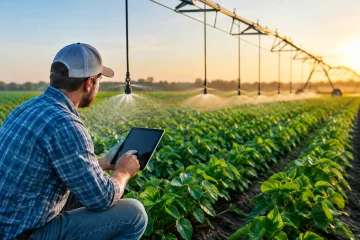
Center pivot systems are built for scale. On large, open fields, they offer strong labor efficiency and relatively uniform water application with less manual movement than many conventional sprinkler setups.
This system is common in corn, soybean, alfalfa, potato, and other broadacre production. It is also easier to automate than many older systems, which helps commercial operators manage water scheduling more precisely.
Why large farms choose pivots
The biggest advantage is coverage per labor hour. One operator can manage a large irrigated area with limited field intervention. Modern pivots can also integrate variable rate irrigation, which helps match application to soil zones and crop demand.
When pivots are not the right fit
They require substantial capital and perform best on large, relatively open, regularly shaped fields. Small farms, fragmented landholdings, orchards, and fields with many obstacles may see poor economic fit.
4. Surface irrigation
Surface irrigation includes furrow, basin, and border systems that move water across the soil surface using gravity. It is one of the oldest methods and still has a place where land, water access, and field conditions support low-cost operation.
For some farms, especially where pumping costs need to stay low, surface irrigation can remain commercially viable. Rice systems are a clear example, and certain field crops still perform well under properly managed gravity irrigation.
Where surface irrigation makes sense
It works best on well-leveled land with appropriate soil infiltration characteristics. Where labor is available and water cost is lower, its economics can still be competitive.
Its main downside
Uniformity is harder to control, especially on uneven fields or variable soils. Water losses through runoff and deep percolation can be significant if design and scheduling are weak.
5. Subsurface drip irrigation
Subsurface drip irrigation, or SDI, places drip lines below the soil surface. This reduces evaporation even further and keeps the surface drier, which can help with weeds and field access.
For intensive commercial production, SDI can be a high-performance system. It is used in some row crops, vegetables, and perennial systems where long-term infrastructure can be justified.
Why buyers consider SDI
The efficiency is excellent, and the buried lines are protected from some surface damage. Fertigation can also be highly targeted.
Why SDI needs careful management
Repairs are less visible and more technical than standard drip. Root intrusion, clogging, and installation quality matter a great deal. It tends to suit experienced operators or projects with strong technical support.
6. Micro-sprinkler irrigation
Micro-sprinklers sit between drip and conventional sprinklers. They apply water over a small area around the plant and are widely used in orchards, nurseries, and some horticultural systems.
They are useful when growers want wider wetting patterns than drip provides, especially for young trees or sandy soils where root zones spread beyond a narrow line.
Best commercial use cases
Orchards with developing root systems often benefit from micro-sprinklers. They can also support cooling or microclimate management in some specialty crops.
Practical limitation
Compared with drip, they lose more water to evaporation and may encourage more weed growth in the wetted zone. In windy areas, distribution can also become less precise.
7. Manual irrigation systems
Manual systems include hoses, movable pipes, and simple pump-and-hose arrangements. These are not usually the answer for large commercial farms, but they still matter in nurseries, small plots, trial fields, and temporary production zones.
Their advantage is low startup cost and fast deployment. Their weakness is labor. As acreage or labor rates increase, manual irrigation becomes expensive in practice even if the equipment itself is cheap.
How to choose among the best irrigation system types
The right system depends on your business model as much as your crop. A high-value berry grower with limited water and strong fertigation needs will usually evaluate options differently than a grain producer managing hundreds of acres.
Compare by core decision factors
| Decision factor | Best-fit systems | Why it matters |
|---|---|---|
| Water scarcity | Drip, subsurface drip, micro-sprinkler | Higher efficiency and better control |
| Large open fields | Center pivot, sprinkler | Better area coverage and labor efficiency |
| High-value crops | Drip, subsurface drip, micro-sprinkler | Precision application supports yield and quality |
| Low capital budget | Surface, manual, some sprinkler setups | Lower upfront cost, but not always lower lifetime cost |
| Variable field shapes | Drip, portable sprinkler | Easier adaptation than pivot systems |
| Limited technical support | Surface, standard sprinkler | Simpler operation than advanced micro systems |
A few practical checks help narrow the decision faster:
- Match the system to crop value, not just field size.
- Test water quality before final equipment selection.
- Calculate pumping and filtration costs, not only purchase price.
- Consider spare parts access and after-sales support in your region.
- Review labor availability across the full season, not just installation.
Which irrigation type is best for most commercial growers?
If the question is broad, drip irrigation usually leads for water efficiency and crop control, while center pivot leads for large-scale field efficiency. Sprinkler systems remain the most flexible general-purpose option. Surface irrigation still works where land and water conditions support it economically.
That means there is no universal winner. The best irrigation system types are the ones that align with your crop mix, water source, soil profile, field geometry, and operating budget. In a marketplace context, that also means sourcing from suppliers who can provide the right design input, parts availability, and technical guidance – not just a competitive quote.
When irrigation decisions are made with both agronomy and commercial performance in mind, they do more than save water. They protect output, improve input efficiency, and create a stronger foundation for farm growth.